

(Or: Striving for Perfection in an Imperfect World)
Have you ever reassured yourself that you’ll get the next one right? You could be referring to any important thing you’ve done in your life—and plan to do again. Writing a book, training a dog, raising a kid, selecting a job, a career, a partner. I’m sure I’ve missed some. Not all of them apply to me, thank goodness, but for books and dogs I’ve said it more times than I can count.
If you’ve read my previous couple Substack essays, you’ll know I’ve spent the last several months wallowing with indecision. I didn’t want to compose a story like the ones I’d already written, but I didn’t have any new ideas. Not a single one. I began to worry that I’d exhausted all of my interesting thoughts, and not only would I not get a new manuscript “right” enough to be published, but I’d never write again.
First, I don’t think there’s a writer out there who hasn’t gotten stuck with their writing at one point or another. There are so many parts to the process: coming up with the idea for a project, fleshing it out, starting the actual writing, finishing the writing, editing it to incorporate the suggestions you get from critique partners and editors, and trying to get the darned thing published. Each part provides another opportunity to dig yourself into a hole. You are not alone.
The thing that helped me the most was remembering that I would never write a story without some overlap with my previous books. Maybe a lot of overlap. Since there are themes that are important to me, why not continue to write about them? It’s like training a new dog with the same tricks you’ve worked on with previous dogs—something I’ve done in the sport of dog agility many times, always with the exciting goal of turning my most recent furry companion into a teammate. Similarly, nothing’s wrong with crafting a story that contains the elements you love most (for me, this includes nature, music, mental health, and climate change, all packaged into a fun middle-grade fantasy). There’s no rule that says I have to move on to something totally different!
Alternatively, many writers find it liberating to incorporate themes they’ve never considered before. Of course, any new theme likely will be important to another writer (or two, or a hundred). This brings up another concern most writers have: how do we write a story that hasn’t already been written by someone else?
Answer: we can’t. On a general level, all of the basic story ideas have been written. On a specific level, however, each story is likely to differ in quite a few ways. Characters, pacing, voice, and plot structure or details, to name a few. One thing that can help give your originality a chance to surface is to avoid reading similar books within a few months of starting your own draft. Then you won’t end up writing, for instance, a book about a magic school that is far too derivative of a particular best-selling series I don’t need to mention.
Whenever I worry about copying someone else’s story, I remind myself of dogs. Every time I’ve adopted a new one, I’ve assured myself that this time, training will be a breeze. The last dog(s) taught me everything I need to know, and I’m so wise at this point that I’ll end up with the perfectly trained companion. Right?
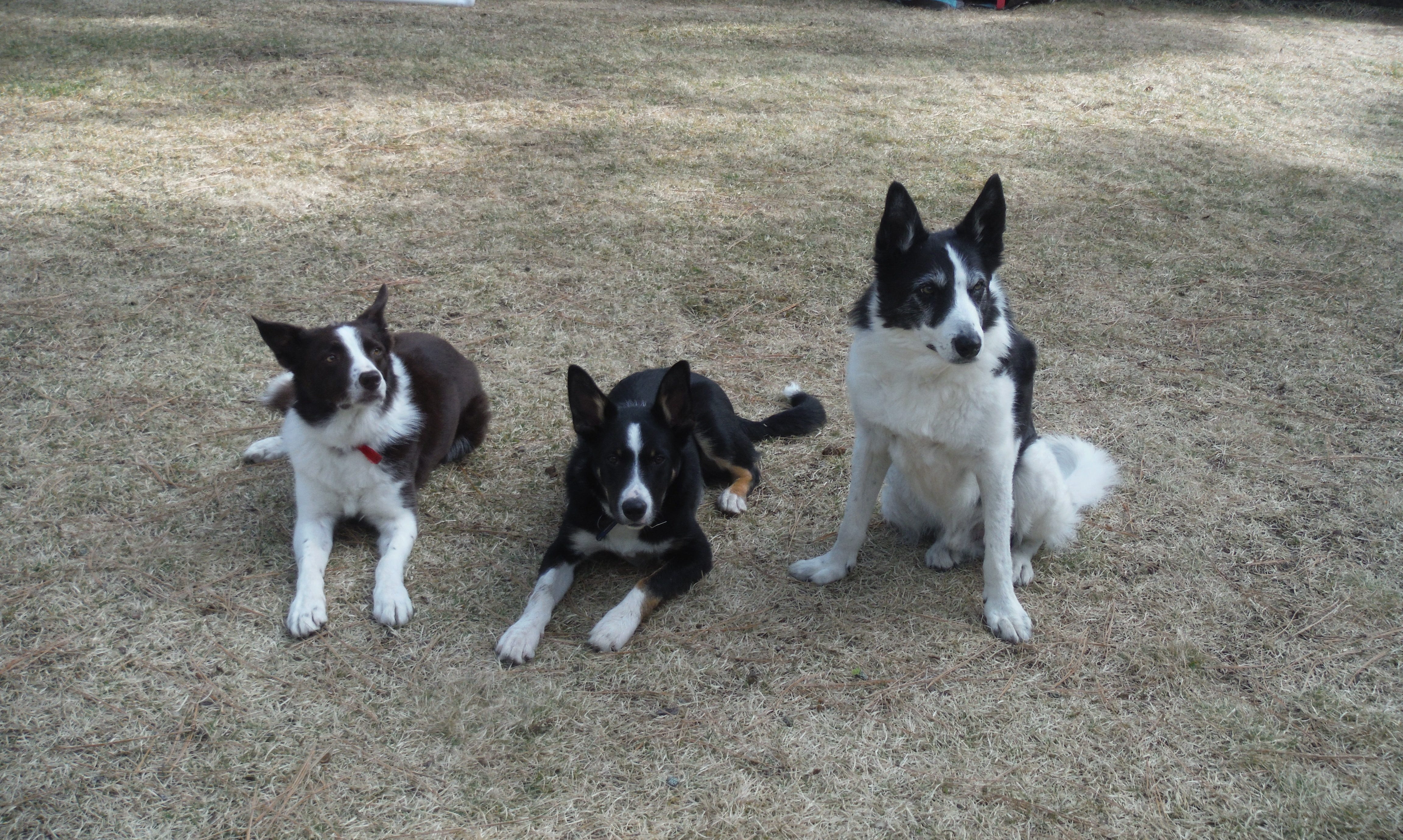
Answer: nope. Just like stories, every dog ends up developing into a completely different beast—even within a breed or a litter. All dogs present their own challenges, but hey, the training process wouldn’t be interesting if they were the same. Over the years, I’ve learned different things from each of my delightful pets.
My most recent dog, Tock, has been difficult in ways I’d never experienced before. He gets easily frustrated whenever he feels that something isn’t going the way he expected. For example, he’s a great trail dog who never gets far away and always waits for me at junctions, but if I turn the “wrong” way (i.e., a direction we don’t usually go), he vents his frustration by leaping up on me while uttering a little growl. Chastising him doesn’t prevent it. He’s quite certain he’s right.
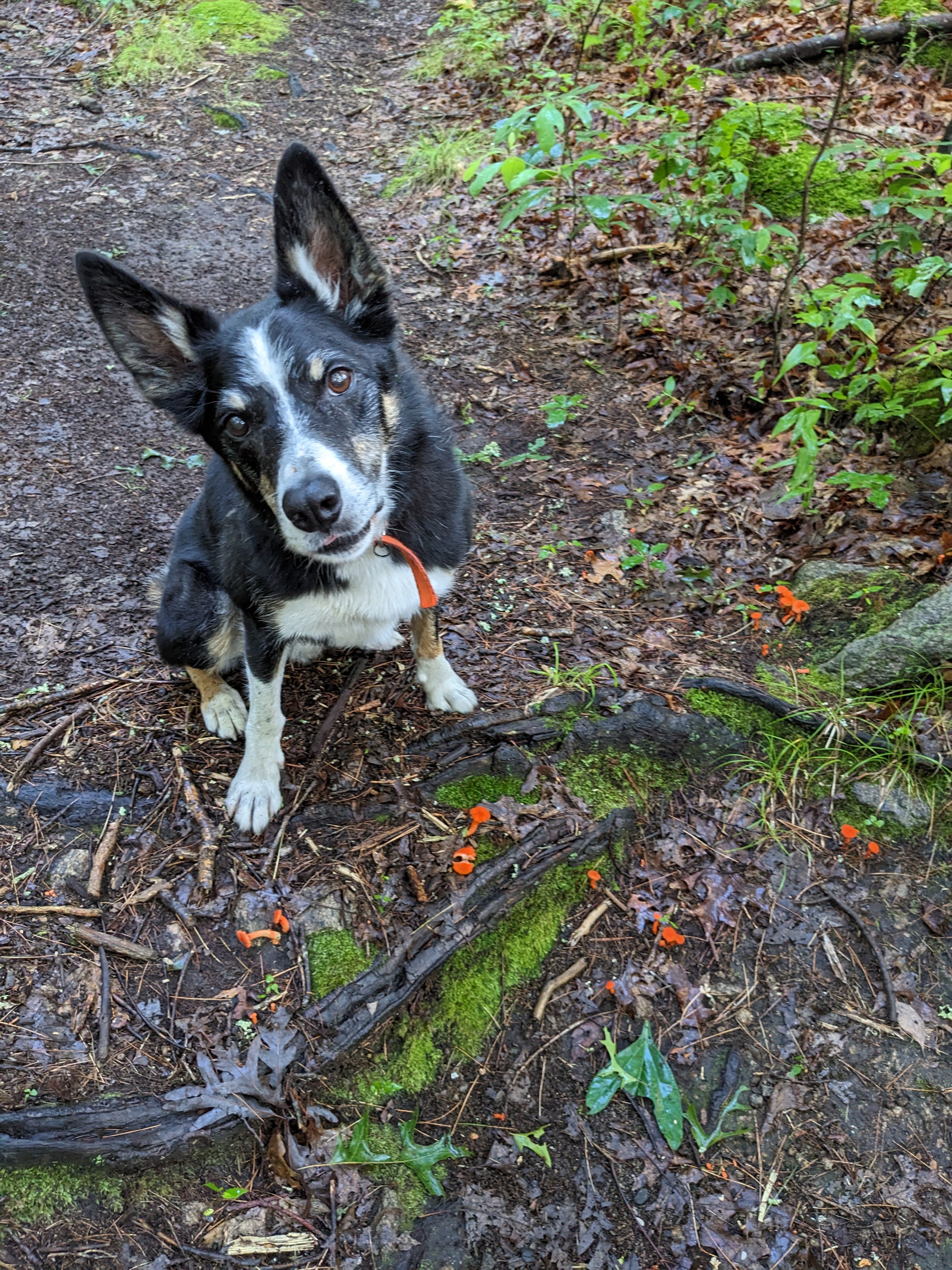
To train Tock out of this annoying behavior, I’ve had to think one step ahead of him, rewarding him for good behavior before he resorts to bad behavior. As I approach the junction—but before it’s clear which way I’m going to go, I call him to me and reward him. He gets a treat for his recall and forgets to punish me for making what he might otherwise deem the incorrect choice.
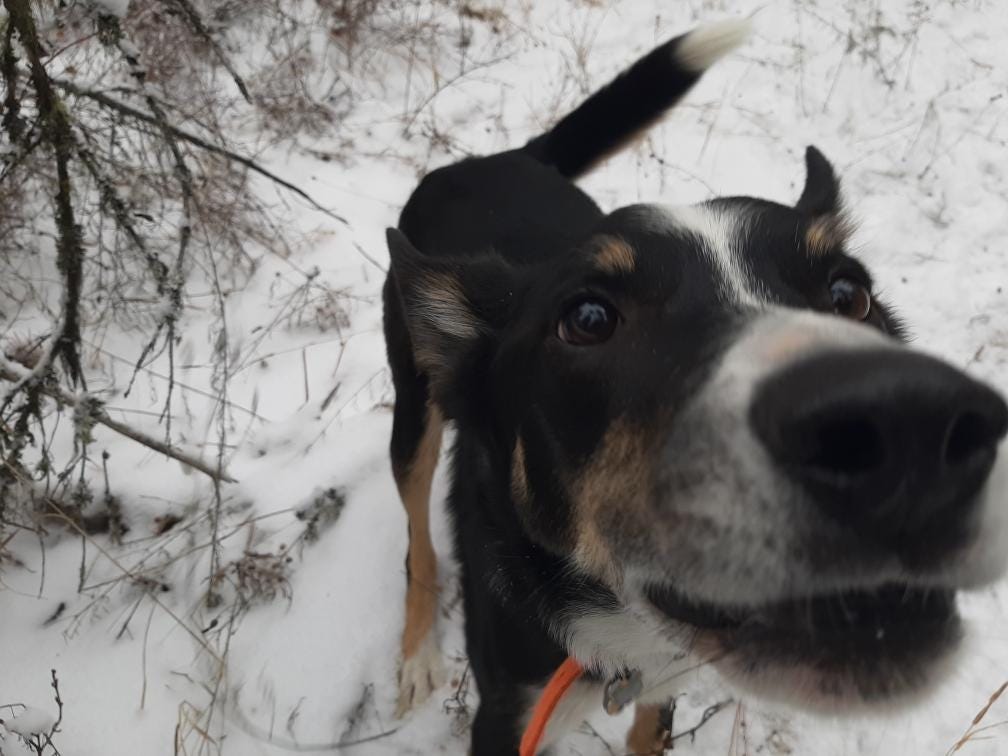
I liken Tock to a headstrong character (or plot) who refuses to let me write them in a way that they don’t want to be written. I can’t just subdue them into submission. I can’t force them to be someone they aren’t. Instead, I need to think about what they want, and try to make that happen. In the end, the story will only benefit from this approach.
The toughest challenge I’ve endured with Tock was a leaping behavior that surfaced at agility competitions. Unlike dogs who bark the entire time they’re running, Tock would keep all of his excitement at running the course bottled up until the very end. But as soon as he completed the last jump, he’d launch himself at me. Not into my arms, like many dogs who are overjoyed to be picked up by their owner to celebrate after a run, but an all-out vault into my torso. At 45 pounds, the combination of his weight and his headlong hurl would almost knock me over. Worse, I worried about getting disqualified if the judge deemed this to be aggressive behavior while we were still in the ring. I had trained previous dogs to run to the leash stand, grab their leash, and tug on it with me as a way to reward them immediately for their run and also keep them busy until I could get them safely out of the ring. This worked great for them—but not for Tock. He insisted on plowing into me like a horizontal rocket, and then retrieving his leash.
What could I do? Well, I reasoned that if I could only get to the leash stand first, I’d be able to direct all his excess excitement into our game of leash tug. To give myself a little more time, I started directing him over the final jump a second time (fortunately, there’s no penalty for re-taking the final obstacle). While Tock was busy circling the jump and re-jumping it, I would race ahead, grab the leash, and hold it out to him by the time he caught up to me. He didn’t waste any time grabbing it and engaging in a vigorous game of tug. We had our solution!
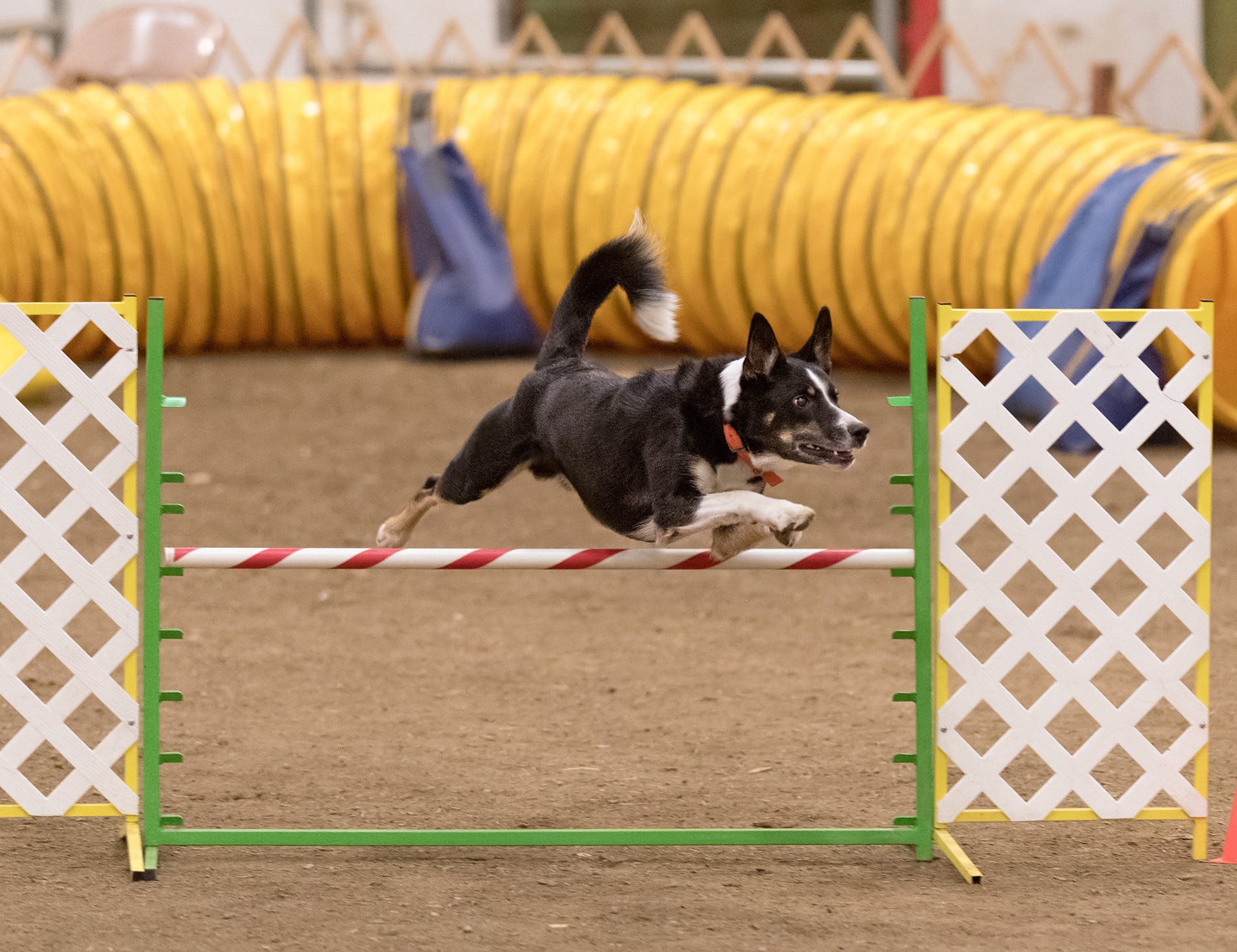
Granted, it was kind of a clunky, ridiculous solution, but it was exactly what Tock needed. He was happy, I was happy, and our teamwork only benefited. After many competitions that ended like this, he was eventually willing to drive straight to the leash stand without the need for that extra jump.
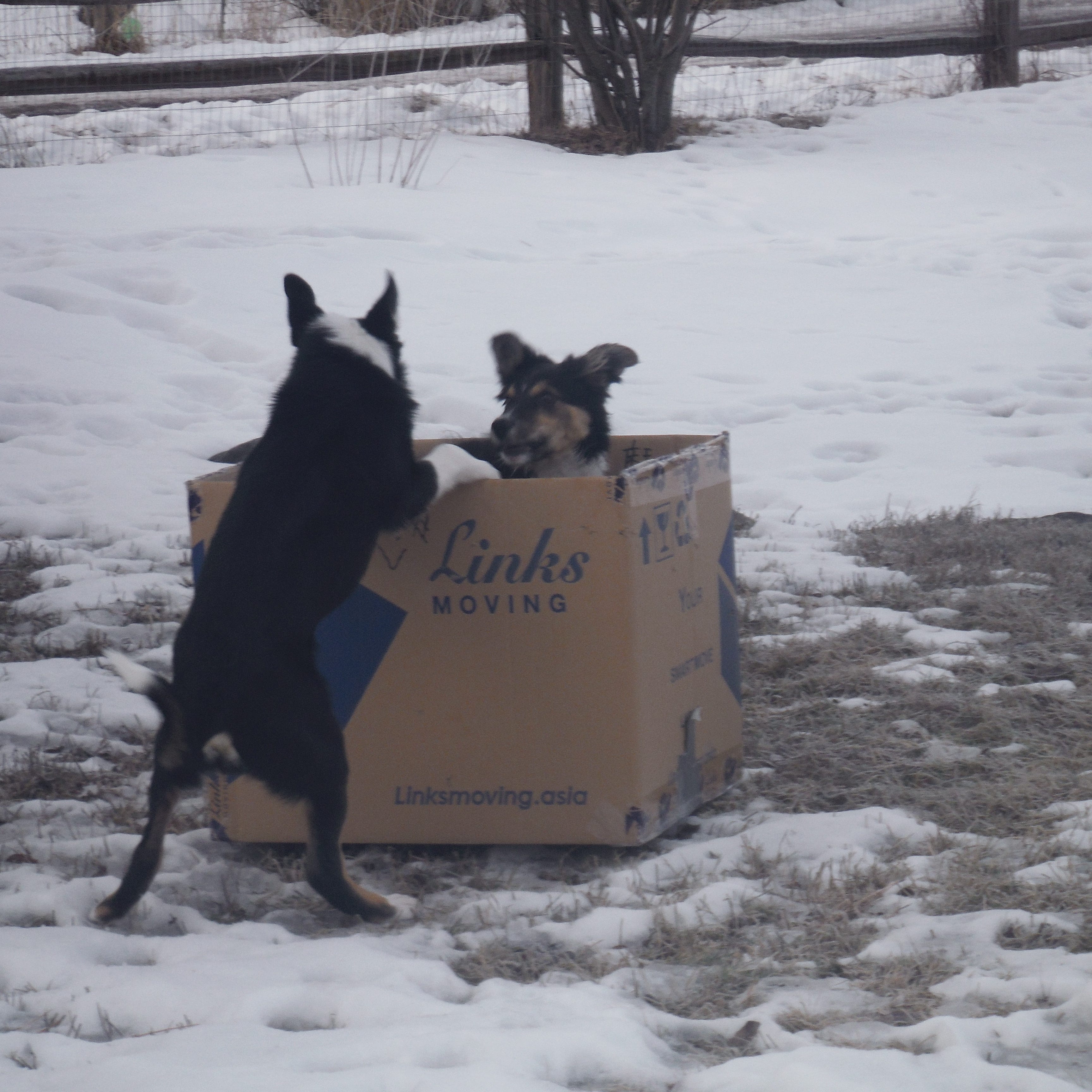
I guess my point is that while there is no perfect story, or dog, or person, or life, a little careful thought and willingness to step outside whatever box you find yourself in can go a long way. We just need to look forward to learning whatever we can from each imperfect situation—and to improving things until we can live with them.
Happy Tales!
 Flights of Fancy