In moments of despair, my hope is not that thing with feathers. That sort of hope is far too buoyant, too high, too perky to be seen or heard.
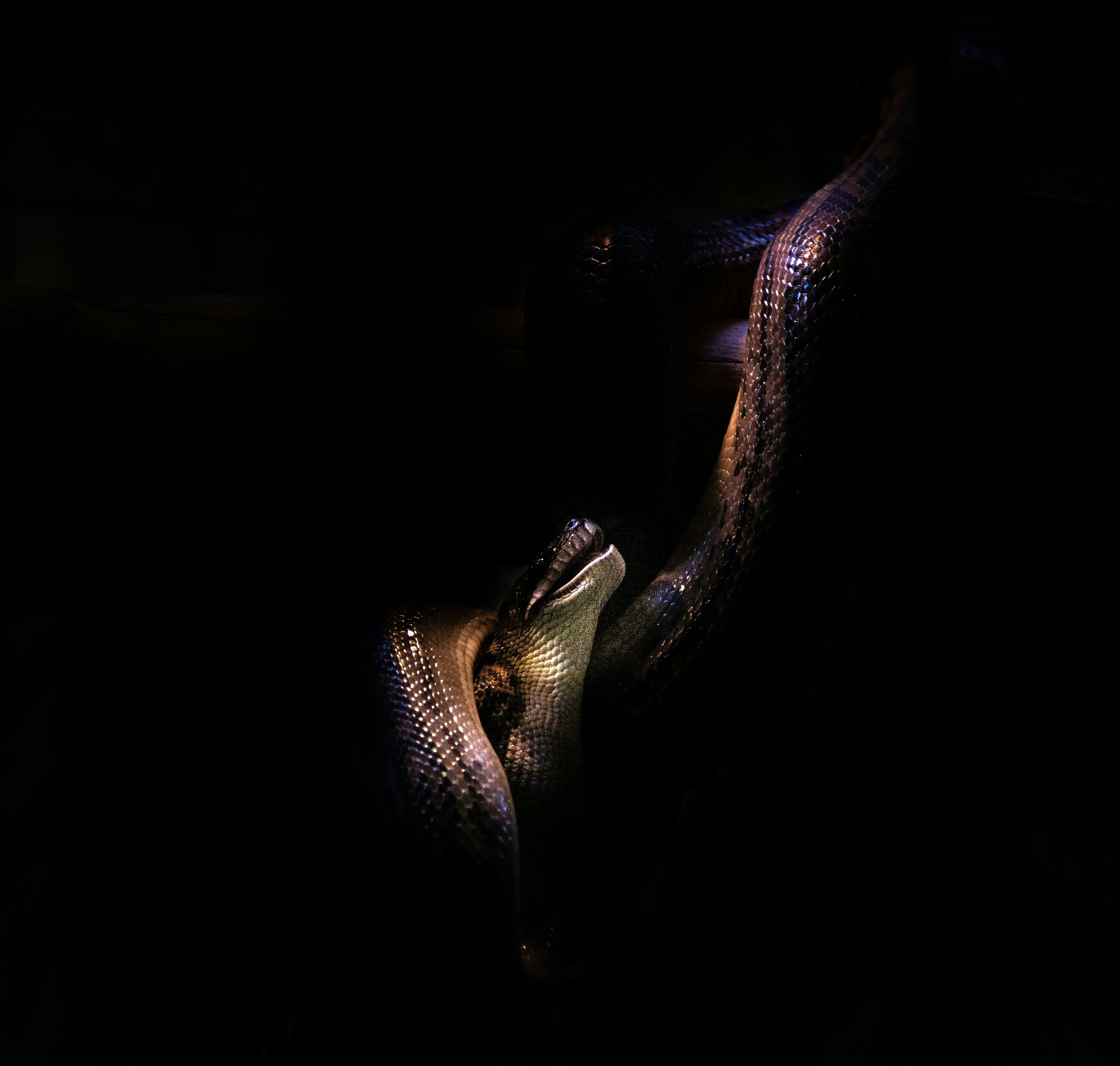
My hope is that thing with scales. A thing with tiny sharp teeth and snakelike eyes. Curved claws and stinky goo oozing from its orifices.
It wriggles and dives into the murky depths. Demons rip off its scales but it does not slow. A slimy bloody trail pulses in its wake.
Hope is that disgusting thing I don’t even want to touch.
I won’t move a finger in pursuit. No, I wallow in sadness with the monsters of my mind. Hollow and desperate, they are more my type.
I let the black mud clog my pores, drag me down
Down, down
Silt so deep, so fine, all around, I may never land
Only drift, lost forever in the dark.
But teeth nip my ankle. Claws rip the fabric of my sleeve. A pungent tail slaps my neck. Slitted pupils widen, round and dark. No longer snake eyes, but dog eyes.
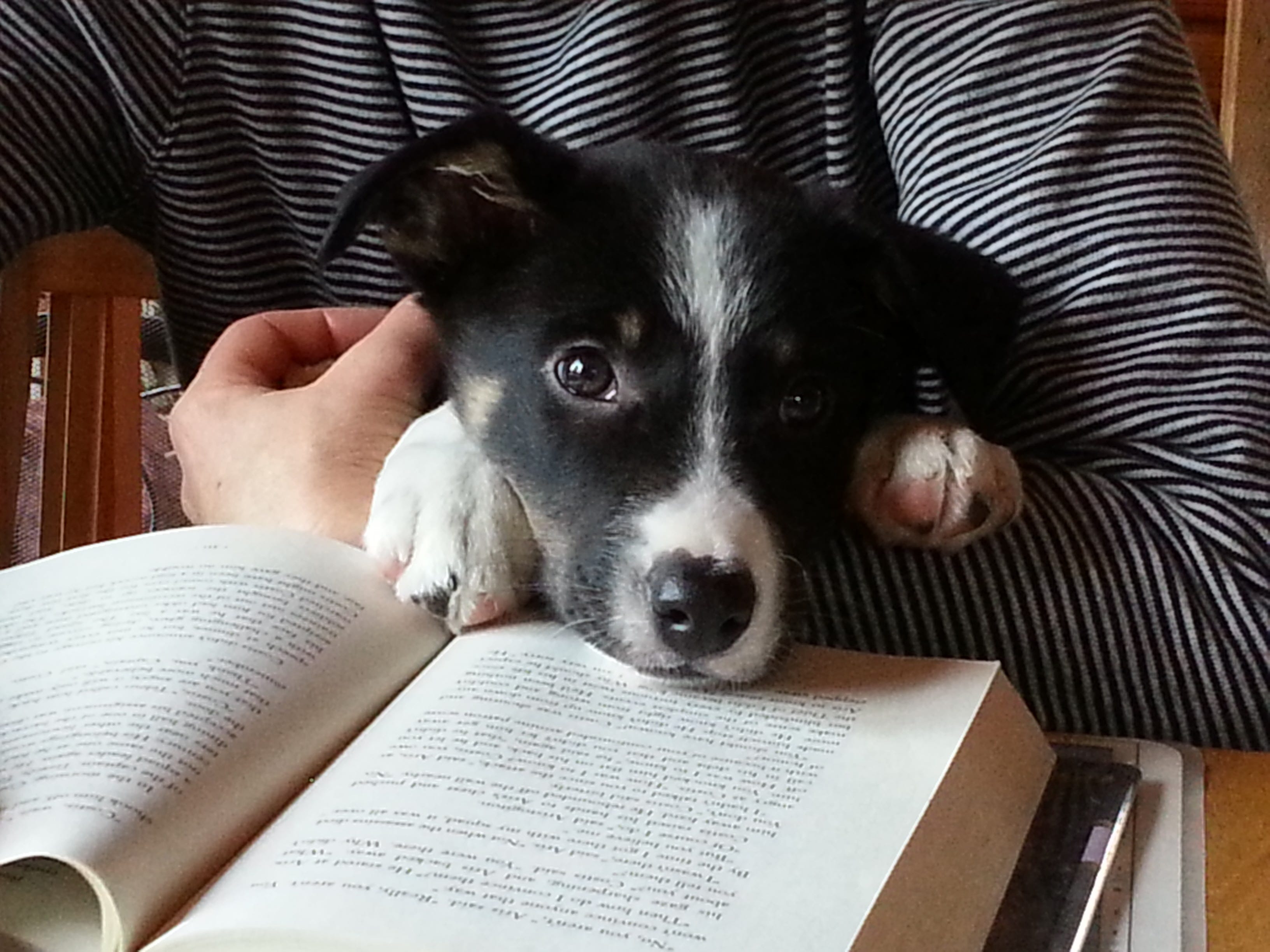
Strangely similar to those of the furry beast by my side, trying to remind me that it’s time for a walk, for dinner, for play.
Hope slithers past—and stops. Twists its head toward me. Its dripping scales reflect silt but also sky. Black to blue.
Hope’s sharp odor mellows into a balm. Moist earth and grass.
We exchange no words. But clearly, it wants me to follow. It won’t move, that stubborn hope, until I do, too.
My blood quickens. That scaly thing needs me. I tug a foot from the muck. It slides back almost as deep as before, yet I trudge onward.
For as much as my hope needs me to exist, I need it more.
Or: Thinking like your dog will make you feel better
Photo credit: Dimitri Karastelev
When we first enter this world, it’s as if we’re signing a really tough job contract. It’s an agreement that in exchange for life, we’re going to have to endure all the hard things that come with it: getting an education, finding a decent job, trying to get along with difficult people, and suffering physical and mental pain, trauma, and loss.
Photo credit: Jessica Hearn
I don’t know about you, but if I could have wrapped my newborn brain around the enormity of this contract, I’m pretty sure I would have wrinkled it up and chewed it into a soggy ball as soon as I figured out how to put my hands in my mouth. This is because one of the hardest things for me to do is to accept big changes—to say goodbye to a certain part of my life as time inevitably marches on. When I turned ten, for example, I remember sobbing because I didn’t want to leave the single-digit ages behind.
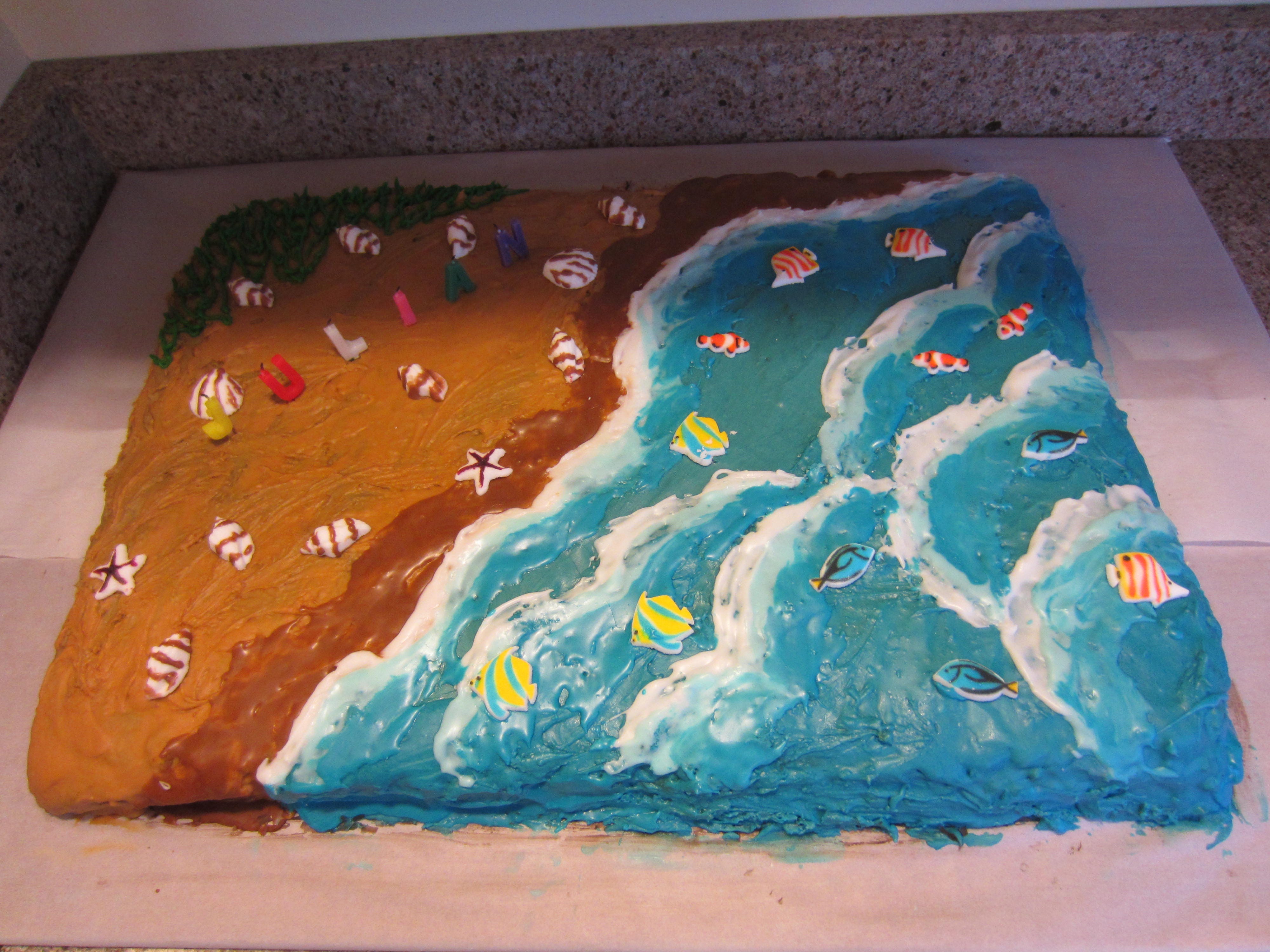
Unlike me, my son was quite happy for his 10th birthday and a homemade ocean cake.
That birthday seemed hard at the time, but I experienced a true calamity as a college music student. Dedicated to my cello since the delightful single-digit age of nine, I was certain I’d be spending my life performing Bach, Brahms, and Beethoven. But I injured my hand and suddenly could no longer play at all. You can probably guess that if your entire identity is wrapped up in a cello, your Life Contract is going to get some pretty big tears in it. I finally began to come to grips with my altered situation after about a year, but the struggle was agonizing. That contract of mine needed a lot of tape.
Photo credit: Andrea Zanenga
Many times since then, I’ve wondered why I keep getting so entrenched in a certain way of being (let’s just say that it didn’t end with music). Is this normal? And if most of us struggle with this at one time or another, what are we supposed to do about it?
To answer to the first question, I turn, as I so often do, to the topic of dogs. I bet any dedicated dog owner would agree with me that the tendency to rail against difficult changes in our dogs is a very typical human response. We know full well when we adopt a new dog that our Life Contracts are going to be tested to their utmost. Eventually, we’ll face a heartbreak stronger than when we lose some of our own human family members. The reasons are simple: dogs bond to their humans like hydrogen atoms to oxygen … and their lifespans are far shorter than ours. They don’t even live as long as cats or parrots, for goodness sake. It seems completely unfair that such an intelligent, devoted creature could reach middle age at six years old, and be ready to take the last step in its life cycle at little more than twice that.
I cherish every second of my time with Tock.
Even knowing this, even with our human-brain capability of seeing past, present, and future all at once, we insist on befriending dogs. We hold them close, and we give a chunk of our hearts to them forever. I’ve said goodbye to three dogs so far, and I can assure you that it never gets easier, and I never stop missing the ones who’ve departed. Each dog is like a novel I might write, full of love and flaws and revising—I mean training—and did I say love?
Old Tarzan. The best agility instructor I ever could have wished for, he hiked and fetched frisbees with me for more than 16 years.
Saying Goodbye: There comes a time when I can do no more to fix a story I’ve written. It’s complete, I adore it despite any residual imperfections, and I know it’s time to let it go. If I’m lucky, it’ll move onward in its path to publication. If not, I’ll put it aside for now. Either way, it’s super hard to say farewell to it (I understand why authors write sequels). But I take comfort in knowing that it’s still there, in my computer or in a picture on my wall, whenever my memories want to pay a visit.
Mothie came to us with a lot of issues, but she wormed her way closer to my heart than any other dog.
Saying Hello: In the meantime, I continue to attach myself to new dogs, and I continue to write. These things are my answer to how to deal with life’s difficult changes. My old stories never really go away, and new ones never can replace them, but dogs and writing both keep me from dwelling in the past or worrying about the future for too long. My new dogs—or characters—allow me the pleasure of living in the present right along with them. Sometimes, they even remind me a little bit of my old ones, and there’s nothing more comforting than that.
Puppy Tock waits in the wings. He and Tarzan were BFFs in the couple years they had together – and share the same favorite game of rolling a tennis ball down the stairs.
Happy Tales!
Tenzing, our first dog, possessed the very same goofiness as Tock, though they never knew eachother.
Yesterday, I was walking up a trail when I encountered a person who asked me to hold my dog so she could pass. “Sure!” I said, and called Tock away from a bush he was sniffing about twenty feet off the trail. Once he got to my side, I snapped on his leash and held him there until the woman had hurried by.
Now, this was not a trail with a leash requirement, nor was my dog exhibiting any sort of alarming behavior toward others on the trail (complete disinterest, in fact). But from the woman’s rather unexpected request to the nervous way she went past my dog, she was clearly feeling out of her comfort zone. Though I was surprised at seeing a person with such a fear of dogs on a path where dogs often outnumber humans, I’m impressed that she was brave enough to visit it, and to take the action she needed to get past her fear.
Photo credit: Jakub Kriz
Like a dog-anxious person on a very doggy trail, we all have to do things we’re not comfortable with or not used to doing if we want to make any forward progress. It happens to me on narrow trails that cut into steep, treeless slopes, where vertigo literally causes my feet to freeze in place. And as a writer, it happens to me every single day.
Photo credit: Michael Loftus
No time is more difficult than when I sit down to write the first couple chapters of a new novel. No matter how many weeks I’ve already spent outlining the story, developing the characters, and researching the setting, I still feel a pretty big mental block at actually starting to write. I’m overwhelmed with the thought that whatever I do is going to have huge implications for the rest of the story. I’m overcome with doubt that I’ll have the talent to create entirely new characters in a brand new world.
Photo credit: Evgeni Tcherkass
So if I’m to take inspiration from the worried trail-walker, I need to come up with a plan that’ll get me past my writing roadblock. For some writers, this might consist of simply waiting, putting the writing off for another day or week or month until their story starts to flow into their fingertips.
Not me. If I did that, I’d probably never write another word. I’d turn into a mummified husk of a writer staring at a dusty black screen, fingers permanently frozen to the keyboard. Ugh. I’d rather end up petrified while sitting on a sun-warmed rock by an alpine lake, thanks very much.
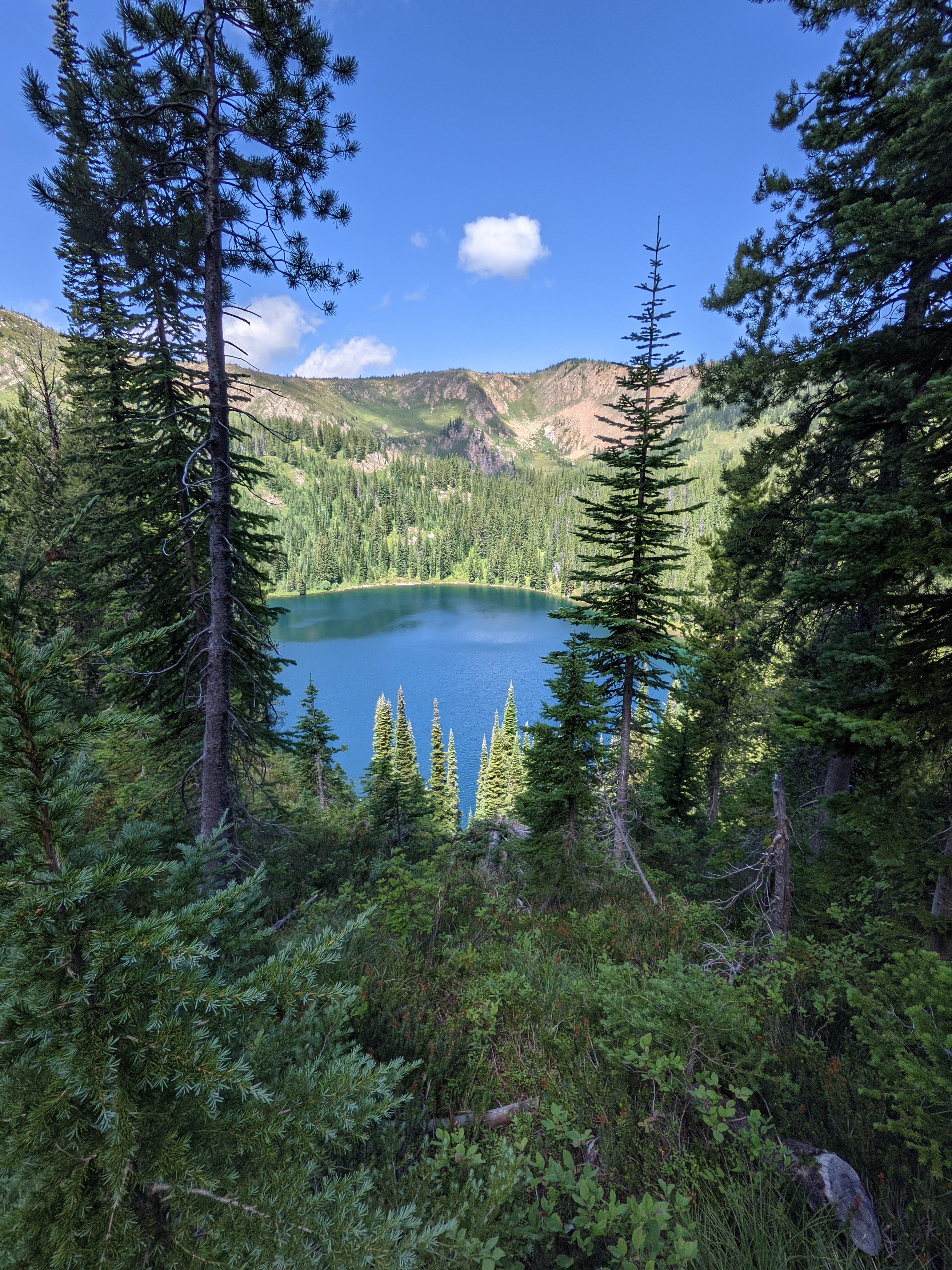
Now this would be a terrific place to remain stuck forever!
My plan for stepping out of my comfort zone happens in two steps:
(1) Akin to the dog-fearful person planning in advance to ask for help from those hikers who are crazy enough to own such slavering, vicious creatures, I seek help from my main characters so I can get as close to their eventual voices as possible. I do this by writing some first-person “prequel scenes,” which take place long before the story will occur, and in which my MC’s basic misunderstanding about the world develops (thanks to Lisa Cron’s Story Genius for this brilliant idea). There’s a lot less pressure in writing these scenes than in composing the actual story because they’re not the actual story. Not yet, anyway (full disclosure: I often end up incorporating bits and pieces of them into flashbacks).
(2) After playing around with character voice and motivation in this way, I’m ready to walk past the metaphorical scary dog. I open the document to the blank page and force myself to write. Word after word after word. I’m not saying this is easy for me. It’s terrifying and often feels painfully slow compared to writing later in the story, when I’m comfortable with all the of the character voices and how they relate to one another. But it gets my feet moving along the trail to a place where I feel much safer and happier.
Photo credit: Nick Bolton
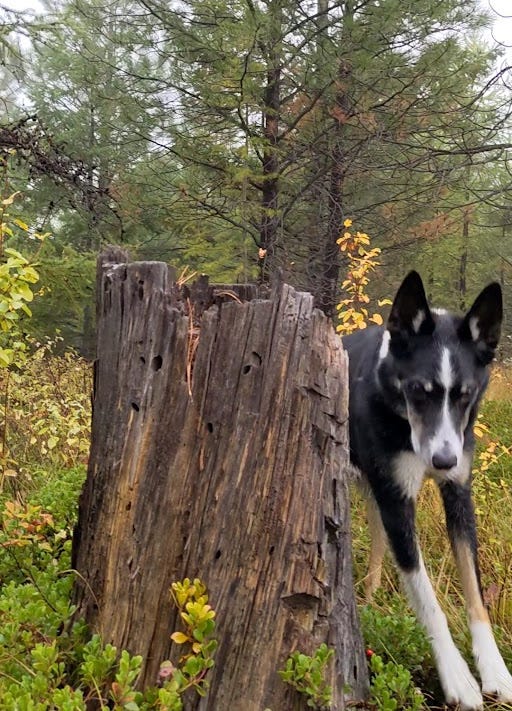
This combination of preparation and a little bit of sheer will power goes for any fear I might have. But what if you just can’t muscle your way into writing? Or what if the stranger-dog situation is reversed? What if it’s the dog that’s scared? I actually have a particularly fearful dog who gets nervous when he encounters “unfamiliar” things. I put that word in quotes because something that’s unfamiliar to him is generally not at all unexpected to me, from a visit to the vet to having to enter a barn through a large sliding door. Occasionally, a previously visited stump in the trail that’s turned extra black from rain or extra visible from lack of leaves will cause him to leap back in surprise with a little growl. Oh my goodness, it might attack us!
Racing past a scary stump.
I jest, but these are very real terrors to my dog. And since he’s pretty much joined at the hip to me, going wherever I go, I must own his fears and find ways to mitigate them. If you’ve read one of my previous posts, Backstory’s Bad Rap is Underserved, you’ll already know that I deal with Tock’s fear of the vet in the two-step manner I’ve described above. But for most of his fears, I have the option to replace that second step with an alternative that is always, always better for getting a dog over their terror: (3) the use of reverse psychology, or more generally, thinking outside the box.
For the scary barn door, for example, I found another entrance into the barn through a much smaller door. Tock was perfectly fine with going in that way. And once he did, he had no problem exiting—and then re-entering—through the big door. For a suspicious stump, I wait for him to take a single step toward it, and then reward him far away from it, so he realizes that doing one tiny difficult thing reaps great rewards in a safe place. Incidentally, this reverse psychology is the same approach I use for agility students’ dogs who are terrified of the teeter.
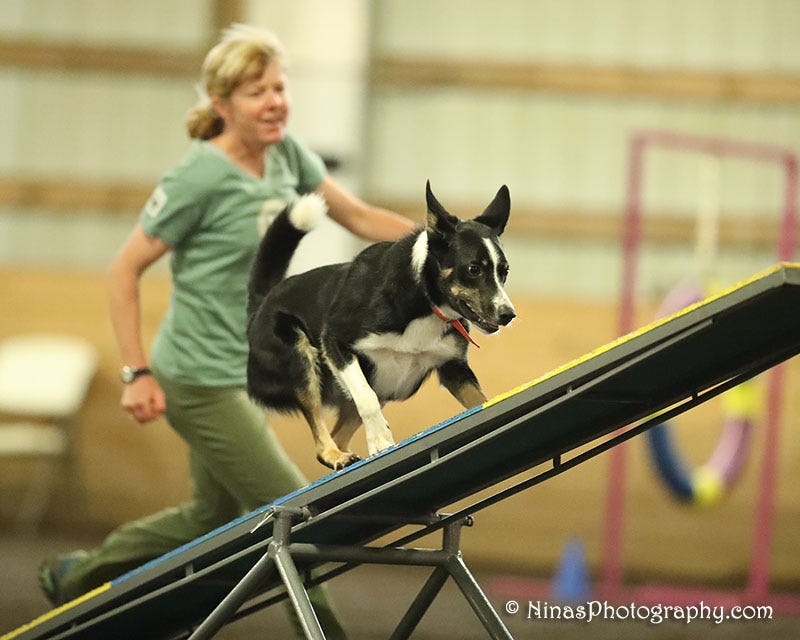
Some dogs are born scared of the teeter’s sudden tip, or the banging noise it makes when it hits the ground, or the height they have to ascend before the board tips. Others become scared due to a frightening experience, such as using a teeter that tips much faster than the one they were used to. Either way, asking for a tiny approach to the teeter, followed by a fun reward elsewhere works wonders (thanks to Leslie McDevitt’s Control Unleashed for this method).
Just as the second step of my Two-Step Approach needs gentling and modification to help dogs overcome their fears, it may need tweaking for you, too. If the setting of the new world causes you to stop and puzzle about it excessively, skip it for the moment and move straight to interiority or dialogue. This allows you to get directly into your character’s head in a manner that you’re already comfortable with (remember those prequel scenes?). Another way to sneak words out of your mind and onto paper is to write more prequel scenes that get closer and closer to the time the story takes place—until they are the story.
What techniques do you use to step out of your comfort zone, past the danger, and into a brave new world?
One of the worst days in many countries occurs with the annual switch from Daylight Savings Time to Standard Time. We have to reset our clocks backwards an hour, and guess what that means? Hint: I’m not thinking that much about you right here. Besides, I know a lot of people relish that extra hour of sleep (excluding myself). No, I’m concerned about your dogs.
Possibly this goes for other pets, too, but dogs truly love their routines. Delay everything by an hour, and your dog will be standing by your side of the bed, shaking his coat and rattling his tags in anticipation of you getting up (at what is now 4:00 AM rather than 5:00). Then he’ll be standing at your elbow waiting for breakfast—and dinner—an hour before he’s normally fed. As someone who’s perpetually hungry, my stomach growls in sympathy.
And of course, your dog will display signs of restlessness indicating that he expects you to let him out or take him for a walk, long before you’re ready to step outside. At the end of the day, he’ll wonder why you’re taking forever to go to bed. He’s likely to retire early, even though you’re still up and there’s a chance you might play more games with him or even give him a treat.
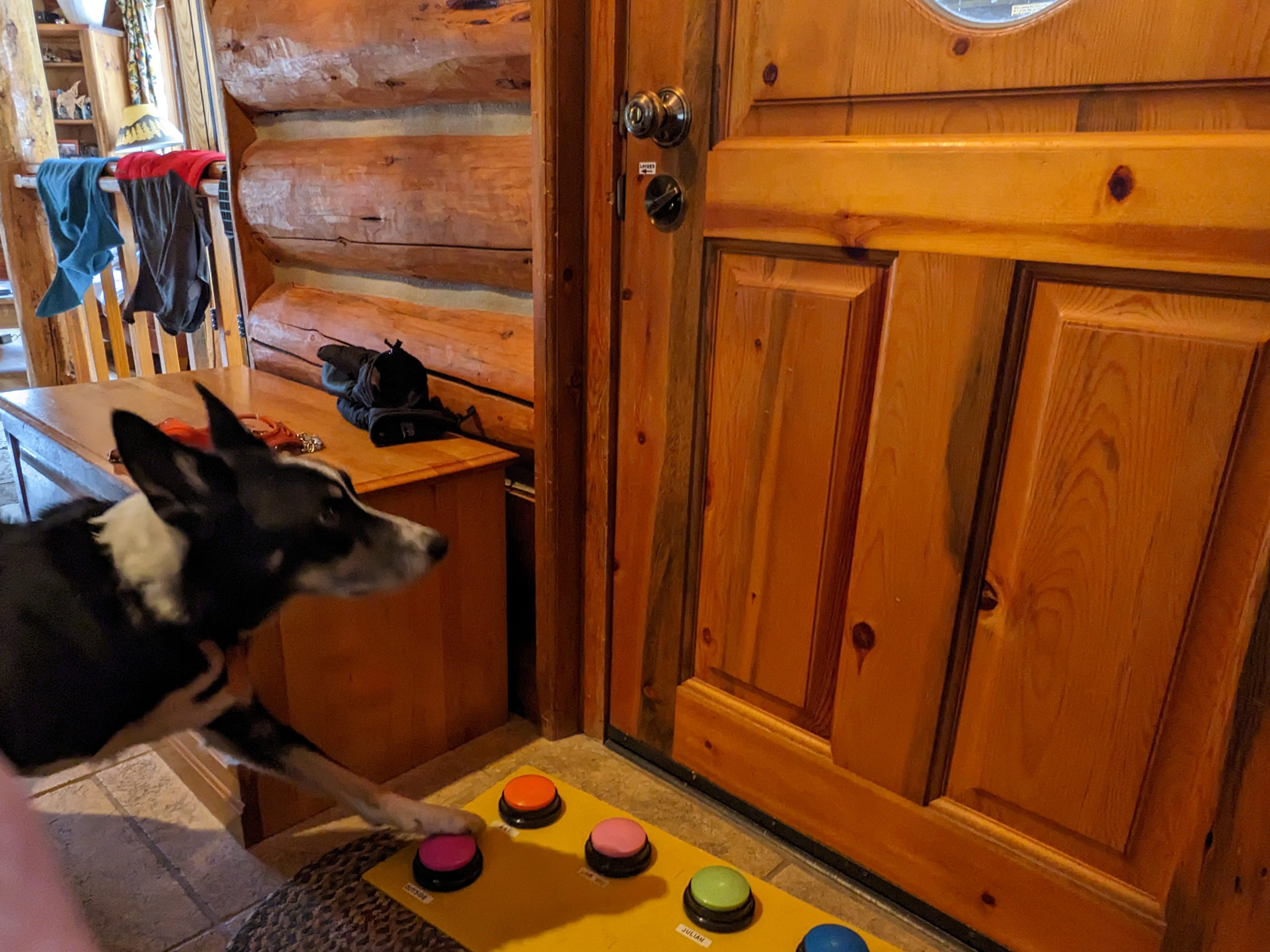
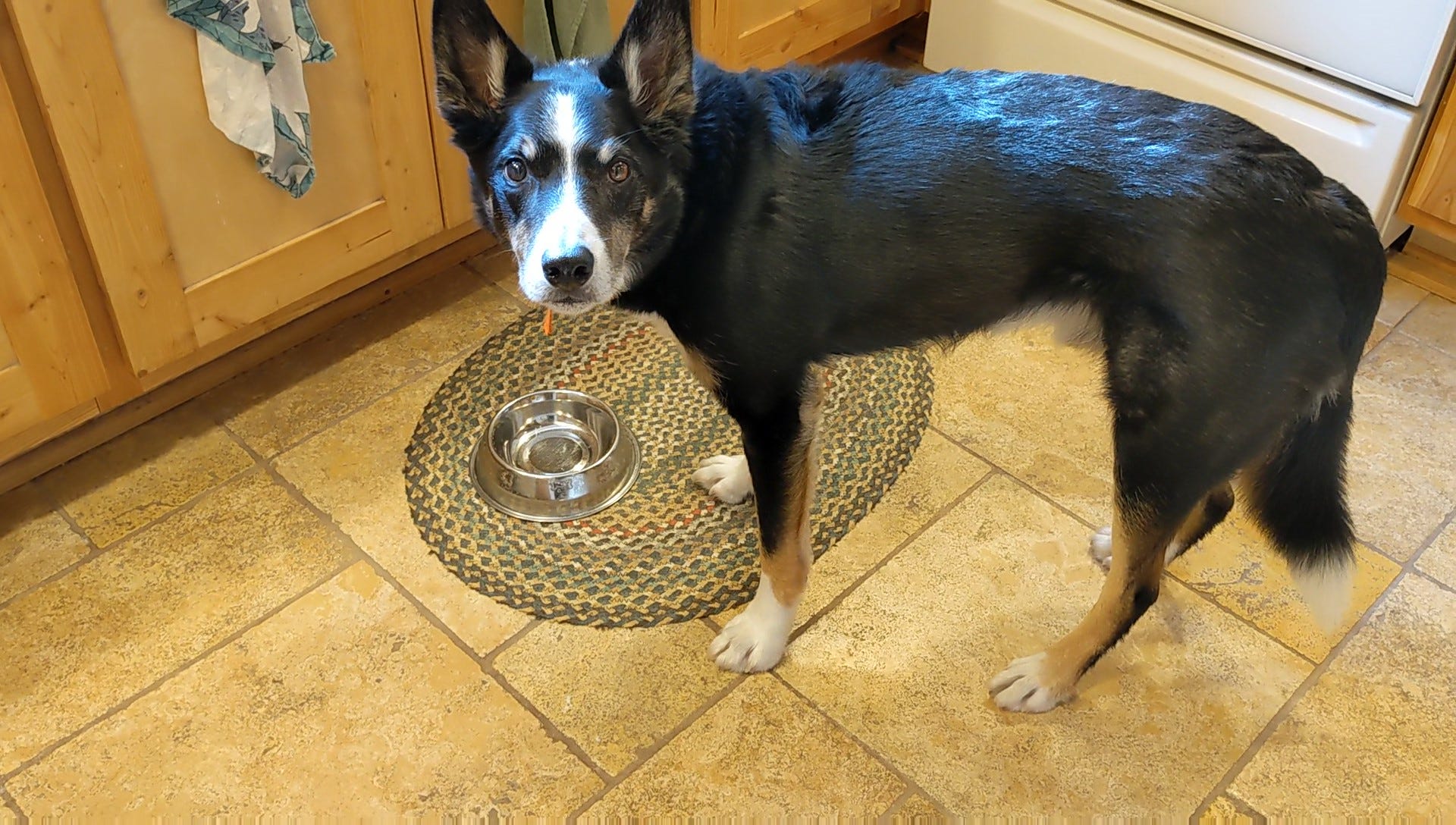
Tock presses the “Outside” button while staring at the door. Could he be any more clear about what he wants?
It takes my dog a good week to get over the time change. For every one of those interminable days, he employs his most beseeching stares for much longer than normal, as though he’s starving to death and suffering tremendously from lack of attention.
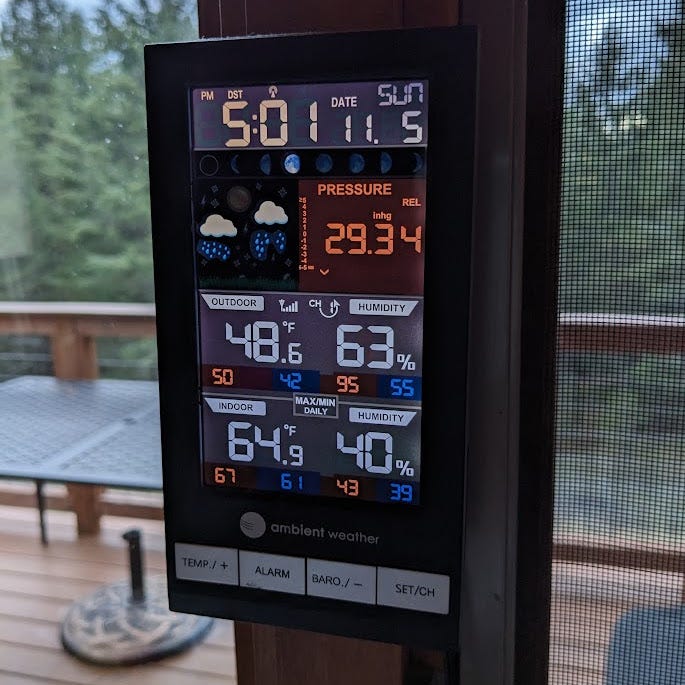
My dog’s behavior makes me feel rather callous. But I cold-heartedly push the new routine into place because once he’s adjusted, we’re back to our usual schedule. It’s probably during this process more than at any other time of the year that I appreciate Tock’s intense devotion to the precise moments that good things happen for him. Without a watch or a phone or a daily planner, his brain makes use of other cues to understand timing. This could be external, such as changes in daylength and temperature, or internal, such as his level of hunger, alertness, or sleepiness. Whatever it is, he’s as accurate as the atomic clock in our weather station.
If you’re lucky enough to spend much time outside, you’re likely aware that wild plants and animals have their own clocks, too. Over millennia, each species has evolved in a way that enhances its own survival and ability to pass on its genes to the next generation—and a large part of its success stems from knowing exactly when to flower and fruit, when to eat, migrate, and grow a new coat of fur.
Photo credit: Dulcey Lima
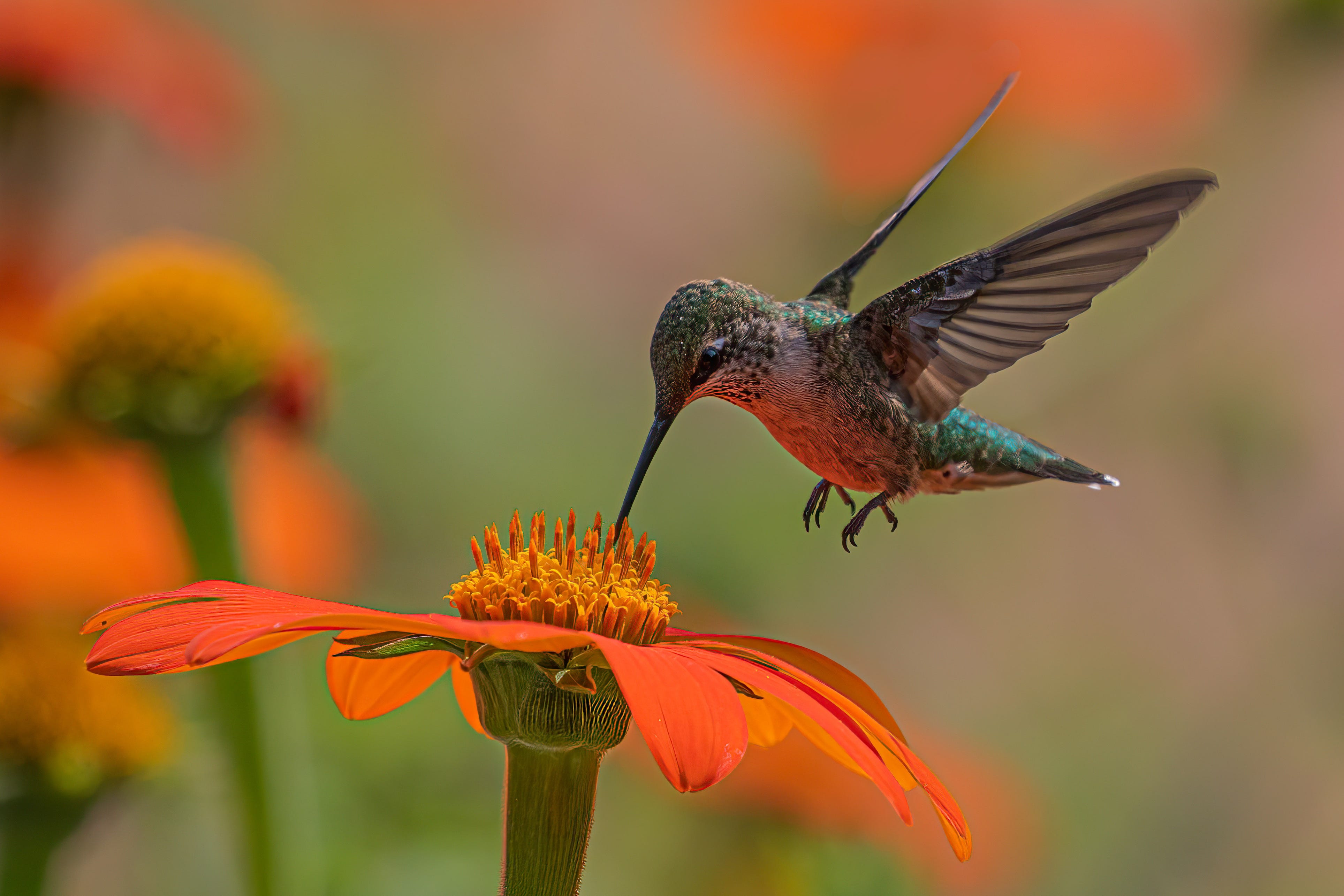
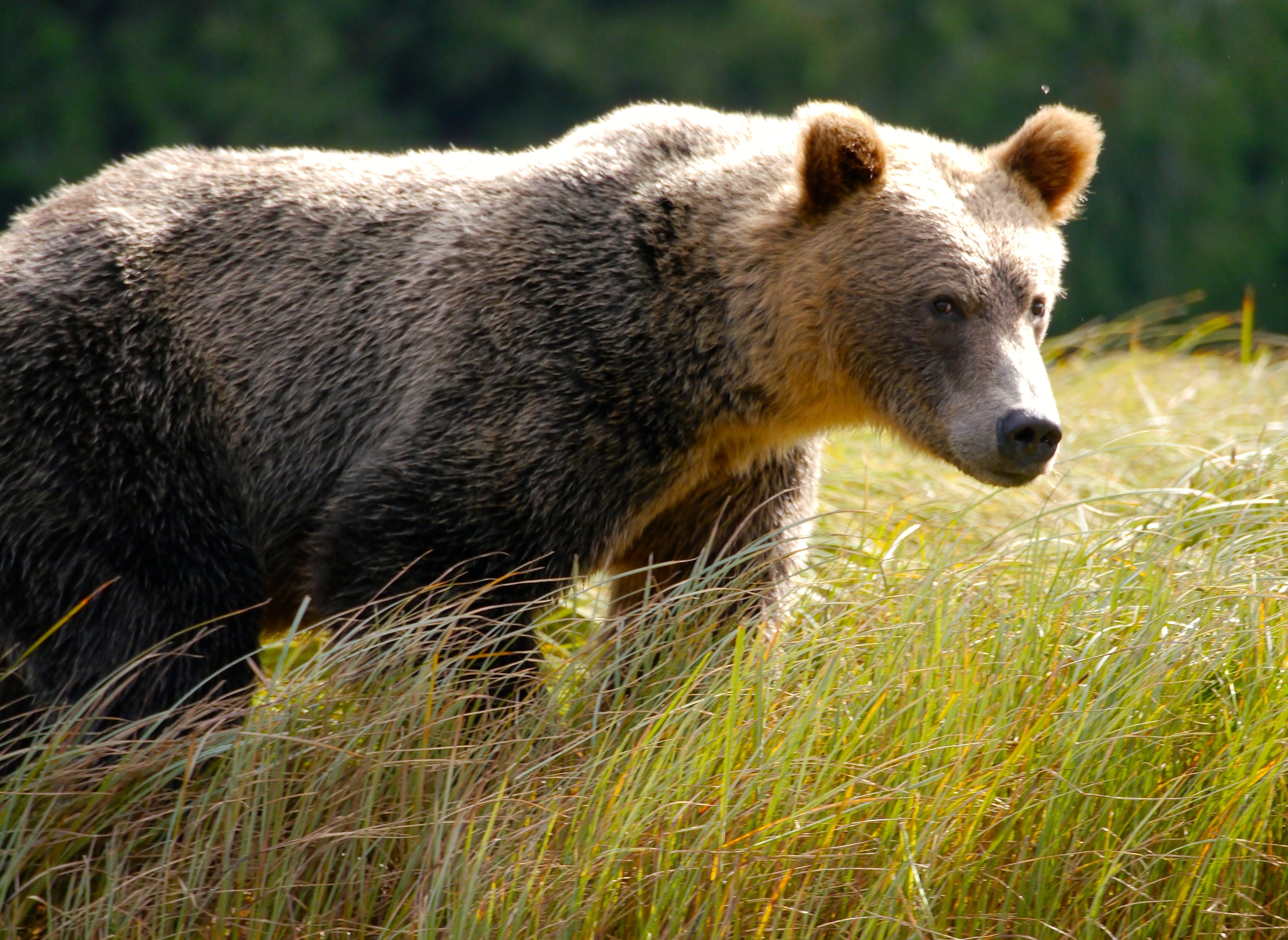
A hummingbird that arrives so early that its crop of flowers isn’t yet producing nectar—or so late that the flowers are already drying up—won’t have as much food to support its young. Likewise, a grizzly bear that comes out of hibernation too early may not find enough of the delectable glacier lily bulbs that it relies on for spring nutrition in many alpine areas.
Photo credit: Anna Tremewan
The problem, unfortunately, is that global changes in weather are now happening at a more rapid pace than ever before, and they’re wreaking havoc with natural systems. Like the white-coated snowshoe hare on a brown, melted-out hillside, some species are unable to adjust their tortoise-slow evolutionary processes to keep up. And unlike my dog, they don’t have the luxury of muscling through a week of misery and just “getting used to it.” Many species do alter their physiological and behavioral patterns in a way that seems to correspond with longer warm seasons, but they’ll be in trouble if the plants they eat or the animals they interact with don’t adjust at precisely the same pace, or if severe weather becomes more unpredictable overall.
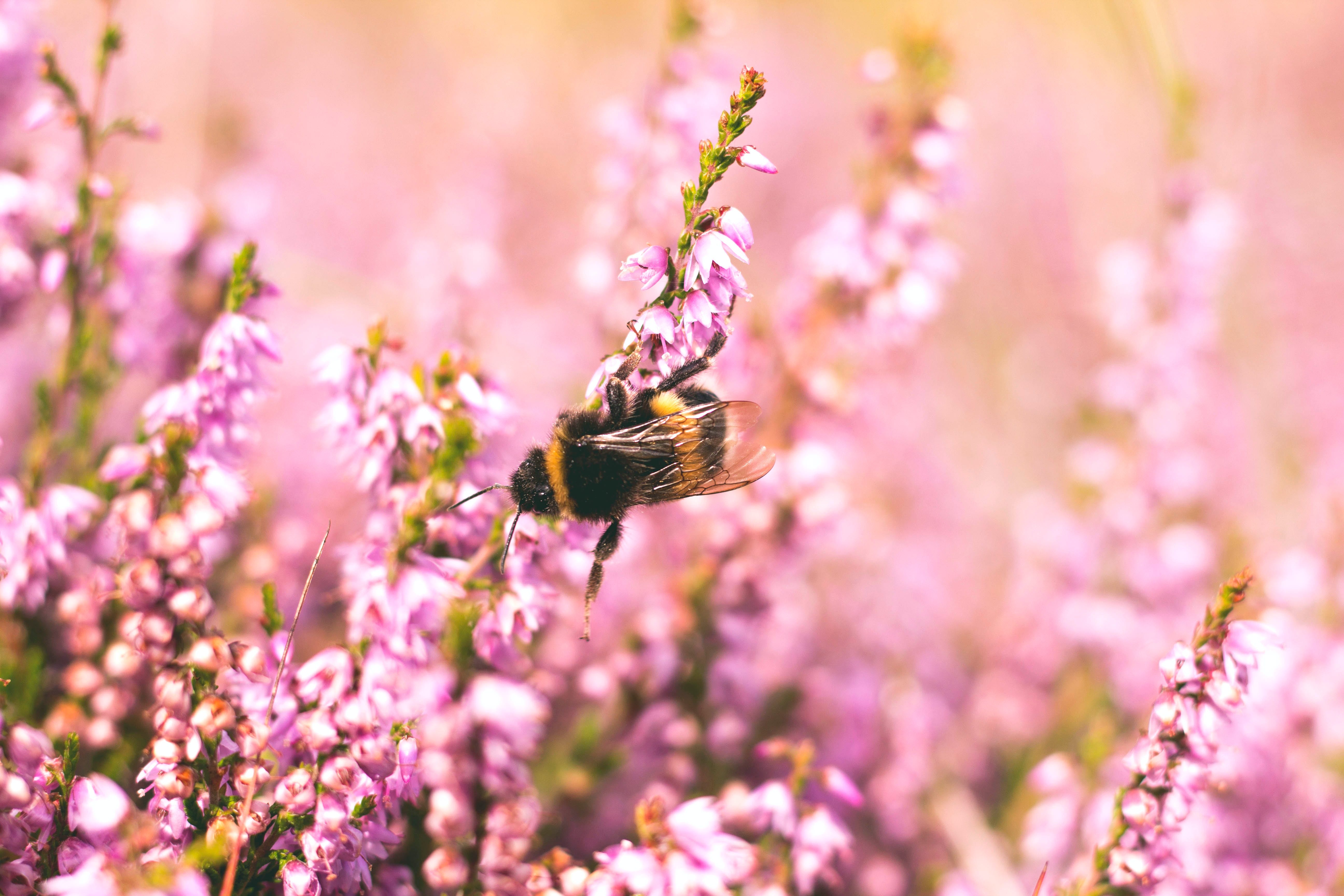
Each species of bee in a given area has its own biological clock and flowers that it prefers to pollinate. Photo credit: Josephine Amalie
“No species lives in isolation,” says professor David Inouye, leader of the world’s longest and most comprehensive study of ecosystem phenology in the southern Rocky Mountains (i.e., an incredible fifty years of measuring the timing of interconnected biological cycles). The big unknown question today is whether the major life events of different species will continue to become more and more mismatched. Perhaps new species will step in to fill the void where others cannot, but the chances of these newcomers meshing perfectly in an already established ecosystem are small. Clearly, we need a lot more research to determine the answer.
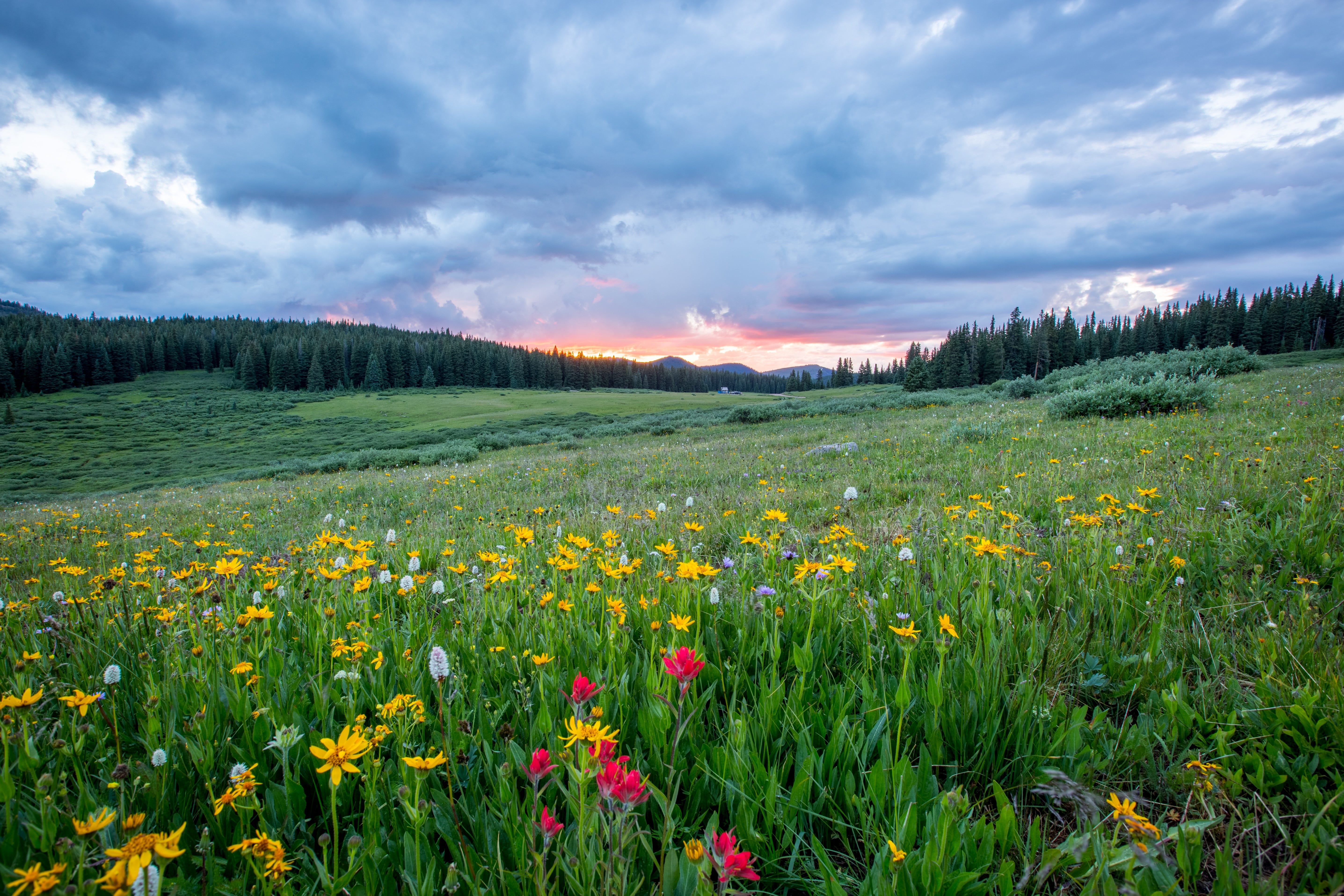
The meadows of the Rocky Mountains are home to diverse collections of plants and animals, but species relationships are undergoing upheaval as their routines shift in changing climates. Photo credit: Joel Holland
At the moment, it feels to me like we’re living inside a massive global climate experiment with no controls and too many study subjects doing whatever they please. It’s my fervent wish that we humans do what we can to slow climate change down, so other species have a chance to adjust their routines in order to survive and reproduce. But how?
This is when I fall back on the thing that keeps me grounded most of all—writing. It’s one area in which I personally might be able to make a difference, by shedding light on the things that matter to me. Climate change, for instance. Once people appreciate the intricate balance of life forms that comprise an ecosystem, they might begin to think about how easily that can be upset, and how they can minimize their own contributions to climate-related turmoil.
So … I write. And I’ve found that I write best when I stick to a certain schedule. For me, this means a small chunk of time before dawn followed by a larger chunk at mid-day. Of course, the actual frequency and amount of writing time varies with each person. Some write best in the morning, some in the evening, some interspersed throughout the day. The main thing is that we know we have to write, and we dedicate blocks of time to doing it. We have routines. It’s my guess that most successful writers are as embedded in their routines as their dogs. How else would we ever trick ourselves into writing more than a paragraph?
Sparkle reminds her owner that it’s way past feeding time! Photo credit: Mary-Ann Sontag
Routines are bread and butter for writers, and we rely on them in order to create. Whether we think about the survival of an entire ecosystem or witness the angst our dog feels during the time change, appreciating the importance of routines ensures that we’ll do what we can to maintain them (or to ease the transition to a new one as gently as possible, in the case of that shift to Standard Time). This gives us the concentrated time we need to let our thoughts flow into words. It’s personal and perhaps selfish, but to me, writing is the real reason for my own routine. Without one, I’d never have written this.
How to boost your confidence en route to your goal.
I don’t speak in superlatives very often, but the absolute best way to train a dog is through a process called shaping. The basic idea is that you don’t tell your dog what you want, but you reward them for doing it anyway.
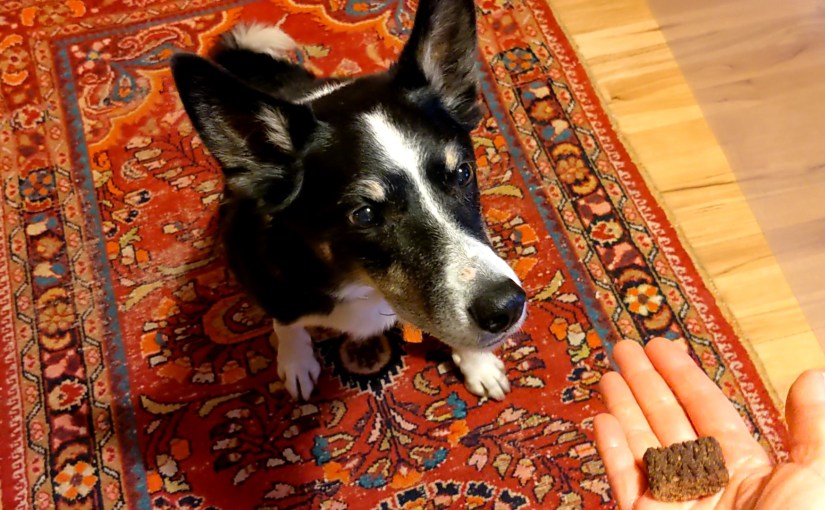
Tock gets a treat for doing something I wanted.
“Hold on,” you’re probably saying. “Why would a dog do something for you—a trick, a recall, a stay, whatever—if you never tell them to do it? Let alone how to do it.”
Thank goodness I’m here to tell you. The trick to shaping is that you start small.
Photo credit: Summer C
Of course, I don’t mean small in the physical sense, but in terms of easiness. The same principle holds for writing. If you’re like most people, you’re not gonna sit down and write a novel on command when someone hands you a pen—especially if you’ve never written anything beyond a high-school essay until this point. No, you’ll start with something easier—a paragraph, a journal entry, a page.
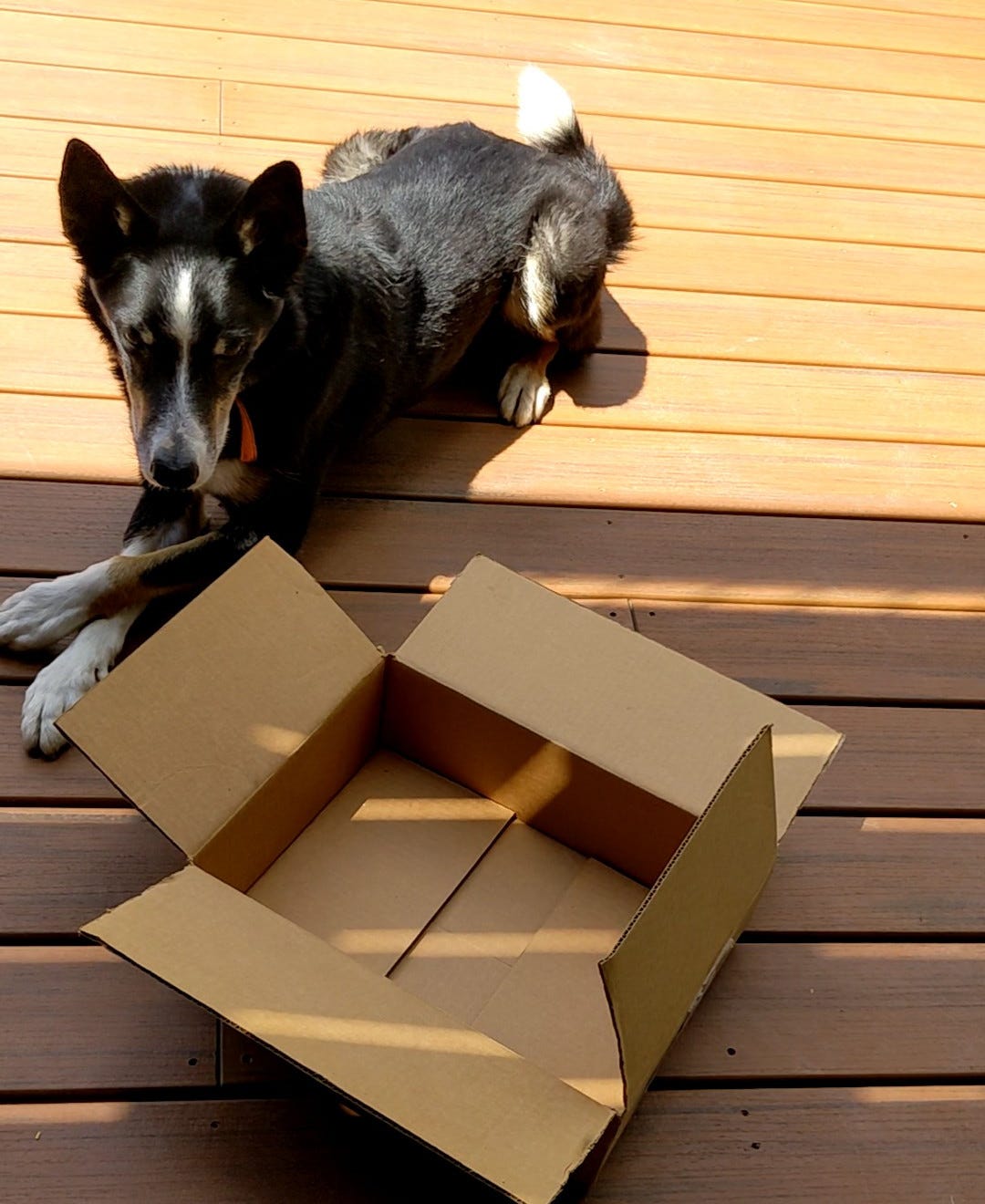
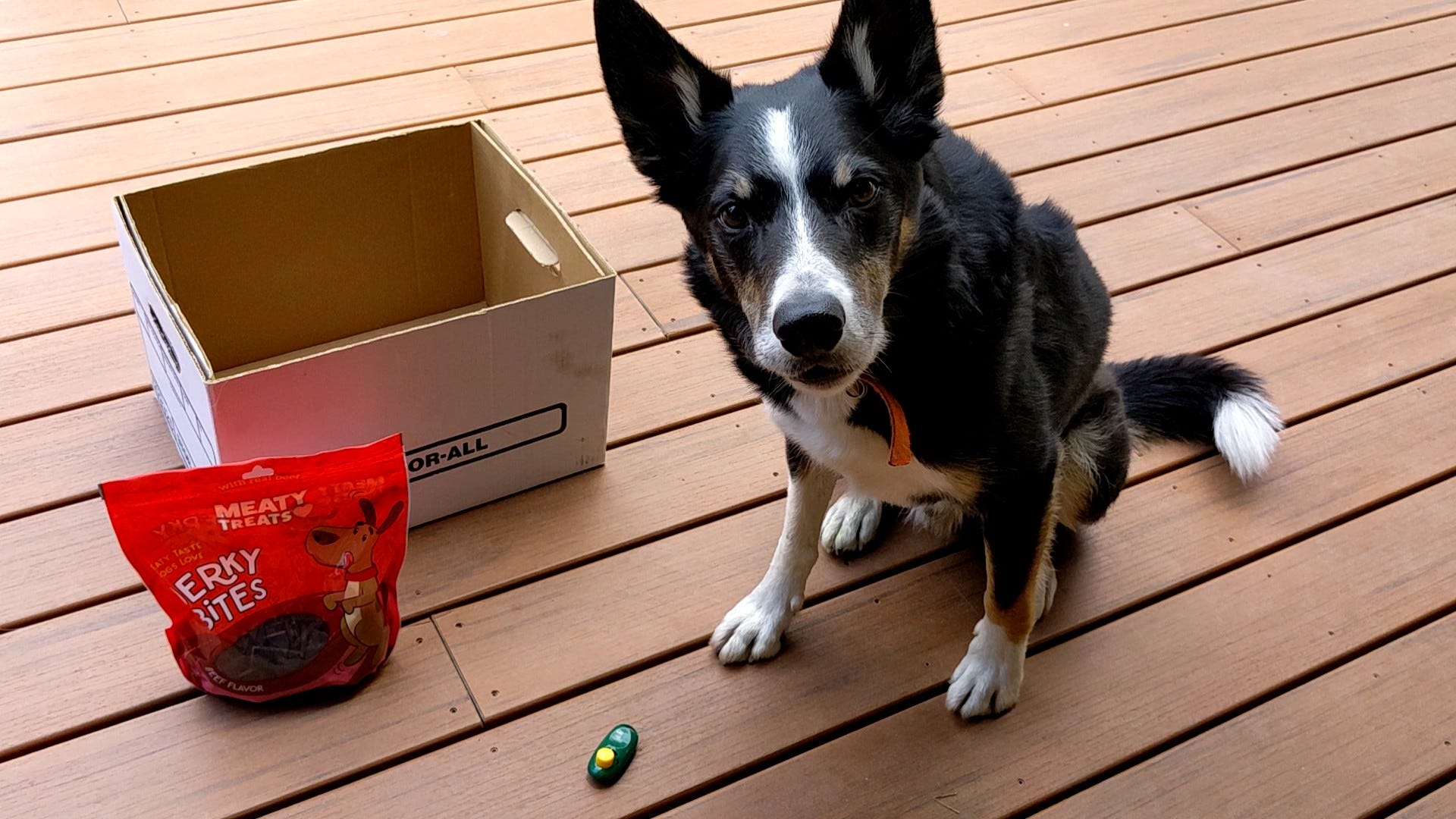
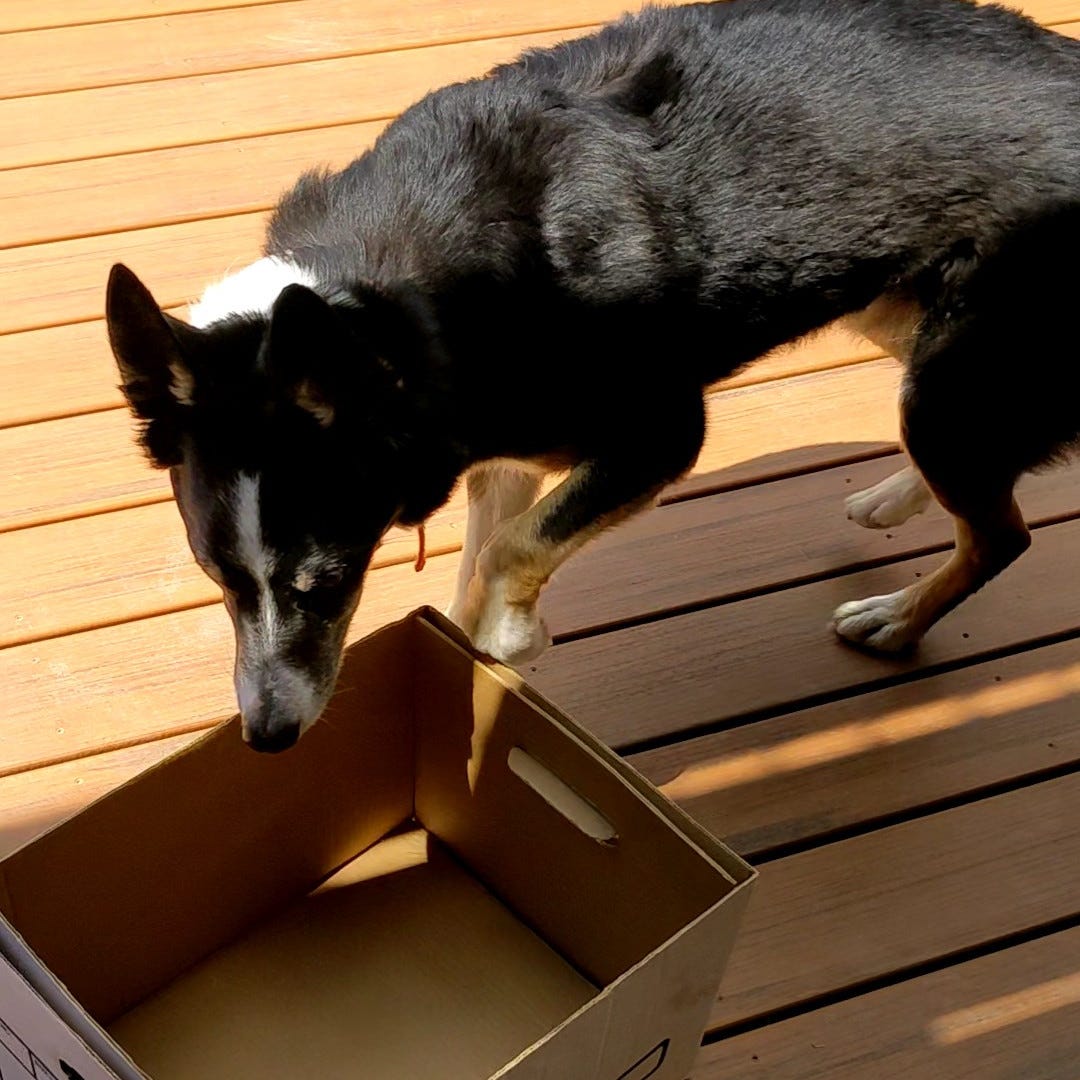
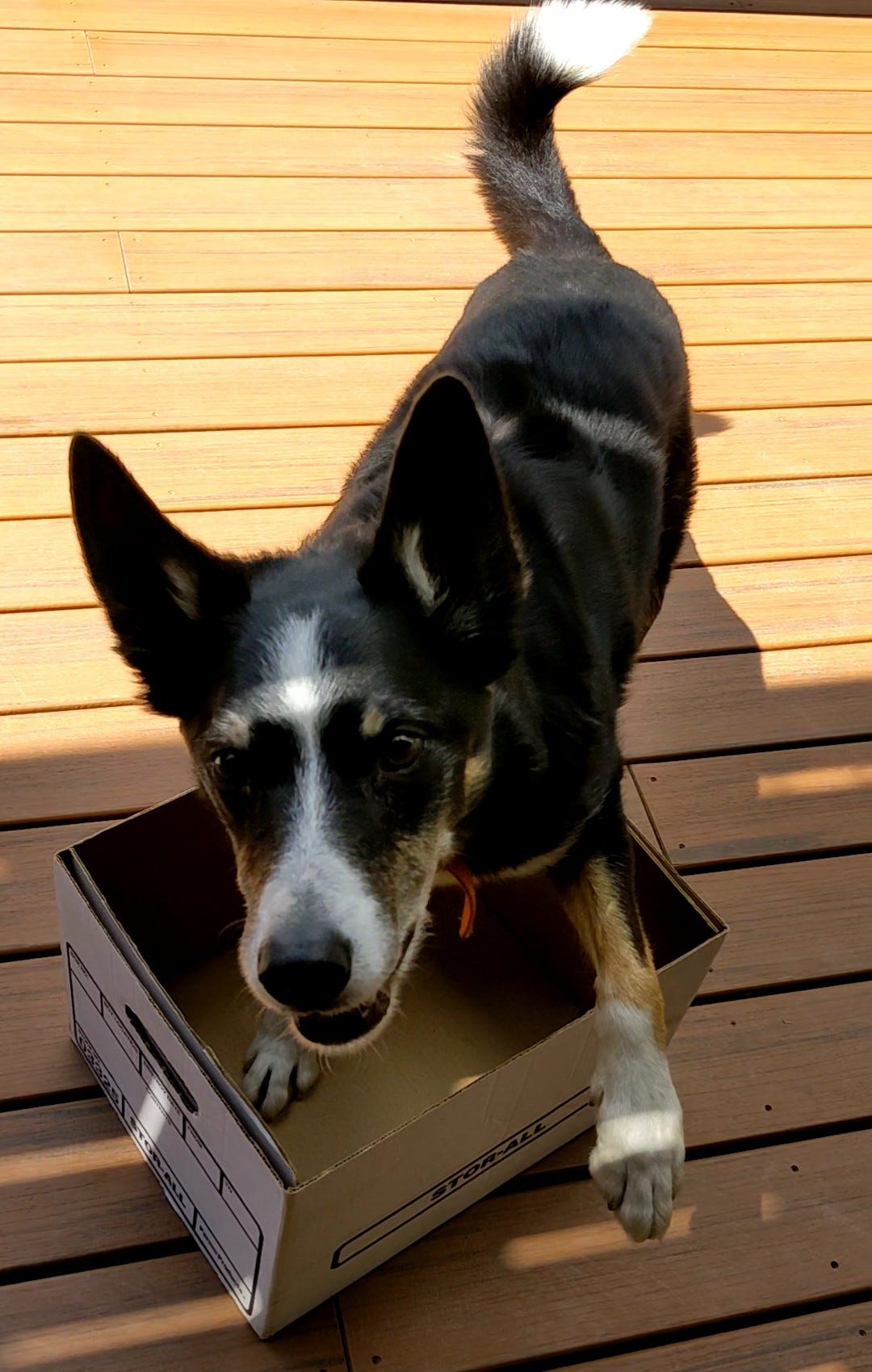
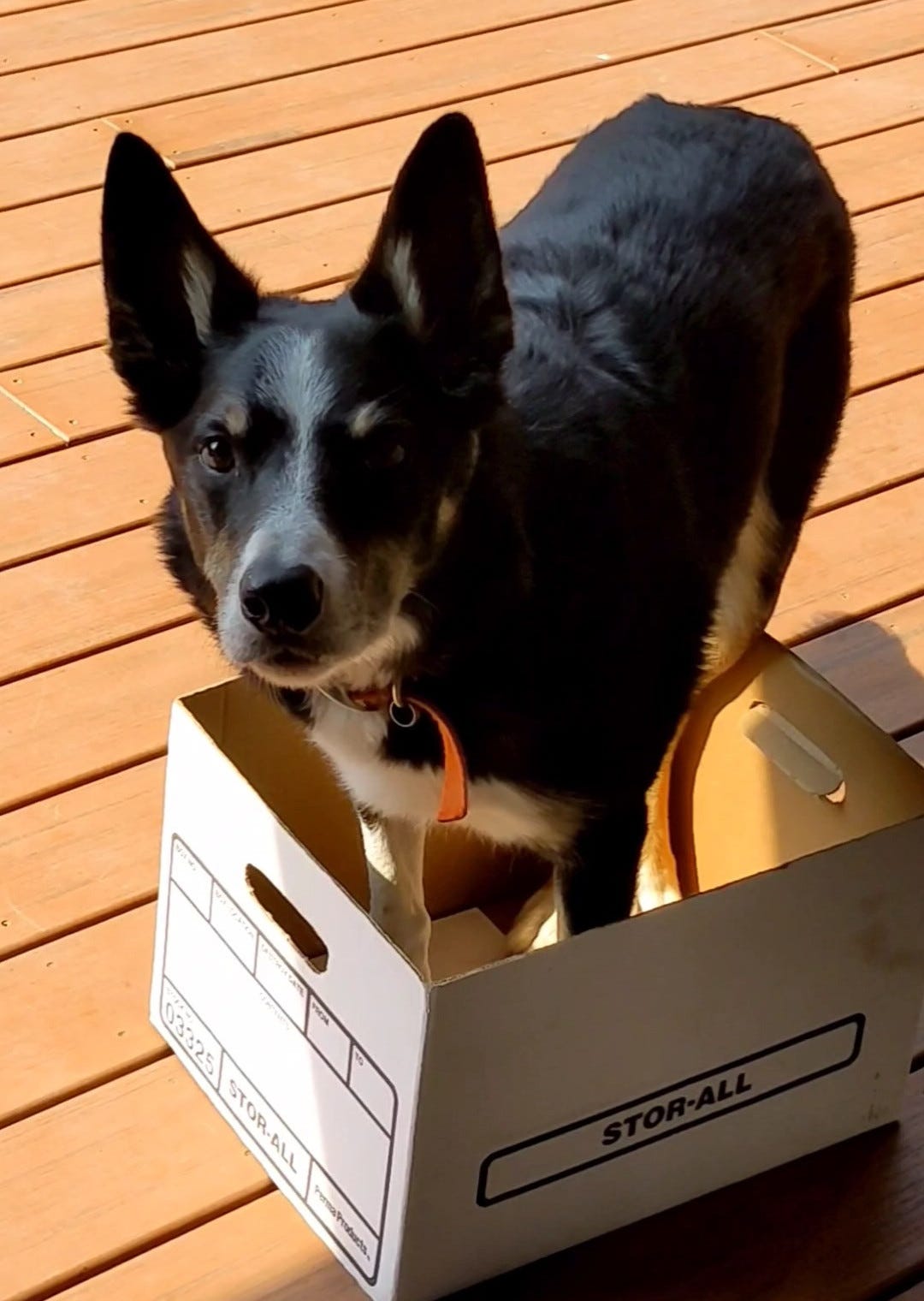
As for your dog, let’s say you want him to stand in a tiny cardboard box. Collect (1) a box that’s not tiny, but is roomy enough for him to fit inside comfortably, (2) a bag of treats, and (3) your dog. An optional item you can bring to the training session is (4) a clicker (I’ll explain more about that in a moment. For now, all you need to know is that it’s a handheld button that emits a loud click when pressed).
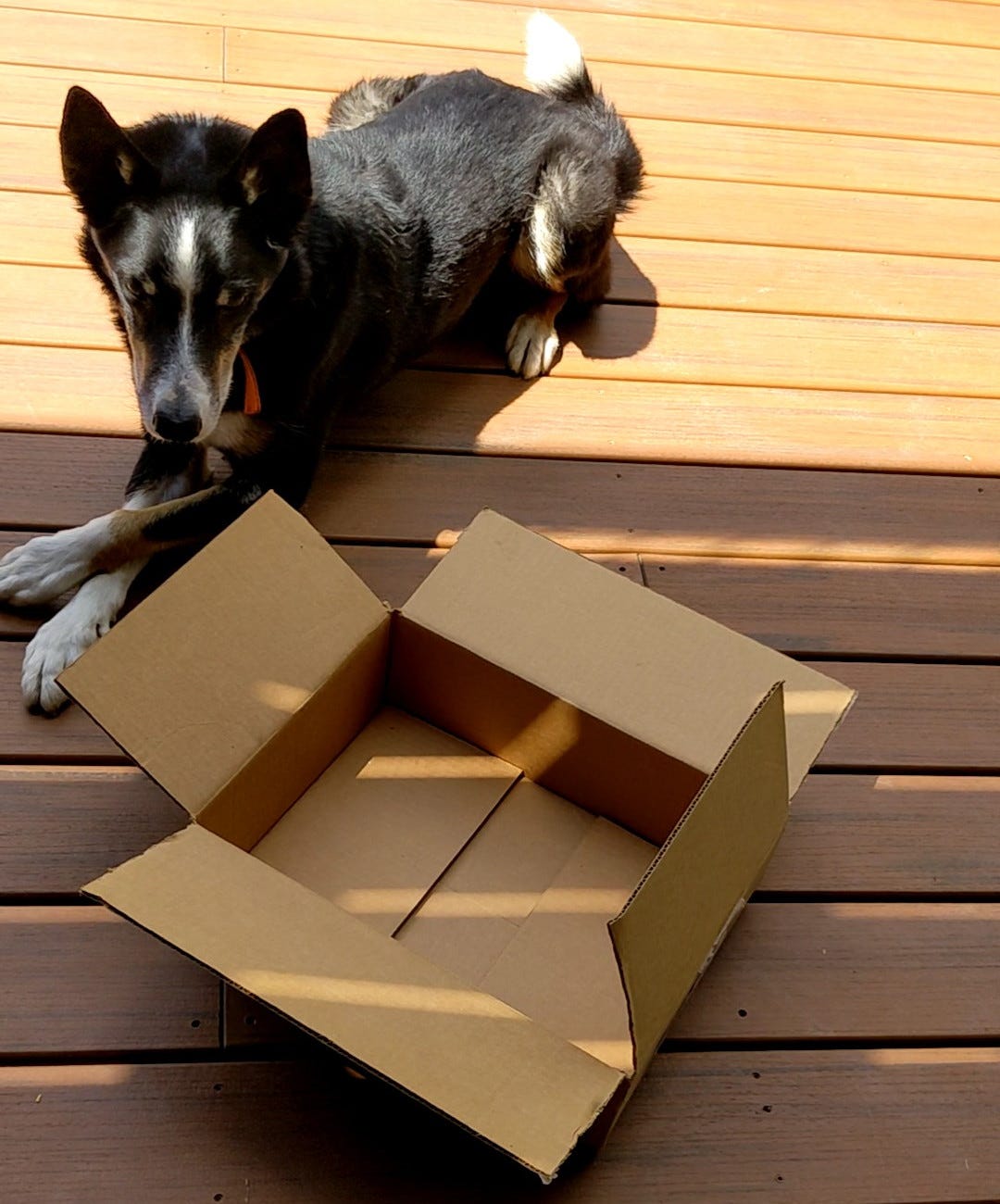
All you need to train a dog to get in a box.
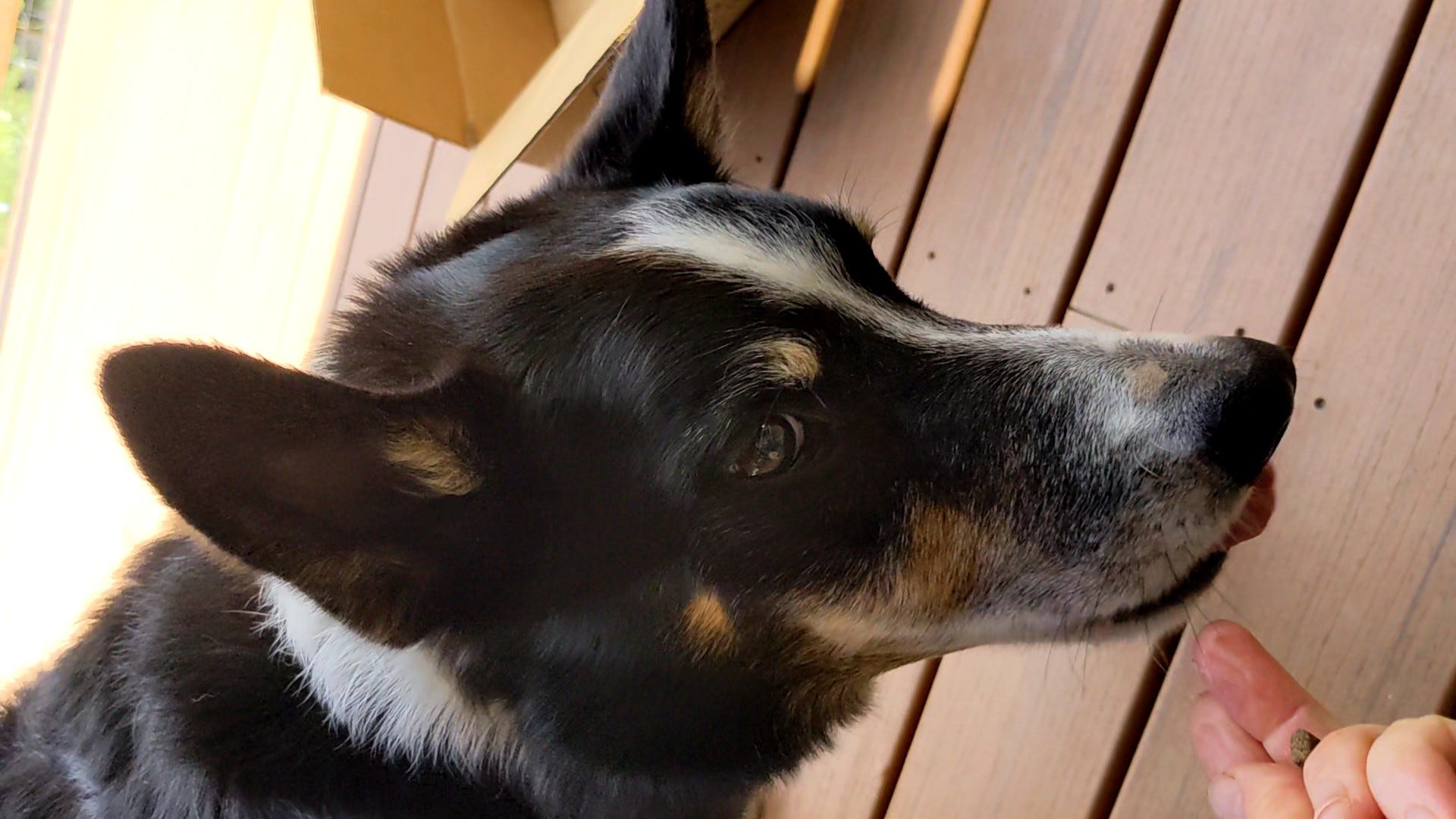
The second thing you need to do is very simple: put the box down near the dog. Unless your dog is totally distracted* or terrified of boxes,** he’s gonna check it out. The second he looks at it or sniffs it, press the clicker (if your dog has never experienced a clicker before, you should start by simply pressing the clicker and rewarding, over and over, until the dog has learned that the click means “you’re gonna get a treat!”). Instead of or in addition to the clicker, you can say a one-syllable word like “Yes!” or “Good!” Whatever sound you choose, you’ll use it to mark a behavior, the same way a camera click takes a snapshot to preserve the perfect pose.
*The solution for a distracted dog is to do your training in a boring room with no distractions. **The solution for a terrified dog is to start with something that doesn’t resemble a box. A piece of cardboard, for instance.
Photo credit: Sam Williams
In my parallel writing universe, I’d guess that this external marking of a dog’s behavior is analogous to making the conscious decision to write about … something. To sit down (click) and scrawl or type (click) with a purpose other than exercising your fingers. At the start, when you’re terrified that you cannot possibly write a single thing, just a bullet point for an outline or a sentence for a story will do.
Back to dogs: immediately after clicking, reward your dog with a treat. You can then either pick the box up and put it down again, or simply wait for the dog to do something with it again (either look at it, sniff it, or walk toward it, depending on the dog). After about five times, assuming your dog is hungry, he’ll have caught on that interacting with the box is quite valuable to him.
Tock checks out the box when it’s put down near him.
Clearly, writers aren’t going to stuff themselves with a piece of chocolate after every sentence. But when I’m finished writing my sentence, paragraph, page, or chapter, and I know I’ve accomplished a small goal of sorts, I allow myself to read what I wrote. Seeing that my labors produced a tangible result—no matter how much fixing or replacing will be necessary later—is the perfect reward for a writer.
If I rewarded myself with my favorite treat every time I wrote a sentence, I’d no longer be able to move—or sleep. Photo credit: Taisiia-shestopal
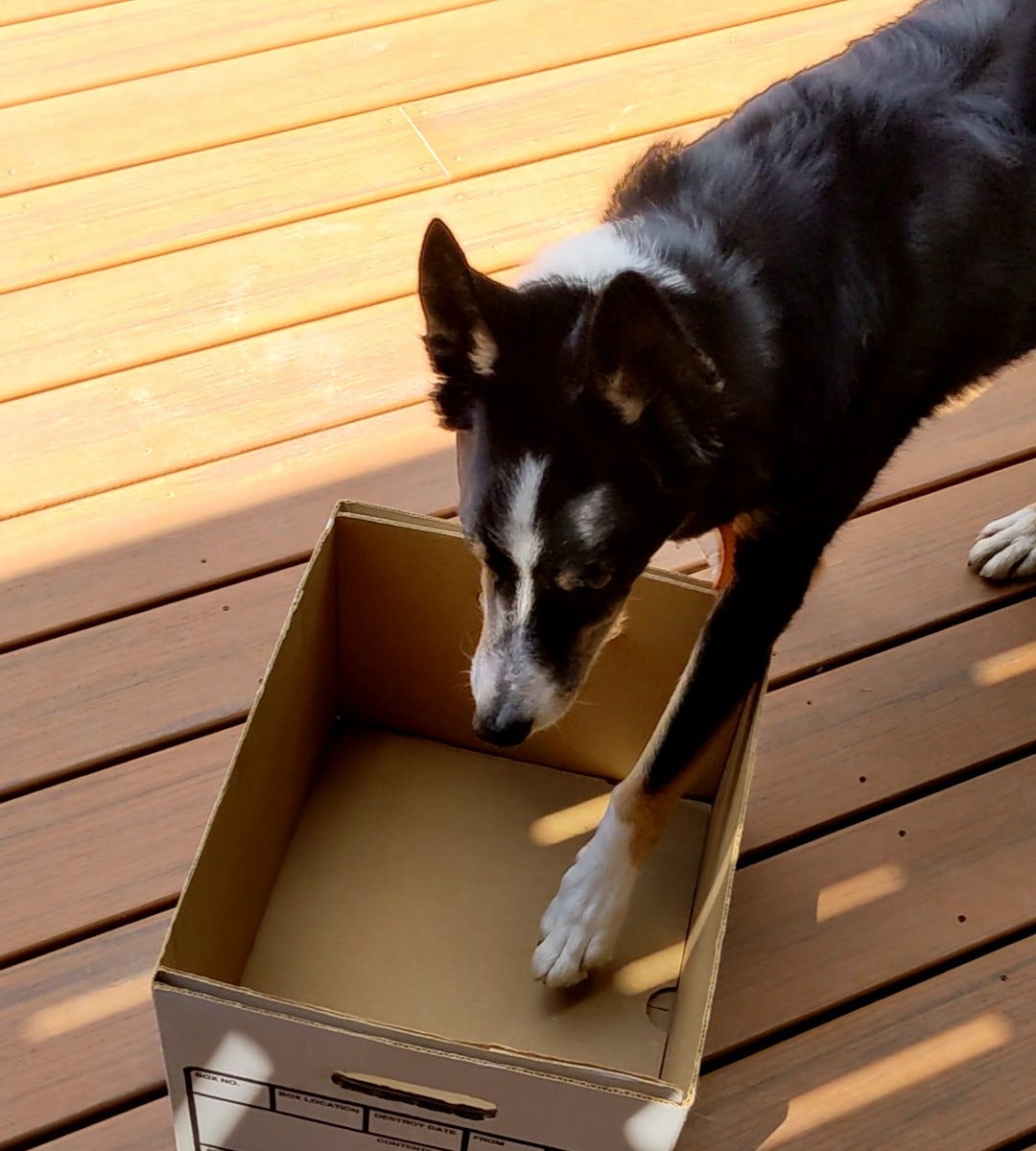
Once a dog has caught onto the game of doing-something-for-a-treat, this is where shaping gets fun. Now you’re going to raise your criteria for the click. Rather than stagnate at that one level of behavior, you’ll expect further progress. If your dog was looking at the box for a reward, wait until he sniffs it to mark the behavior. If he was sniffing it, put it a little farther away and wait until he steps toward it. If he was already stepping toward it, wait until he paws at it. Then until he puts a paw inside the box. Then two paws, then … you get the idea.
There are two important things to remember about this stage of shaping: (1) it requires great patience to wait for your dog to try something new, and (2) if your dog gives up or goes into mental meltdown, you’re raising the criteria too fast.
Tock tries a different trick in the hopes that it’ll earn him a treat. It doesn’t.
If you’re a writer, these things might sound familiar. You know the tremendous patience and dedication that it takes to craft a story. You know just how much you can push yourself toward your goal without becoming overwhelmed and demoralized—and stop writing altogether (like 99% of people who say they’ve got a novel inside them to write, but then never end up writing it). You learn your craft in stages, you write some, you learn how to read your material critically and perfect what you’ve written. Eventually, you will write a complete work and be able to type THE END. Only now can you label it for what it is: a story!
Likewise, a trick that a dog learns through shaping only gets labelled once it’s complete. Your dog not only hops eagerly into the box, but stuffs himself into successively smaller and smaller boxes until he’s performing the behavior you had in mind all along. “Box!” you might call it, or “Get in!” You’re ready to ask him to repeat the performance in other places, with other boxes of various shapes and sizes, and you’re reasonably confident that he’ll do what you ask.
Best of all, shaping has created a thinking dog, who voluntarily offers harder and harder behaviors all along the way to the finished product. He knows that when you get out your clicker and your treats, all he has to do is start offering behaviors and he’ll figure it out. Training him to do other tricks becomes an easy feat.
Success: all the way in!
Though the book we want to write is bound to take longer than the trick we teach a dog, we too can use the principle of shaping to simplify the process. All we have to do is start with an easy goal, accomplish it, and move on to something harder. We’ll learn how to write the first description of setting, dialogue, backstory, action … and keep upping our skills so we can write more. We’ll knock off the first page, first chapter, midpoint, climax, book. And because we’ve taught ourselves how to do it, why stop with one book? We can do it again, and again, and again…
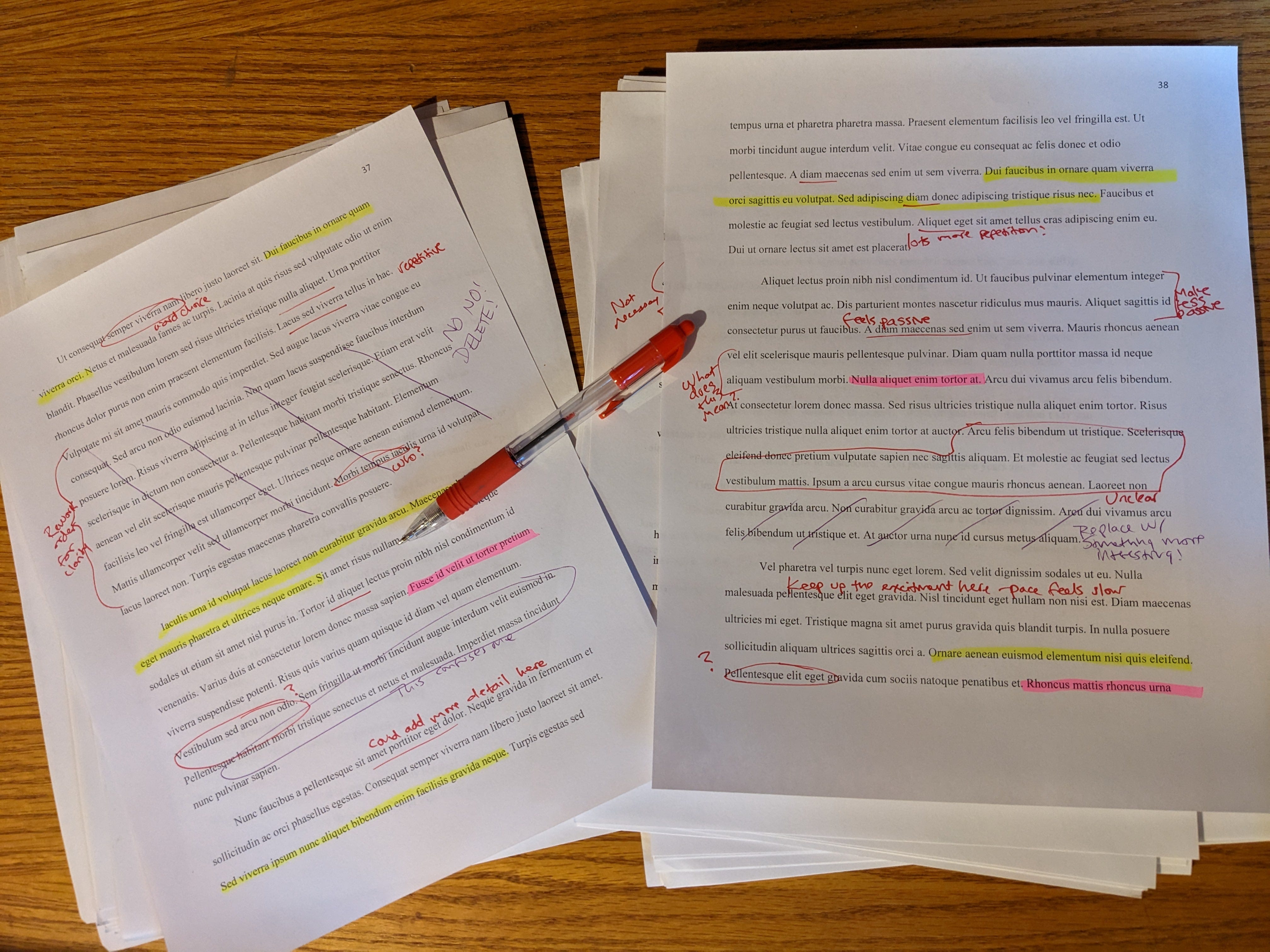
Kill Your Darlings! All of us writers have heard the phrase countless times. It refers to one of the primary steps of revision: trimming the excess away from your manuscript, getting rid of unnecessary dialogue, long descriptions, excessive “telling” (rather than “showing”), superfluous scenes, redundant characters. Eliminating these things is fantastic because it helps you tighten your plot lines, increase clarity, and reduce word count, all at the same time.
But it’s hard. These sections that you wrote are called “darlings” for a reason. You’ve possibly spent hours tweaking a particular phrase to get it perfect, so its lyricism and insight will reverberate through your readers hearts and minds for eons to come. Or perhaps a section came to you all at once in a moment of genius inspiration. And it’s gorgeous. Profound. It’s everything wonderful—except that your editor or beta readers or critiquers think it’s in the way. It slows the pace. It’s inconsistent with everything else that’s going on in the story.
When I wrote my first Middle-Grade manuscript, it was far too long. 138,000 embarrassing words long, in other words! But even more embarrassing was that I wasted time lamenting to other writers and even professionals that there was no possible way I could shorten it. I’d already gone through multiple drafts, scouring for places that didn’t feel like they belonged. In what alternate universe could I ever whittle the thing down to the 50-65,000 word maximum expected for an MG fantasy? J. K. Rowling wrote long books—why couldn’t I?
Answer 1: Sorry, you’ve only got the one universe, as far as we know. And you’re not J. K. Rowling. You’re gonna have to deal with it.
Photo credit: Greg Rakozy
Answer 2: If you’re a debut author trying to publish traditionally in this universe these days, you might be able to break a couple tiny rules, but not the Word Count Rule. Not until you’re superhero famous and people will greedily buy everything you write, even if it’s longer than Encylopedia Britannica.
Ah, if only I’d thought to look to my dog for answers. Dogs are absolute masters at killing their darlings. Think how many fluffy squeaky toys you’ve purchased over the years for your canine companion. And then think how many you’ve purchased again because the first one got destroyed. Sometimes I think dog behaviors have evolved purely to speed up the rate at which they can find a squeaker and eviscerate a toy to get it out. This also goes for the tag on the back of a toy, in my dog’s case (his favorite predatory activity, however, is giving the “death thrash” to his Bungee Ball).
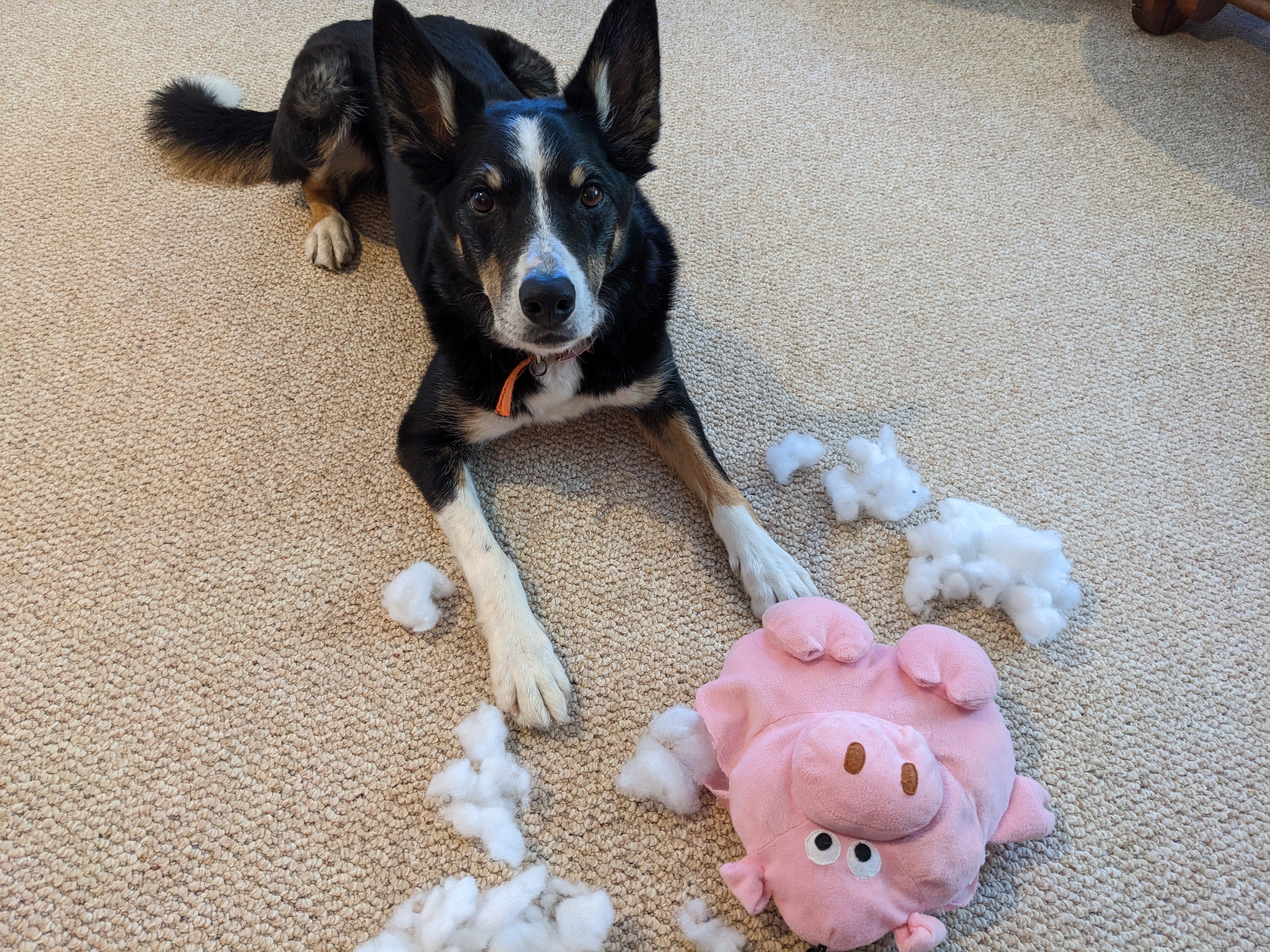
Tock is quite proud of this pig that’s been de-fluffed, de-squeaked, and de-tagged. Though in fairness to him, his former siblings were responsible for the first two things.
As a long-time dog owner, I’ve at last come up with some strategies for how to part with those ill-fated “toys” of yours (i.e., the parts of your story that people you respect have circled with a red pen, scrawling next to it either DELETE, Consider removing, or Necessary? depending on how tactful they felt like being).
1. INCINERATE. Sometimes there’s no hope for these toys because they’re so utterly torn apart. You have to throw them in the trash. This is akin to a phrase, scene, or character in your book that truly deserves to be deleted forever. Maybe you once thought it beautiful, but upon further examination you discover it’s actually full of cliches, stereotypes, repetitive language, and boring verbs. It’s so bad it’s not even fixable. Select and delete, the sooner the better. Like ripping off a band-aid. It can actually be fun, if you channel the joy your dog obviously feels in yanking out the stuffing and flinging it all over the living room. Does he show remorse? Generally not—merely satisfaction at a job well done.
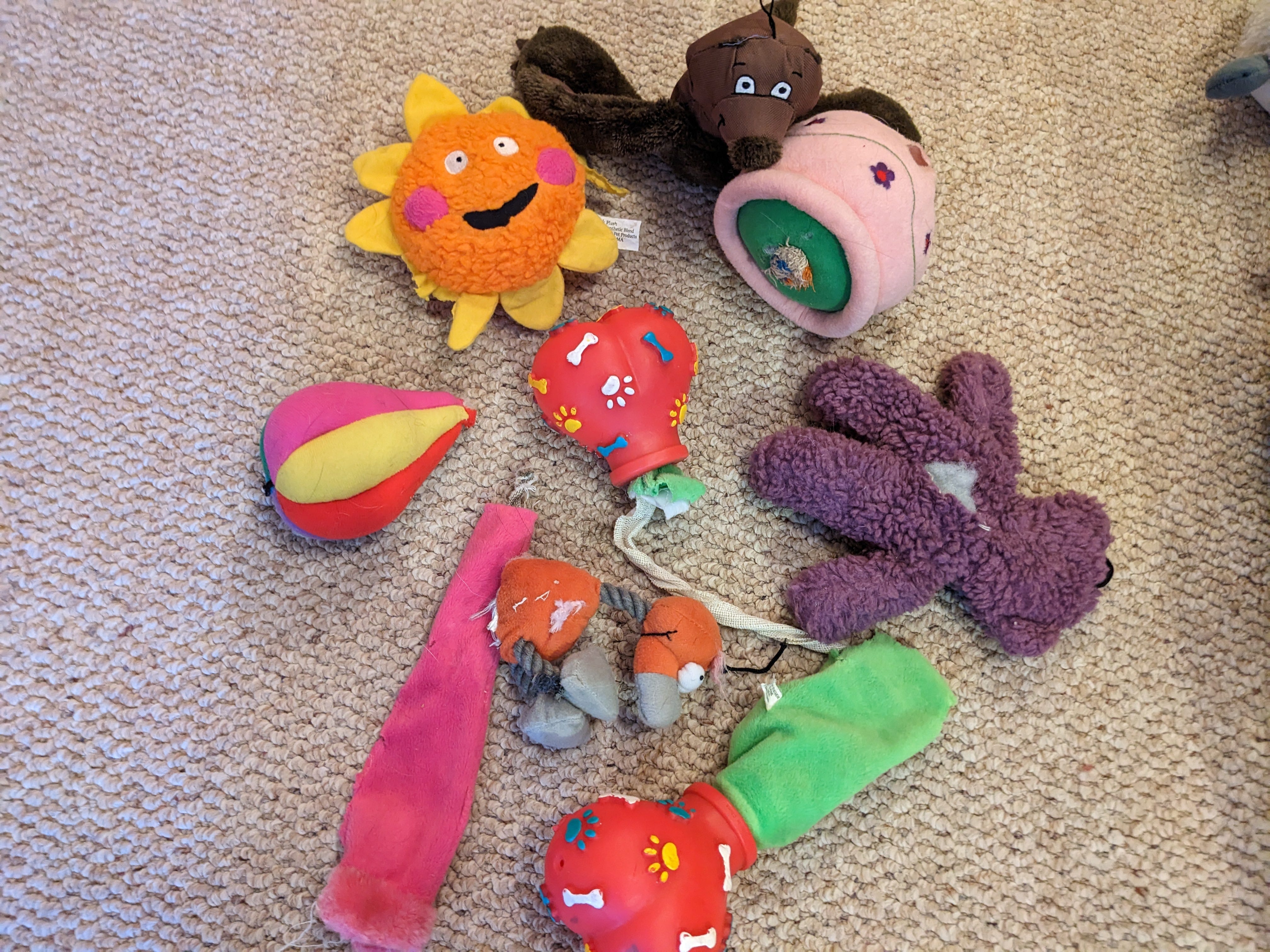
A few of the toy remnants in Tock’s collection
2. RETAIN HOPE / SAVE FOR LATER. Some toys might survive the onslaught. Maybe they only have a tiny tear in them, and if you hide them for a little while, your dog will forget that he initiated the supernova process once long ago. I frequently snatch a toy from the jaws of death and hide it in the bottom of my dog’s toybox. Sometimes he ferrets it out again right away, but often he forgets about it for a while, allowing both of us to pretend it’s still alive, somewhere. This is similar to taking your lovely snippet of writing and storing it in its own little file. Call it Precious Fragments, Scenes for the Sequel, Deleted Info that I Cannot Bear to Part With, call it what you will, but something about knowing it’s still out there can make the process less painful.
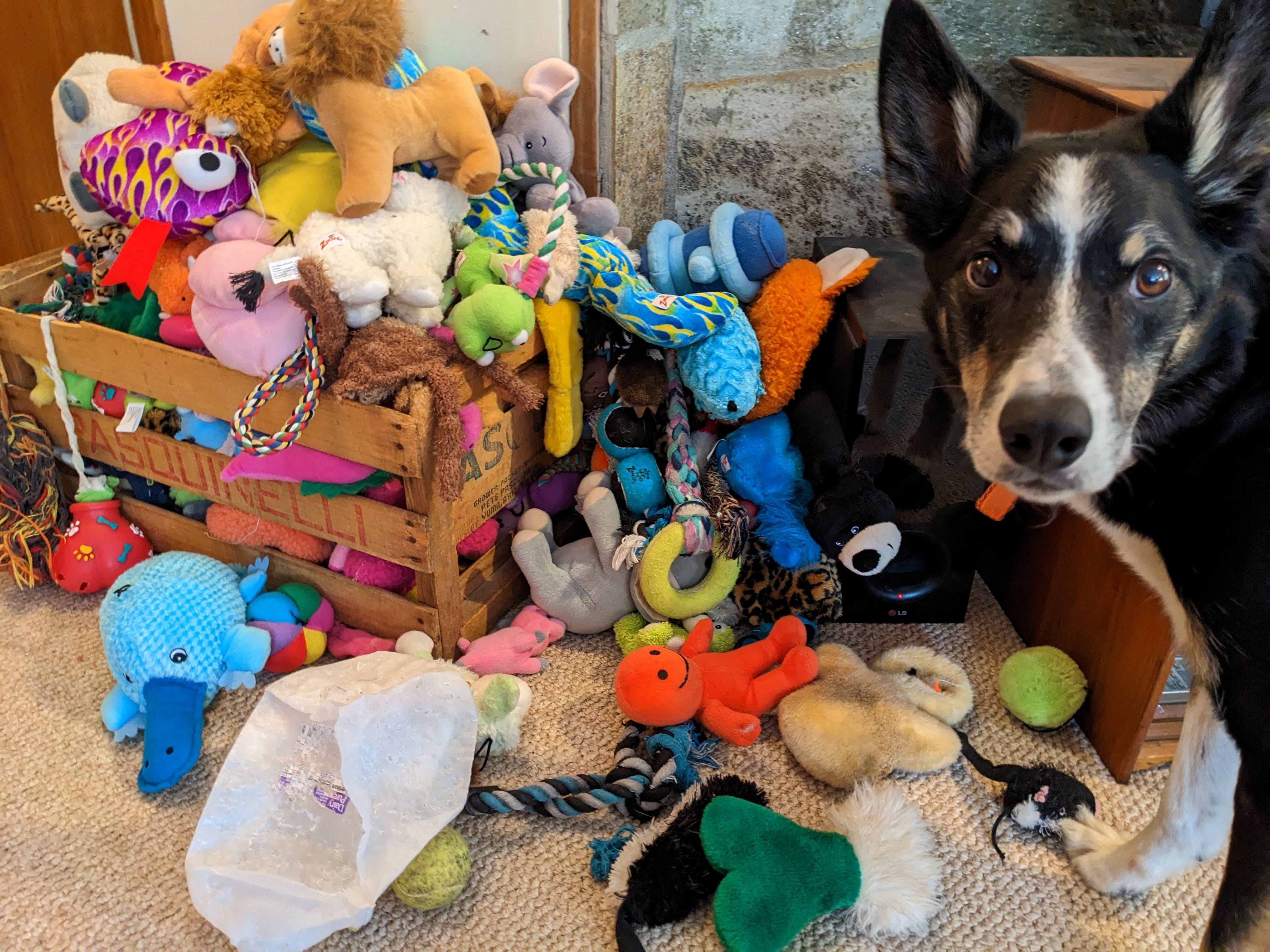
Tock’s toybox (Note: most of these toys were prizes from agility competitions, not purchases!)
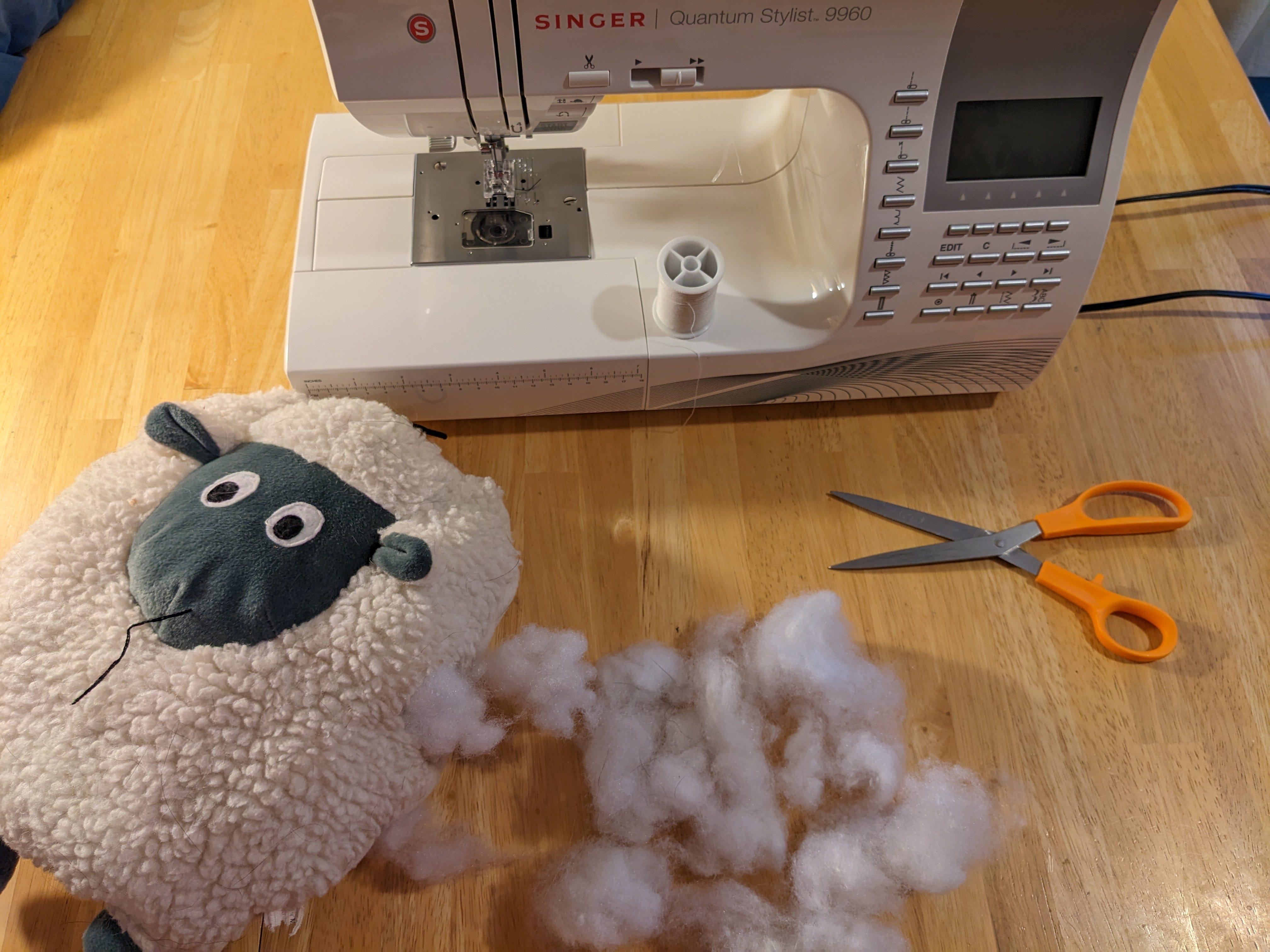
3. FIX? I put a question mark here because I’m a terrible seamstress. Sometimes I’ll try to handstitch toys back together, but they never last very long. As for writing, fixing can work well if the extent of the damage was small and only requires some re-wording for better clarity, or a little bit of reduction to avoid repetition. But in my experience, large-scale fixing almost always shows up in the story as a patch job. If you have a character that’s not needed, for instance, no amount of alteration to their personality is going to rectify the situation.
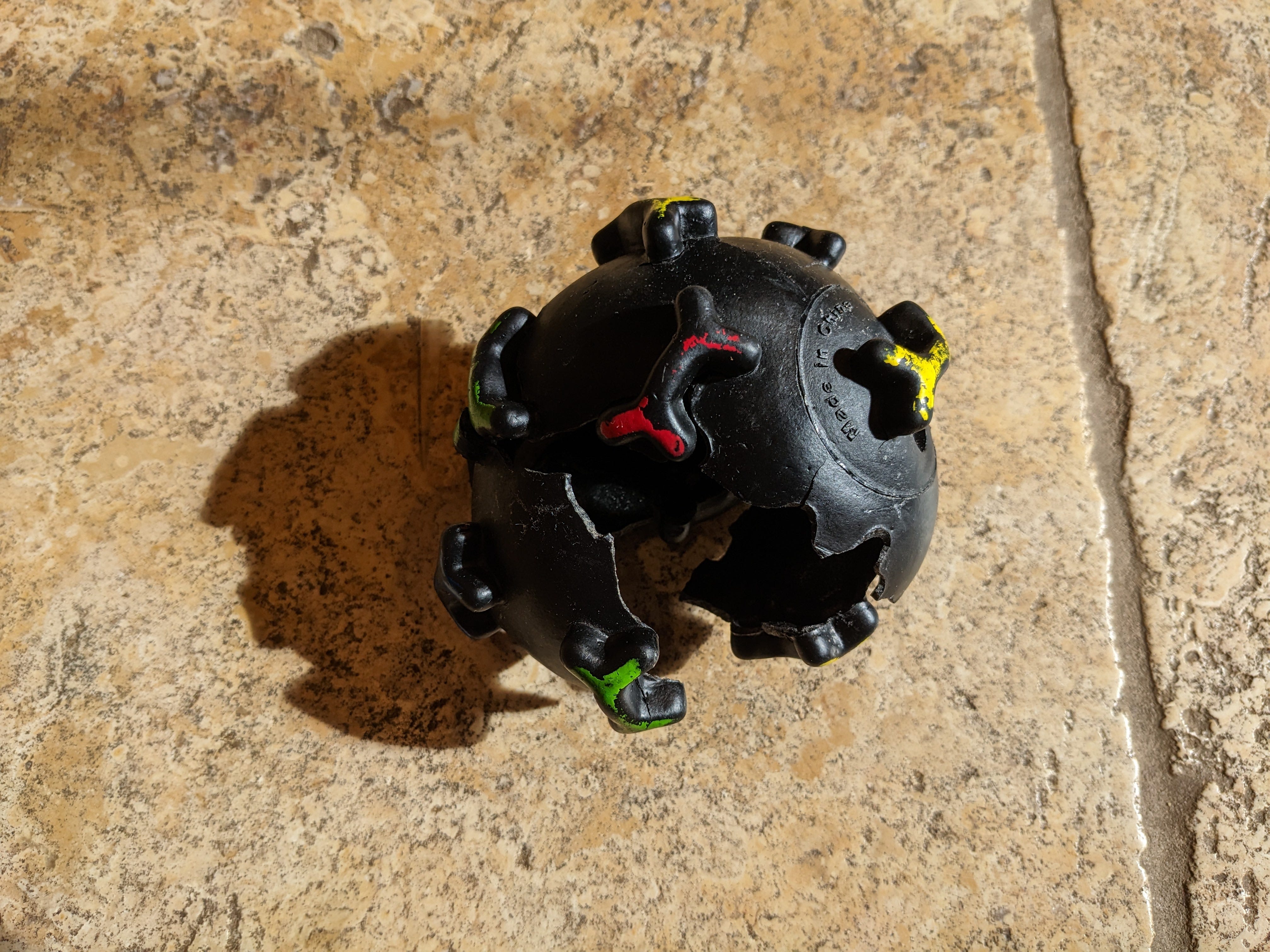
4. USE ELSEWHERE. Occasionally, a toy survives against all odds and finds a new life—not as the toy it once was but as something new. My dog, for instance, has a particular talent for recycling squeaky balls that long ago lost their squeakers and are so broken they resemble nothing more than a tattered piece of plastic. He’ll mouth them back into a rough ball shape and hold them carefully so as not to destroy their faint likeness to a toy—even though he knows he can no longer play with them in any way but a gentle game of tug (note: I would never let him do this if he had any inclination to ingest bits of plastic). Just as I love how Tock can recycle his toys like this, eking every bit of life out of them, I adore finding a new home in my story for those favorite-but-dysfunctional phrases. With careful insertion into just the right place, whether it’s one or ten chapters later, you may be in luck at saving some of your darlings from annihilation in this way, too.
Tock’s beloved Bone Ball – broken but still gently used
5. REPLACE WITH SOMETHING SHINY & NEW. When more than half of my dog’s squeaky balls have reached the broken-plastic phase, I take pity on him and get him a new one. Or two. Or three. This doesn’t stop him from playing with the bits of plastic (unless I subject those to Strategy #1), but he plays with the new ones more. This goes for writing, too. You can re-use phrases in different places all you want, but what do you do with the gap they left behind? Sometimes simple deletion doesn’t work. You need to come up with a new gem to put in its place. Just make sure to run it by your critiquers to see if they think it’s a keeper this time.
New squeaky balls!
The final word of wisdom I’d like to part with is that nothing lasts forever. Not toys, not pet phrases. And the more you look at a selection of your writing, the more you or someone else is going to find wrong with it. Revision is a terrific tool—my favorite part of writing, actually—but there is such a thing as too much of it. Give your specially crafted phrases a round with your most trusted critique partners and professionals, and at some point … make the decision to accept that final version. Then there’s nothing left but do query / publish (topics for another day), and sit back and enjoy it!
My dog agility students know the answer to this one!
When I take on a new dog-handler team to teach them the sport of dog agility, I start by describing some different scenarios and posing the question: Which of the following dogs do you think is most ready to compete?
(1) A dog who moves at a medium pace through the course, mostly doing the obstacles in their correct order, but who keeps putting its nose to the ground to sniff things and trots right past some obstacles.
(2) A dog who’s super eager to work with its handler, though so quick to make decisions about where to go that it occasionally knocks a bar or has a wrong course (i.e., an obstacle inserted incorrectly into the sequence)
(3) A dog who’s even quicker than #2, but so fast that it flies off the teeter without waiting until the teeter touches the ground (thus breaking a safety rule), after which it zooms around the perimeter of the ring without taking the rest of the obstacles.
(4) A dog who takes all the obstacles in their correct order at a slow trot and wins the blue ribbon for having a clean run.
If you answered #4, you’re not alone. Most of my students give this answer, too. But in my view, you’re wrong. The correct answer is #2—the eager dog who makes mistakes. Here’s why: that dog exhibits a motivation to do what its person wants that none of the others has. It might make some mistakes, but it possesses a spark of life that not even the slow, accurate winner of the class displayed. It has drive.
It’s my firm belief that the agility teams who end up being happiest doing this sport—whether or not they ever compete—are the ones who’ve been trained in what I call the DASH principle. This is a simple acronym in which D = Drive, A = Accuracy, S = Speed, and H = Habitat, and it embodies the essence of dog agility. Drive gives you a motivated, happy dog. Accuracy gives you a dog who can do all the obstacles in correct order without knocking bars, jumping off teeters, refusing obstacles, taking incorrect obstacles, or accruing any of the many other possible faults. Speed gives you a dog who zips through the course well below the time limit. And habitat means you have a dog who can generalize and perform obstacles in different locations with all sorts of distractions around the ring (other dogs barking, children running, food everywhere, you name it). Learn the components in the proper order, and you’ll have a fun canine partner who loves bounding through a ringful of obstacles as much as you do (note: you don’t actually get to do the obstacles).
But this bears repeating: you must learn DASH in order. Train your dog to do simple tricks with drive before you do anything else. Soon you’ll be able to raise the difficulty level of the “tricks,” and voila, you have a dog who can accurately perform the weave poles, or the teeter, or any of the other obstacles. As your dog gains confidence, so will its speed. And finally, you’re ready to take your dog on the road and test its skills in new habitats.
Now, back to the question that has plagued writers through the ages (or at least as long as agents have been a necessary part of the traditional publishing process): what do those agents want, anyway?
After attending more query, pitch, and submission workshops than I can count, and after celebrating friends and colleagues who have managed to land an agent, I think the answer lies within the principles of good dog agility training. Agents are looking for drive. They’re looking for a premise that is so motivating to them personally that it stirs their soul. Sure they appreciate a writer with excellent (i.e., accurate) technique who has clearly spent years studying the craft and has polished their submission materials to a brilliant sheen. Sure, they respect a writer who’s got the speed of mind to have other projects in the works. And of course they like a writer who has the potential to show their book to as wide an audience as possible (i.e., many habitats).
But an agent needs that drive above all else. Without the spark of a premise that interests them, they’ll never read past the query letter to the first page. And with it, they’re willing to overlook a lot of mistakes. They know they’ll enjoy the story so much that they won’t mind working with the author as long as it takes to make it as good as it can be. Their goal? A book that wins the blue ribbon not for plodding correctly through all the steps of Writing 101, but for its heart, its intrigue, its fascinating portrayal of life in all its messiness.
If we compare the agility dogs that have the D in DASH to the books that are lucky enough to obtain an agent, they have one thing in common. They’re fun! Not in a comedy sense (unless the book is a comedy, of course), but in the sense of having heart and soul. They’re fun to watch run at an agility competition, or fun to settle down with on the couch and read. They’re not always error-free, but they’re as enthralling as a musician who sings or plays their heart out, not caring about the occasional wrong note. To me, they’re like the opera tenor Placido Domingo, who sings with a fervor and intensity that stirs my heart even more than the pure and perfect tones of Luciano Pavarotti.
Photo credit: Gwen King
If I raised a few brows by daring to elevate any singer above the great Pavarotti, I meant to. That’s because the appreciation of drive in someone else’s work is subjective. Very subjective, especially when it comes to the creative arts (books, music, etc). One agent might be completely unmoved by your work, while another is almost instantly ready to fly with it to the moon and back. But your chances of finding any agent are going to increase enormously if you revisit your premise, your query, and your characters and look for heart, passion, and purpose every step of the way. Something that elicits those feelings is gonna be far more stirring and memorable than a perfect performance.
And I’m fairly certain a lot of those agents might just happen to agree with me.
Or: How Your Character Can Keep Things Interesting
When I’m walking with only my dog for company, as I usually do, I become lost in thought. My feet trace the circuitous paths they’ve taken so many times, while my brain goes off on whatever wild tangents it chooses: What am I going to do about that plot hole in my WIP? … that was such a funny story on the radio … better remember to add red pepper to the grocery list … how can I make my antagonist more villainous? … what exactly are we going to have for dinner—
And then Tock barks at a squirrel and I return to full consciousness, back in the present. But unless I’ve made it out of the trees to a place with a view, the strange sensation of having no idea where I am sometimes sweeps over me.
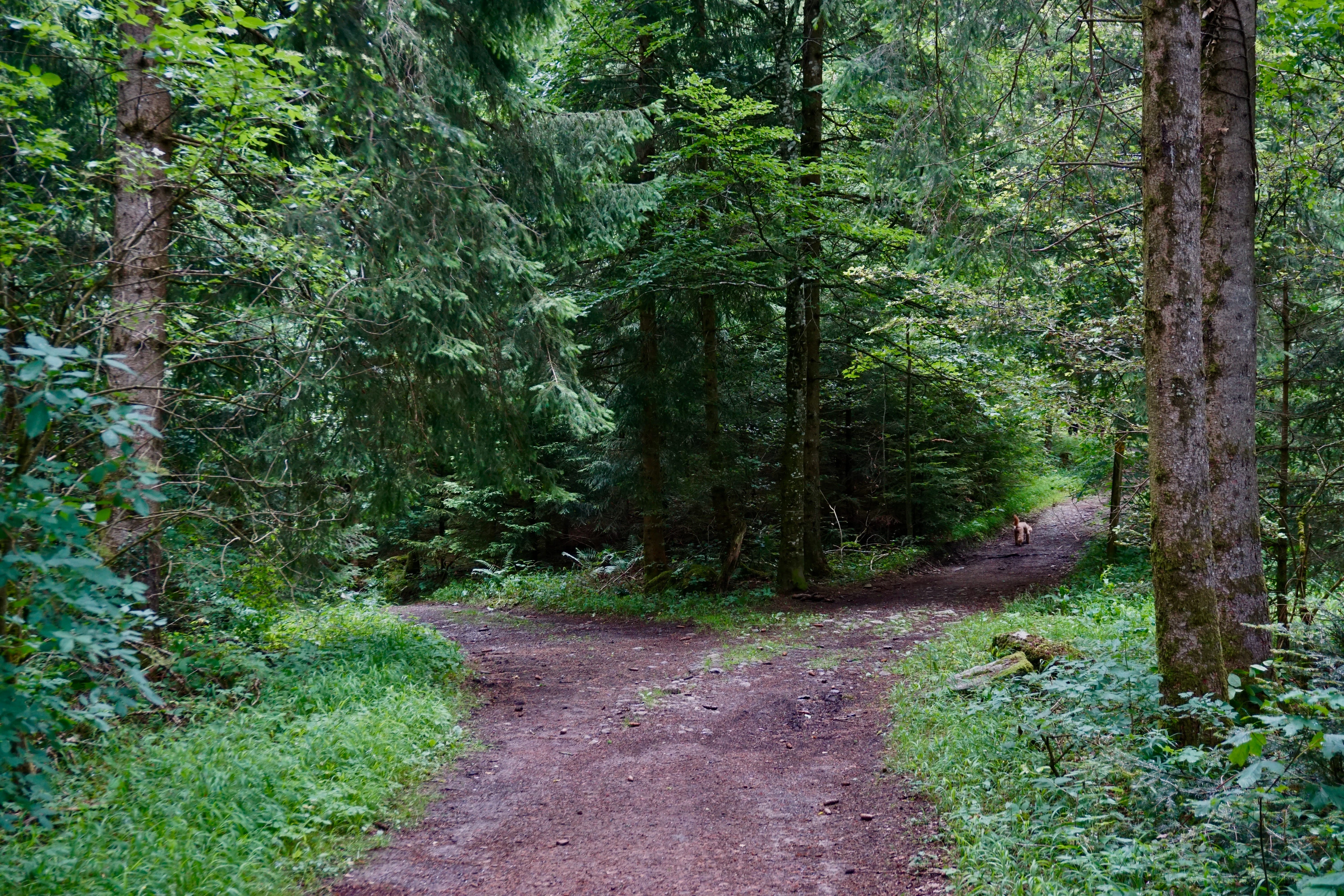
Let me put your concern that I’m a victim of amnesia to rest. I always know which general trail system I’m hiking in. Based on how sweaty and tired I am, I also know whether I’m still heading up to my destination or down toward the trailhead (except for the rare flat bits, it’s gonna be one of those two things). But the trails in the woods near me are plentiful and have a way of looping, branching, and re-connecting as if they can’t bear to stay apart from one another for too long. Every now and then while I’m in my semiconscious mode, I’ll even follow my dog into a wrong turn—not because he doesn’t know where to go, but because he enjoys taking little detours to explore scents or find an especially big, prickly pine cone for me to throw for him. On a wonderful walk with my dad (and dogs) once, we were so immersed in conversation that we failed to pay attention at a critical junction right near the trailhead. We ended up actually repeating a large portion of the entire walk before we figured it out (this was a flattish trail, or we probably would have noticed sooner).
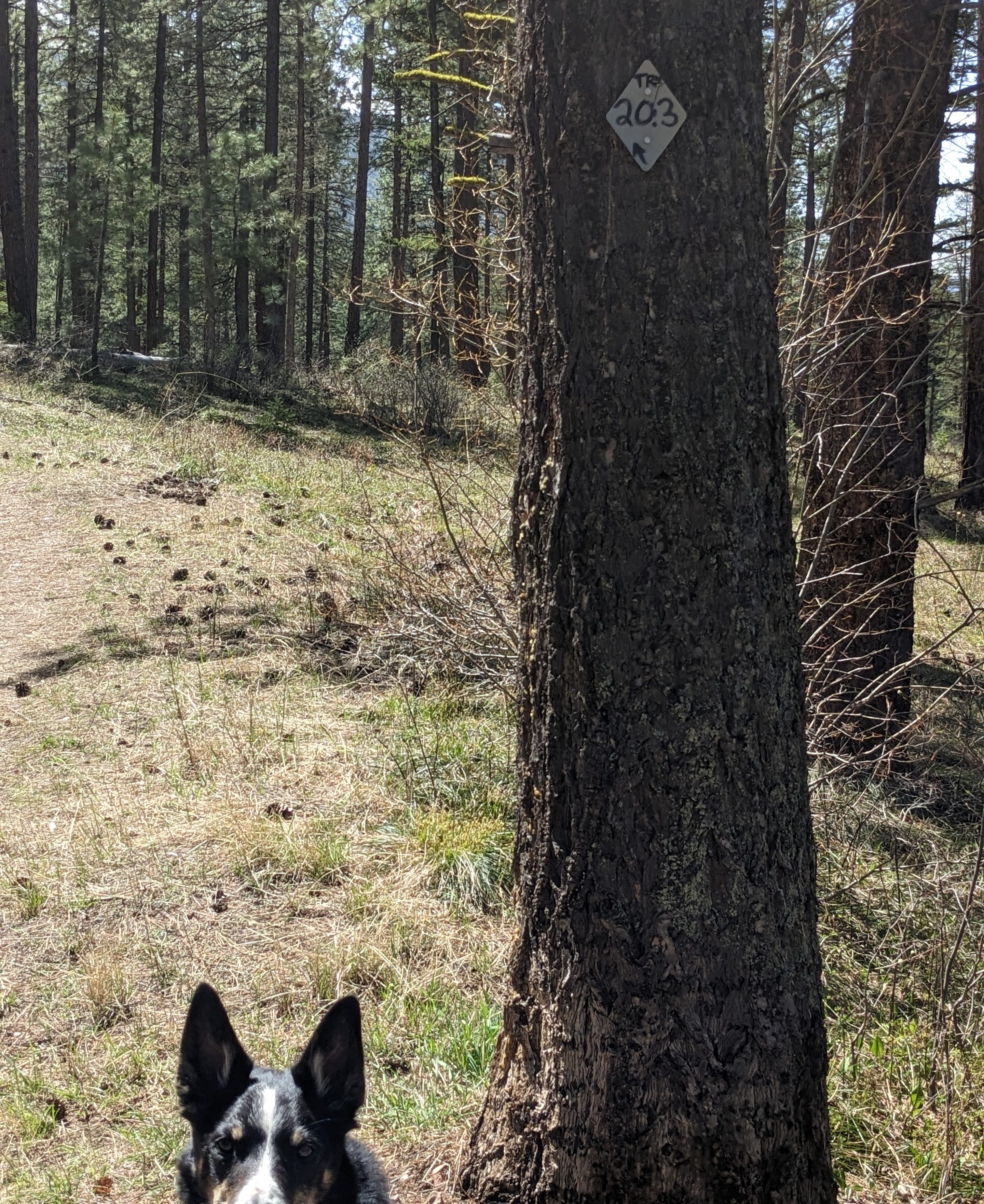
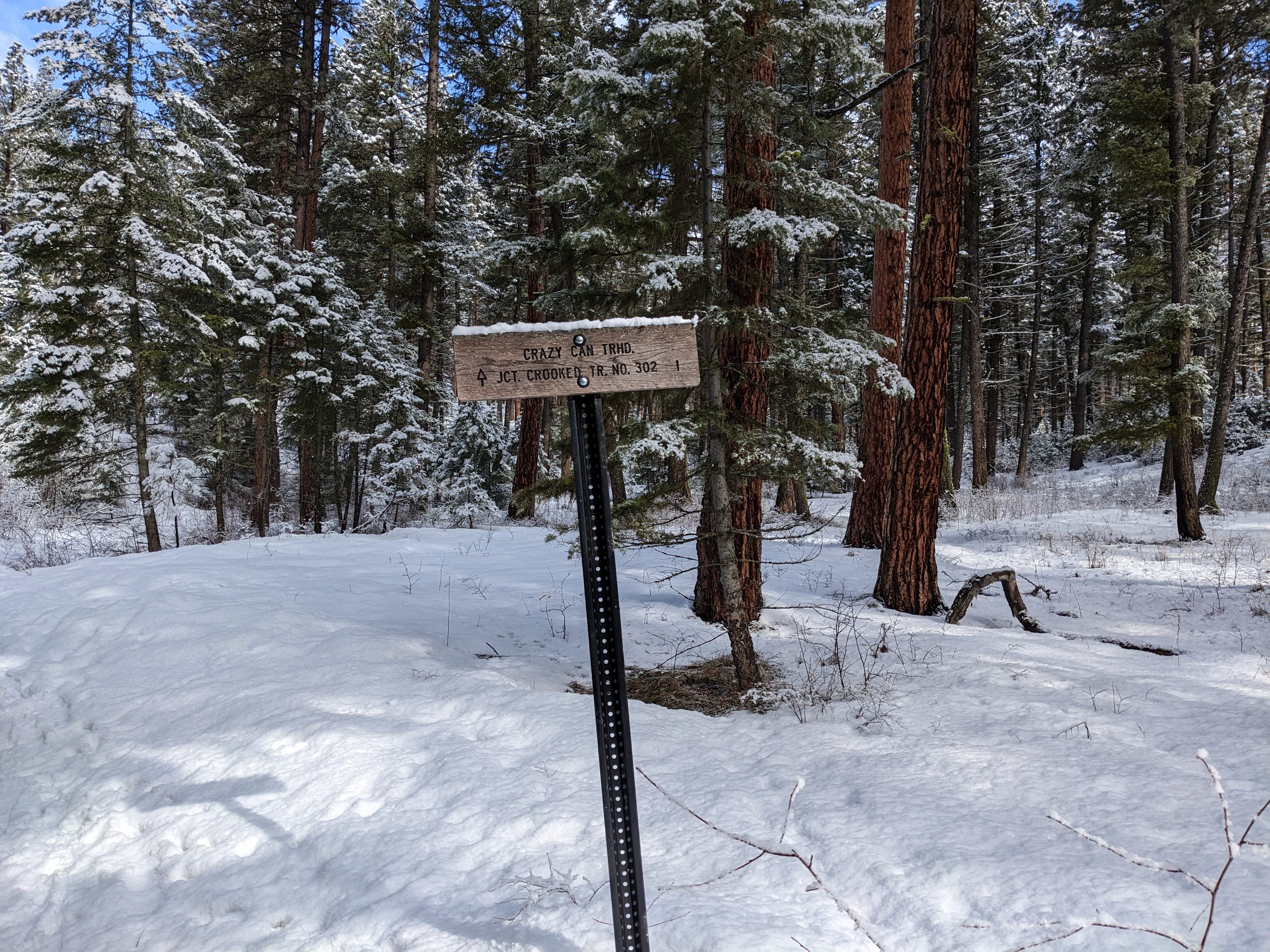
After I’ve “come to” and returned to reality, I tuck my confusion away and simply keep putting one foot in front of the other. I study the plentiful pine, larch, and fir trees on both sides of the trail and the even-more-plentiful needles at my feet, trying to figure out exactly which section of the trail I’m on. Did I pass the third junction already, or am I still on the second? Am I almost back to the car or do I still have a good half hour of walking ahead of me? The occasional trail signs posted on trees are spectacularly unhelpful because they often appear to have been conjured by someone who doesn’t believe in whole numbers.
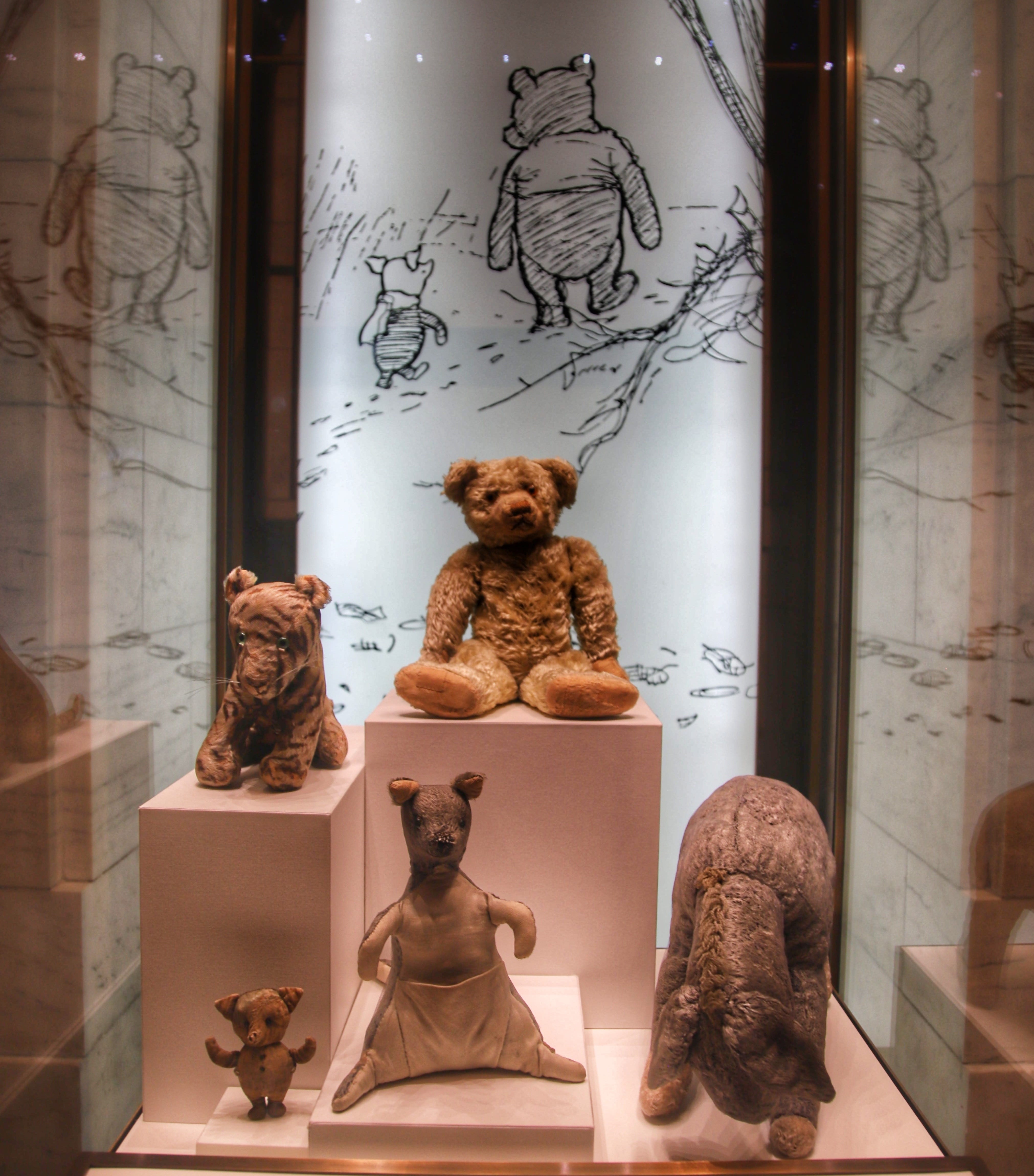
Questions about my location flit through my head, but they don’t alarm me. On the contrary, I revel in the feeling of not knowing, however briefly, where I’m going and what decision I’ll need to make at the next trail junction. I’m on a real adventure now! This chance to walk on an “unknown” path is such a rare opportunity in our GIS-programmed, cell-phone-connected, social-media-spiderweb of a world. On that memorable walk with my dad, I remember looking at the view with new eyes, certain it was a section of trail I’d never seen before, providing a glimpse into an unknown and unexplored valley. I experienced the thrill Winnie-the-Pooh and Piglet must have felt when they stomped around and around the same tree searching for the Woozle, finding more and more footprints the farther they went.
Photo credit: Bernd Dittrich
All too soon, usually before I get to another fork in the trail, my sighting of a particular leaning tree or a hollow stump will jog my memory and snap, I’m back in the 21st century, with a walk to complete, errands to run, and people to see. My pace speeds up and my imagination dims.
But it doesn’t have to. As writers, we are lucky beings. We can allow our characters to take us on the path less traveled every time we whip out our pen and notepad, or sit down at our computer to write. This is true no matter whether we write free-form, with no idea what’s going to happen until the words start to flow (aka “pantsing”), or whether we prepare a detailed outline, with all of our plots, subplots, and setting and character details listed before we write a word of the story (aka “plotting”). In either case, all we have to do is follow our characters when they exhibit an inclination to head somewhere new.
I’m a fanatical plotter. I spend at least a month preparing an outline for a new novel. But my characters—sometimes the protagonist, sometimes secondary figures—never fail to surprise me by taking directions I didn’t anticipate. All I have to do is stay relaxed and keep my organized conscious mind out of the way long enough that I can listen to them. And if they choose to detour for just a moment from the reality of the plot, or if they head off on the path overgrown with weeds, I’ll walk right along behind them.
It’s possible it’ll be a dead end, and my characters and I will need to backtrack to the plot I’d already envisioned. But on the way, you can bet we’ll see some fascinating things and we’ll learn a little more about one another. We might even receive a jolt of adrenalin from looking at the view in an entirely new way, counting two Woozles instead of only one, or maybe, frighteningly, two Woozles and a Wizzle. When I return to my outline, I’ll happily revise it to accommodate this new vision for my story. It’s always more interesting than the one I started out with.
So my questions for you, Dear Writer, are these:
1. Which way will your character take you at the next fork in the trail?
2. Will you let your guard down long enough to find out?
3. And if it’s the path less traveled—will you allow yourself to take it, too?
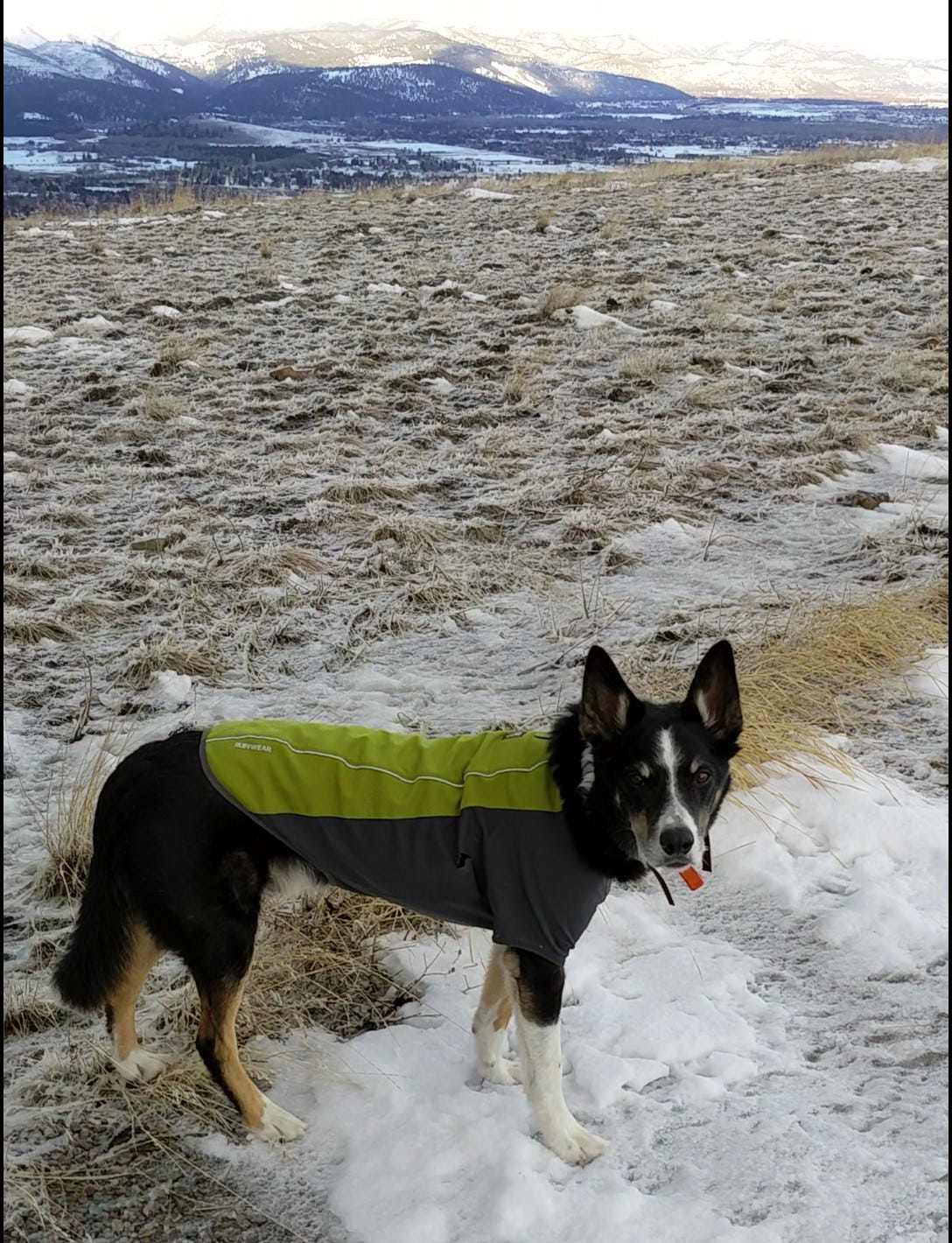
You might think I’m a fashionista based on how much I like to dress up my dog. Trust me, his clothing is for functional purposes only. Tock has short fur and in below-freezing and snowy conditions, he starts lifting up his paws from the cold if he’s not wearing a jacket. And as for the fact that he currently owns five jackets, this is because all but one were inherited from the dogs in our household who came before him.
But when I think of Tock, I don’t consider what jacket he’s wearing, or if, in fact, he’s wearing anything at all. Instead, I recall the intent expression in his eyes as he switches his gaze back and forth between me and the object he wants me to throw. I think of his confidence when his ears and tail are upright, or his fear when he runs up to me, ears pressed back, tail between his legs. His boastfulness (and naughtiness) when he leaps up on me to show off the latest pinecone in his collection. His happiness to see me when he “grins” as I come in the door. His obsessive desire for toys exhibited by pawing at something, though often the thing he’s pawing isn’t the thing he actually wants. His desire to be as big a pest as possible and get me to pay attention to him either by standing at my elbow while I’m typing, or by diving between my legs while we’re on a walk. I’m not sure what he’s thinking when he sings along to my son’s clarinet and saxophone, but he’s adorable nonetheless.
“I’m so happy to see you!”
In short, my dog is way, way more than just a jacket. He’s got more aspects to his personality than he has nicknames (thirteen at last count, way too corny to share). All of his actions and feelings add up to make him who he is: the incomparable, totally unique Tock.
I hope all this talk of Tock has got you thinking about the characters who are important in your own life. Of course, if you’re a writer, this includes the cast of people, animals, and possibly other creatures that occupy your stories. By making them unique, you’ll turn them into personalities that readers will fall in love with and will never forget.
When I reflect on the book characters who are most memorable to me, certain aspects of their natures stand out. The spirit and love for family that young Joseph Johnson displays in Dan Gemeinhart’s Some Kind of Courage. The courage and resourcefulness of the “skinjacker” Allie in Neal Shusterman’s Everlost. The loyalty of Tock in Norton Juster’s The Phantom Tollbooth. (Yes, I named my dog after him.) I could go on and on about characters in lots of Middle-Grade books (the genre in which I write), but it’s true for all the other genres I enjoy reading as well.
My favorite kid book ever, largely because of its extraordinary characters
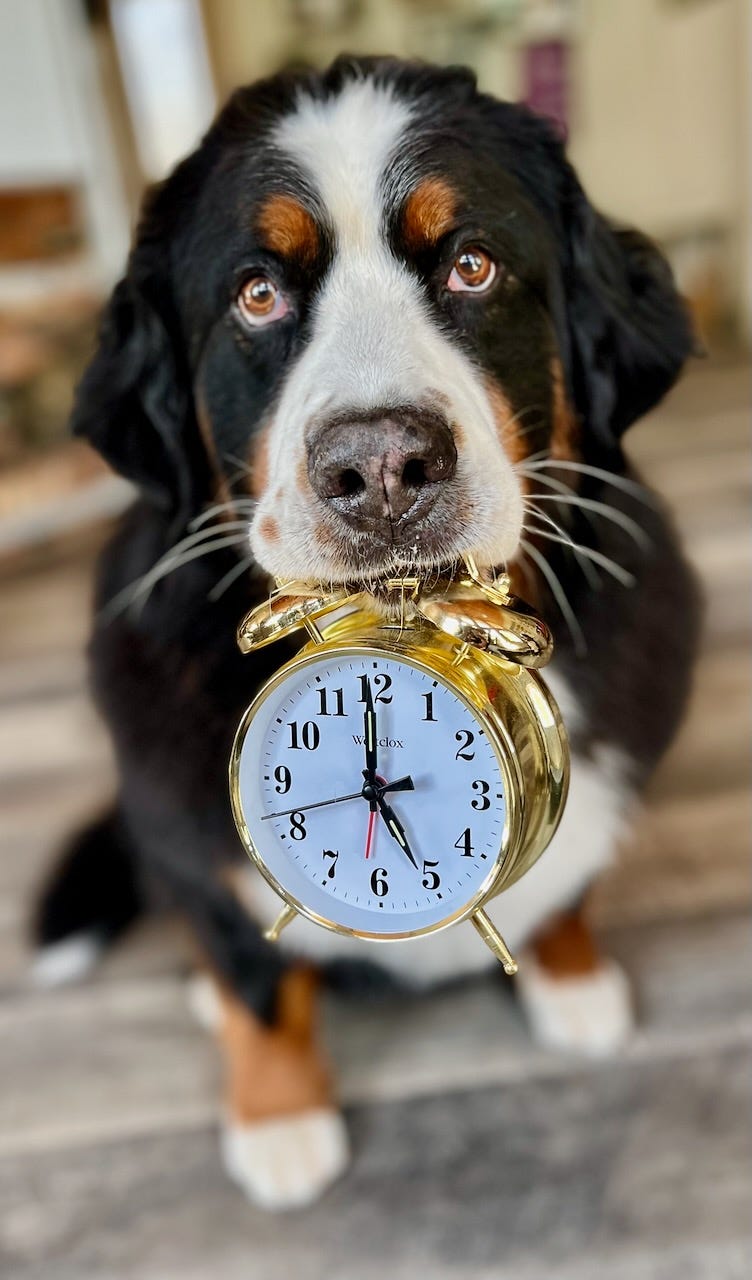
One thing is constant. Even if I last read a book years ago, the thing I remember most about its characters is their temperament: those parts of their nature that make up their identity. I have no recollection of what they looked like (well, except for the dog with a giant clock embedded in his side. Kind of hard to forget that). I don’t remember what sort of clothing they wear, the color of their eyes, the length of their hair, the shape and size of their body—unless these things featured in some important way in the plot.
NOTE TO WRITER SELF: Avoid description of what a character looks like unless absolutely necessary! If you must, include the briefest possible mention of it. Concentrate instead on how a character acts and speaks.
To be fair, I must return to the subject of dog jackets. Tock’s puffy red one, for instance, has special significance to me because it used to belong exclusively to his older sister Moth. By the time she died, the zipper was broken and the whole thing really wasn’t functional anymore. Yet I couldn’t bring myself to throw it out because it made me feel as if I were losing Moth all over again. Not only is it quite useful for Tock as an inner layer when the temps dip into the teens, but putting Tock in it made me feel a lingering connection to my dear departed girl. And who knows, maybe he retains some fleeting memories of her every time he wears it, too. So when my husband (a master sewer in addition to being a master engineer) replaced the zipper and gave it to me, it was the best present I ever got. That jacket is much more than a jacket. It’s a symbol.
The red jacket reminds me not only of Moth, but of a time when all three of my dogs walked the woods with me.
SECOND NOTE TO WRITER SELF: Symbols can include items of clothing, along with many other things.
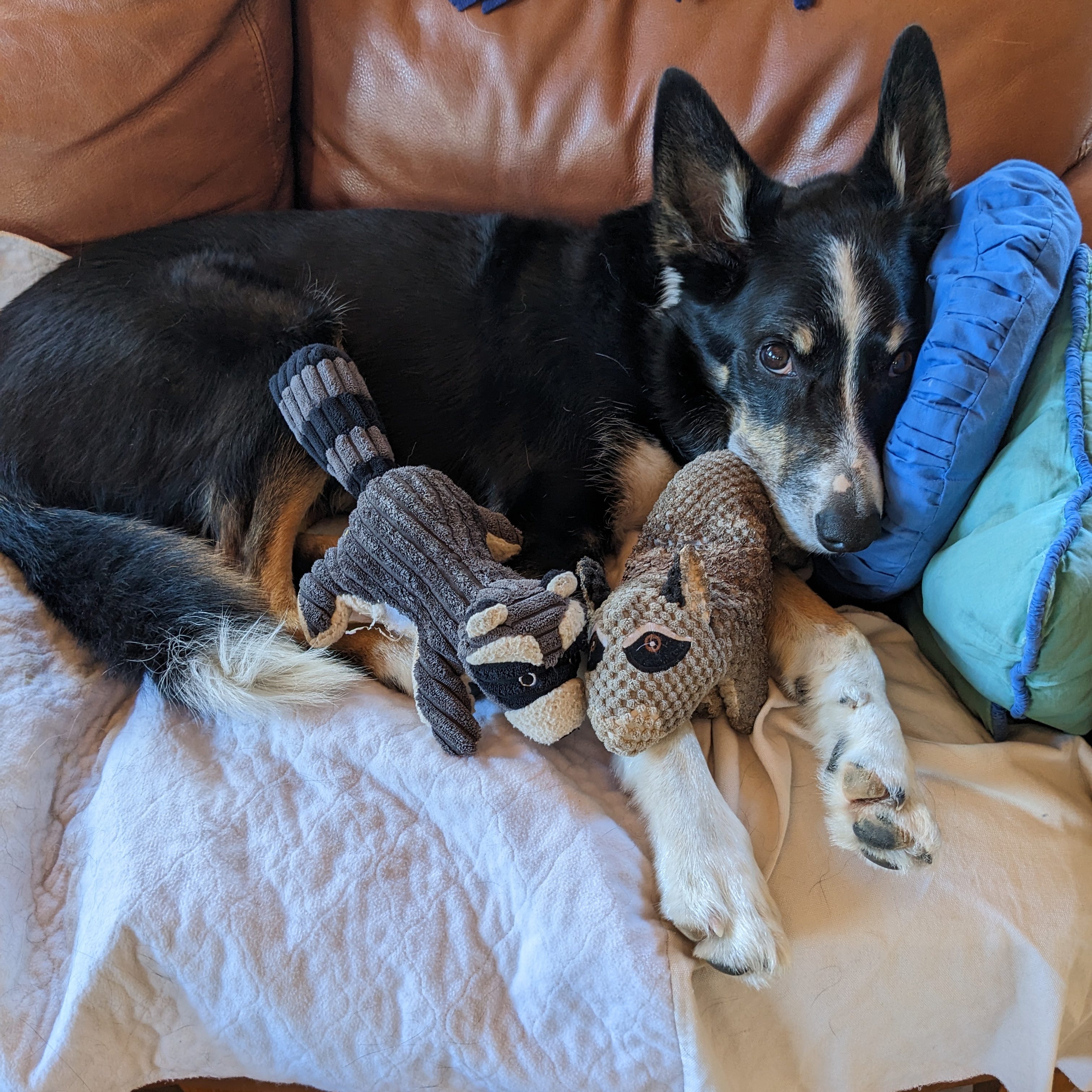
Oh, come on, you might be thinking. Do dogs really understand symbols? Now that Moth’s scent is long gone from that jacket, Tock may not think of her anymore when he wears it—but I sure do. And be assured that Tock has plenty of other symbols in his life that he does understand. His pinecones, tennis balls, frisbee, and sticks all symbolize “work.” His rubber chicken, squeaky balls, and fluffy toys symbolize “play.” His bedtime racoon squirrel symbolizes “comfort,” as do the pillows he likes to rest his head upon. His button board represents a selection of the words that are most important to him (note: the ”Love You” button is wishful thinking on our part, as Tock only likes to engage in affection for about five minutes per day, total). As a whole, these things represent Tock and his world, and if I think of any one of them, I immediately think of him.
Here reclines the “Prince of Pillows,” along with Racoon Squirrel and its less successful replacement, Rocket Racoon.
So when you craft your characters, make special note of the things that are important to them, of the physical mannerisms they engage in when they’re feeling a certain way, of the way they speak to others and the way they think to themselves. To quote Salman Rushdie, characters are “inexhaustibly interesting.” But it’s up to us to write them into a three-dimensional reality that’s as full as it can possibly be.
If my dog yips or twitches when he’s got his eyes closed, I can be fairly certain he’s dreaming of chasing something. Other than that, I have no idea. Thank goodness I have the power to reveal this sort of interiority in my characters.


















 Flights of Fancy