The mundane things that give me hope when I need it most
Three per day, I’m told.*
Write them down. Doesn’t matter how ridiculous, how real, how important to anyone but you. If they bring you some degree of happiness, they deserve your recognition.
Like swallowing daily pills, capture your observations. Any spark of interest, any surge of hope: jot it down. Here’s my list for a week in May.
1. The nightlight’s pattern on the wall
2. Waking up: wow, I was able to go back to sleep after all
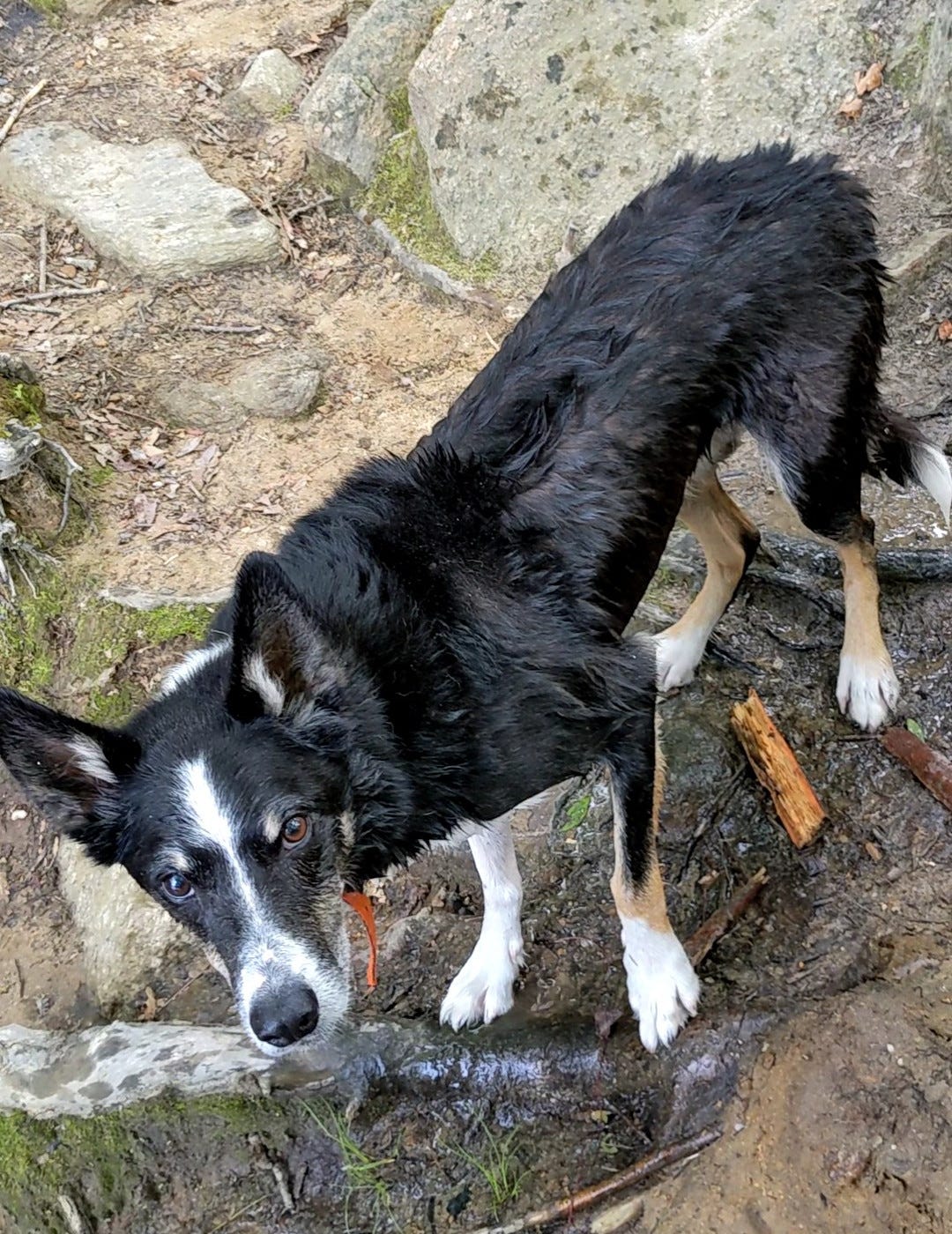
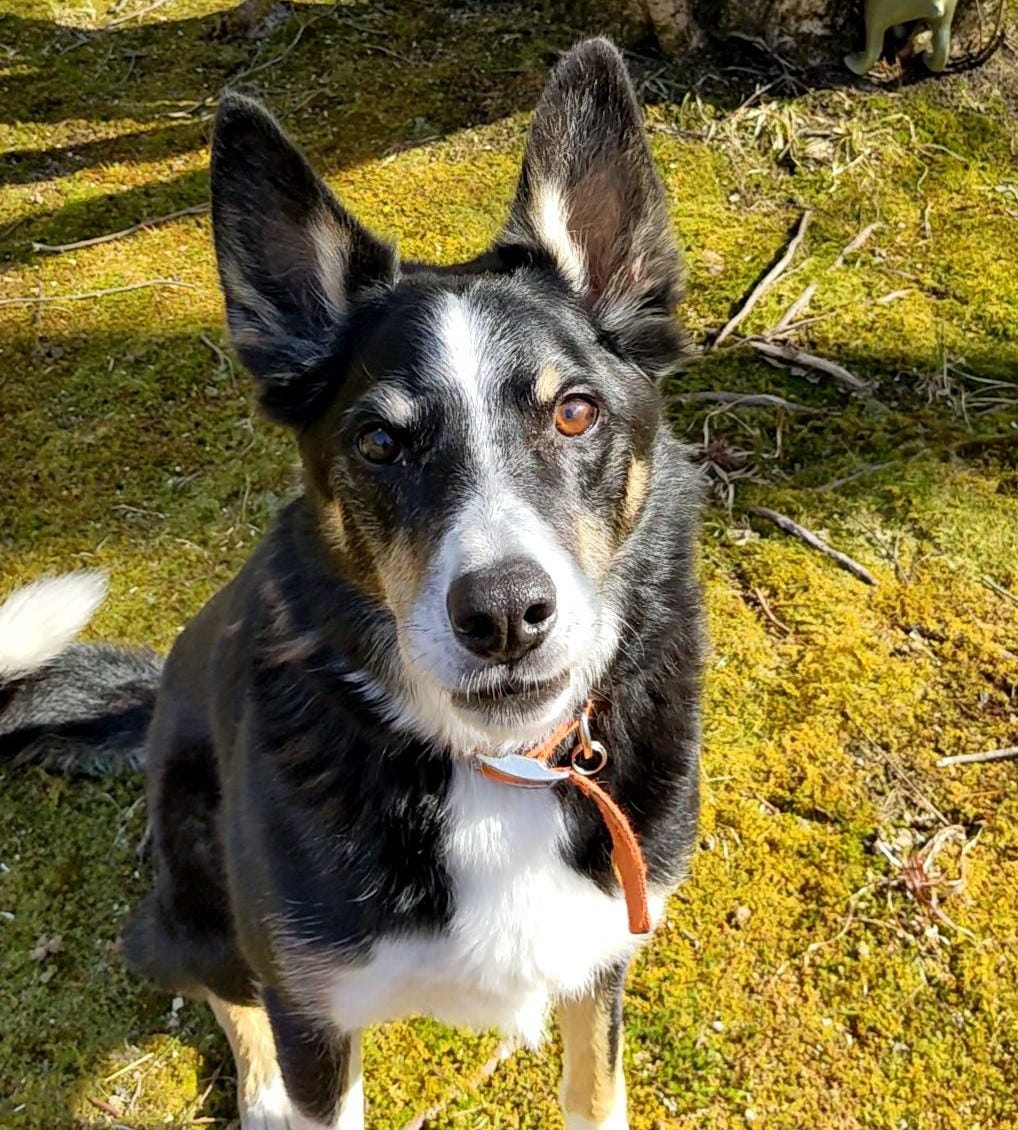
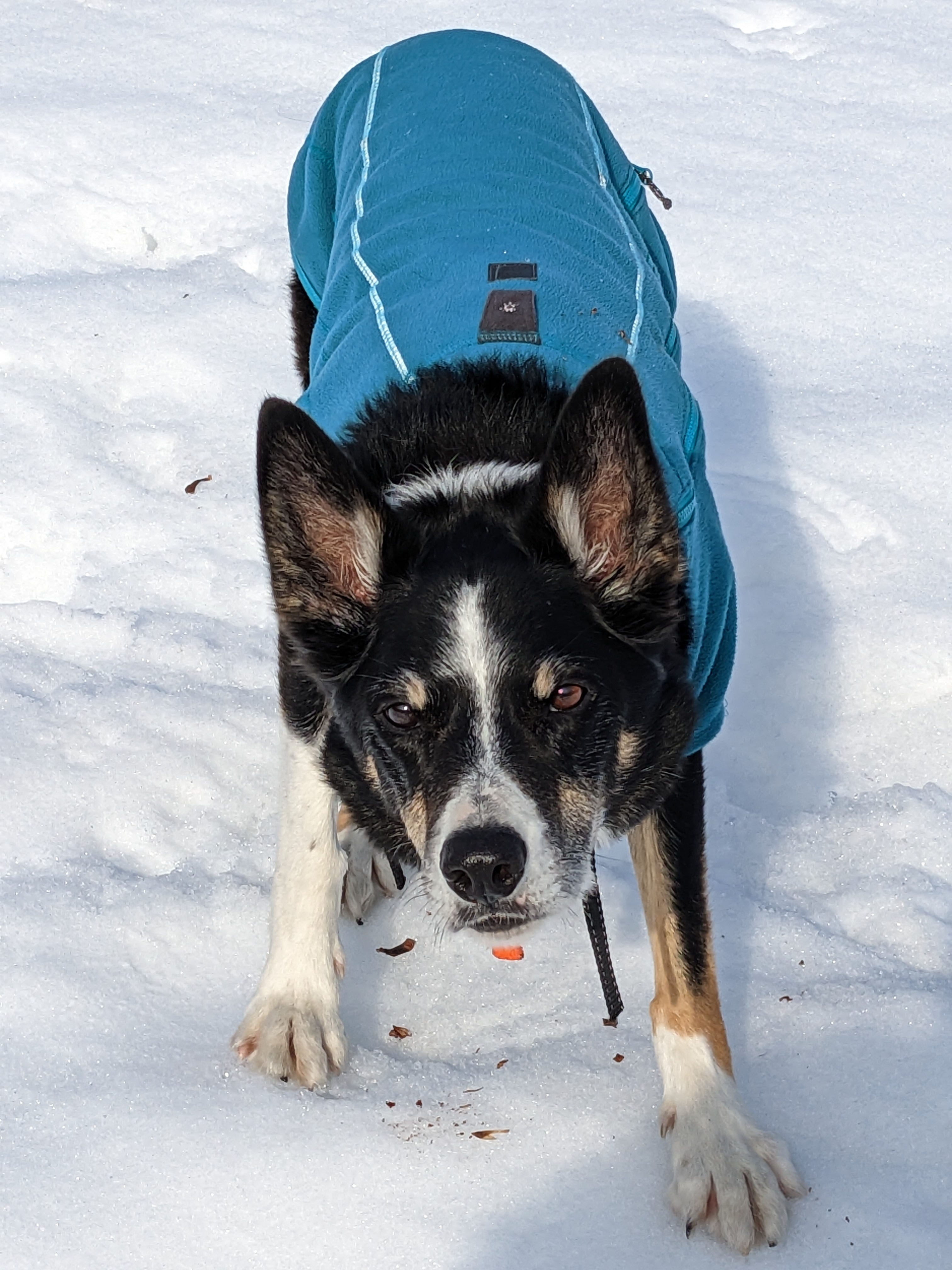
3. Dog watching me, always
4. No gloves!
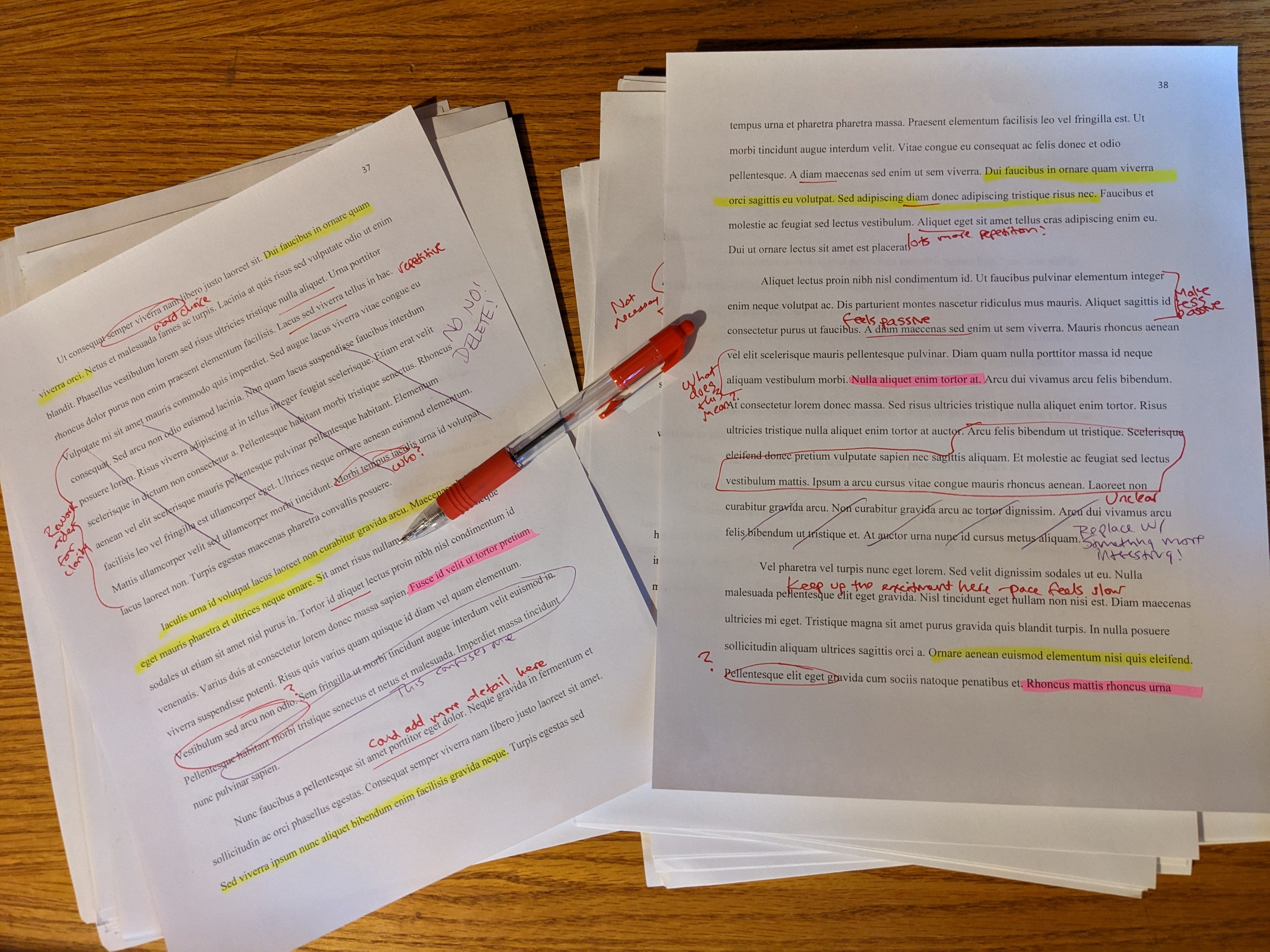
5. Edits to make on a manuscript
6. Leaves four times bigger than last week
7. Blender clatter: oats + water = oat milk
8. Wiggly lamb tails
9. Flash of orange: an oriole on the picnic table
10. Small red frog in the brown leaf litter
11. Reading a chapter of my recently completed story: I like it!
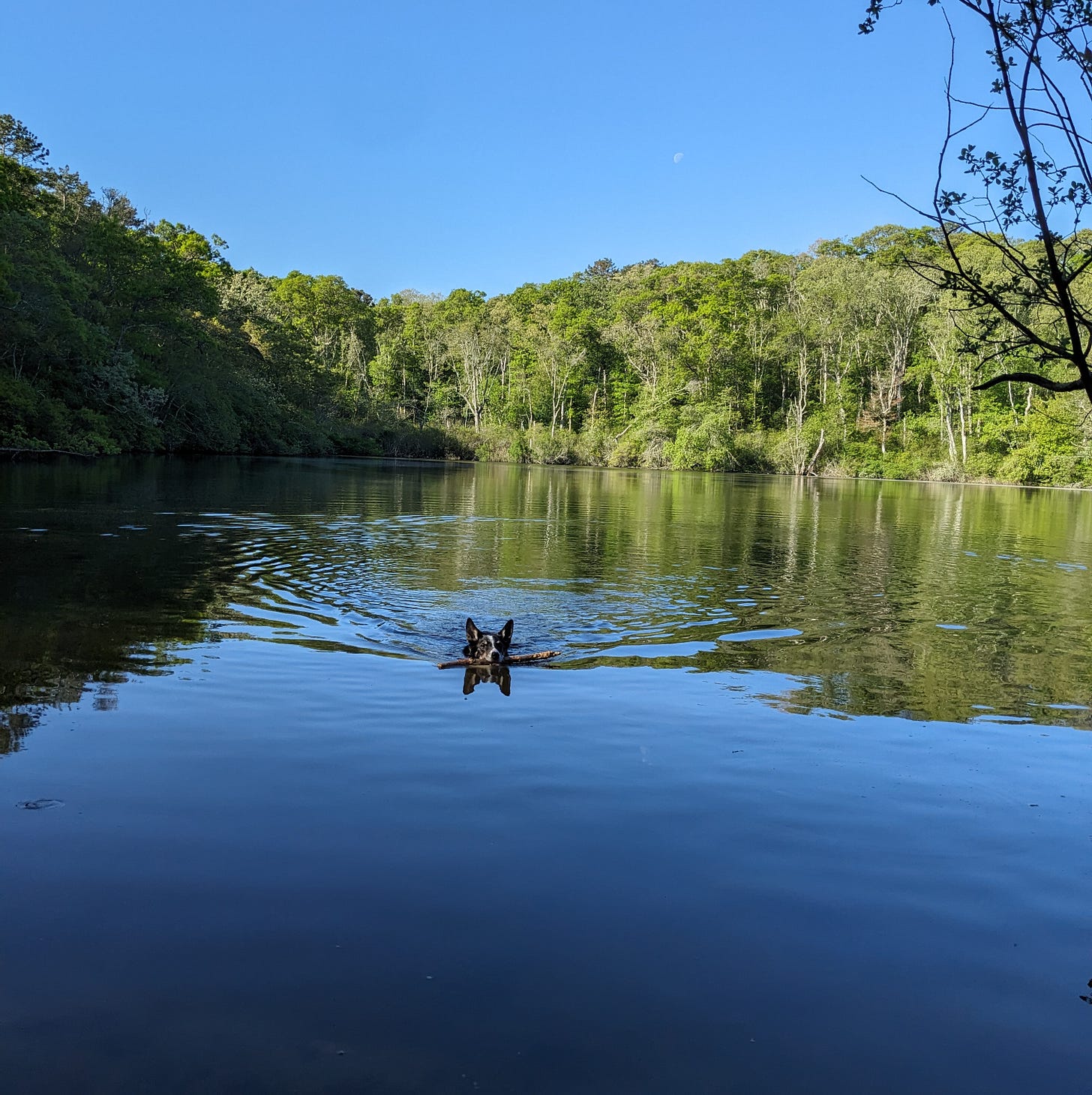
12. Greenery ringing the pond
13. A pair of curious otters poking their heads from the water
14. The chocolate-rich aroma of spring soil
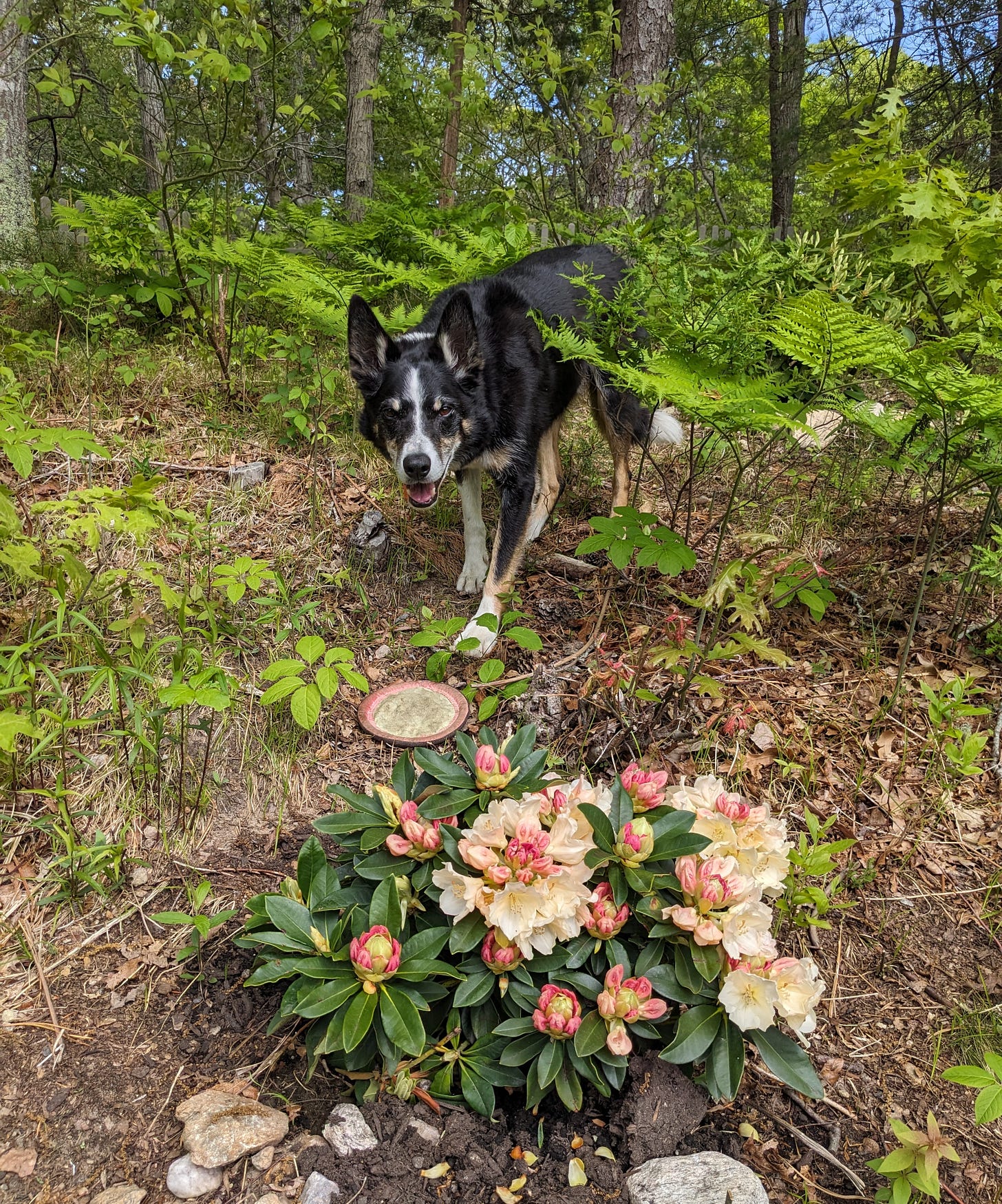
15. Watching the rhododendrons bloom
16. A query, successfully sent into the ether
17. A card game with my son: this time I will win
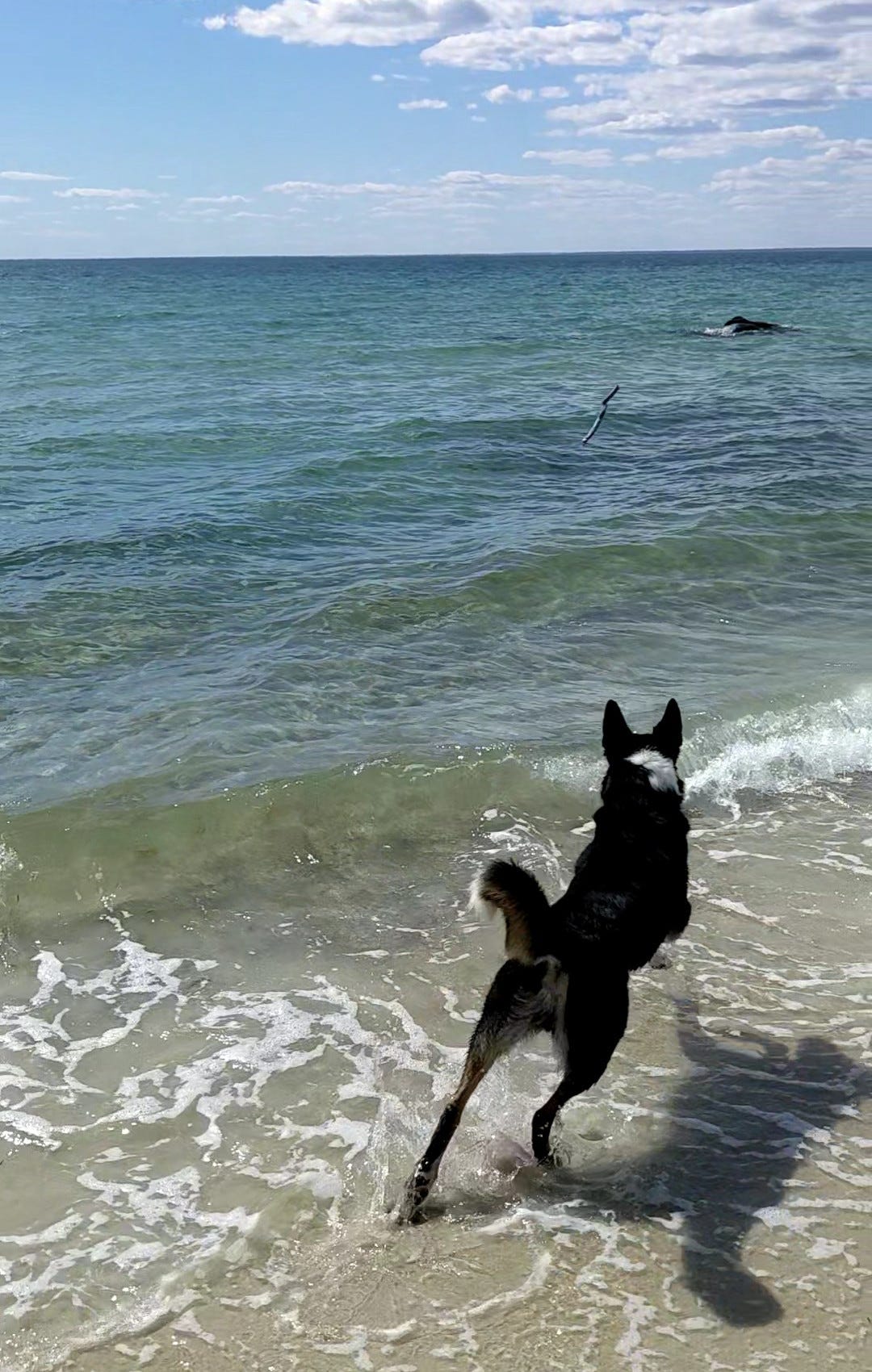
18. The pride of owning a big stick … for a couple minutes
19. Scrabble with my husband: this time I will win
20. Curling up in bed to read
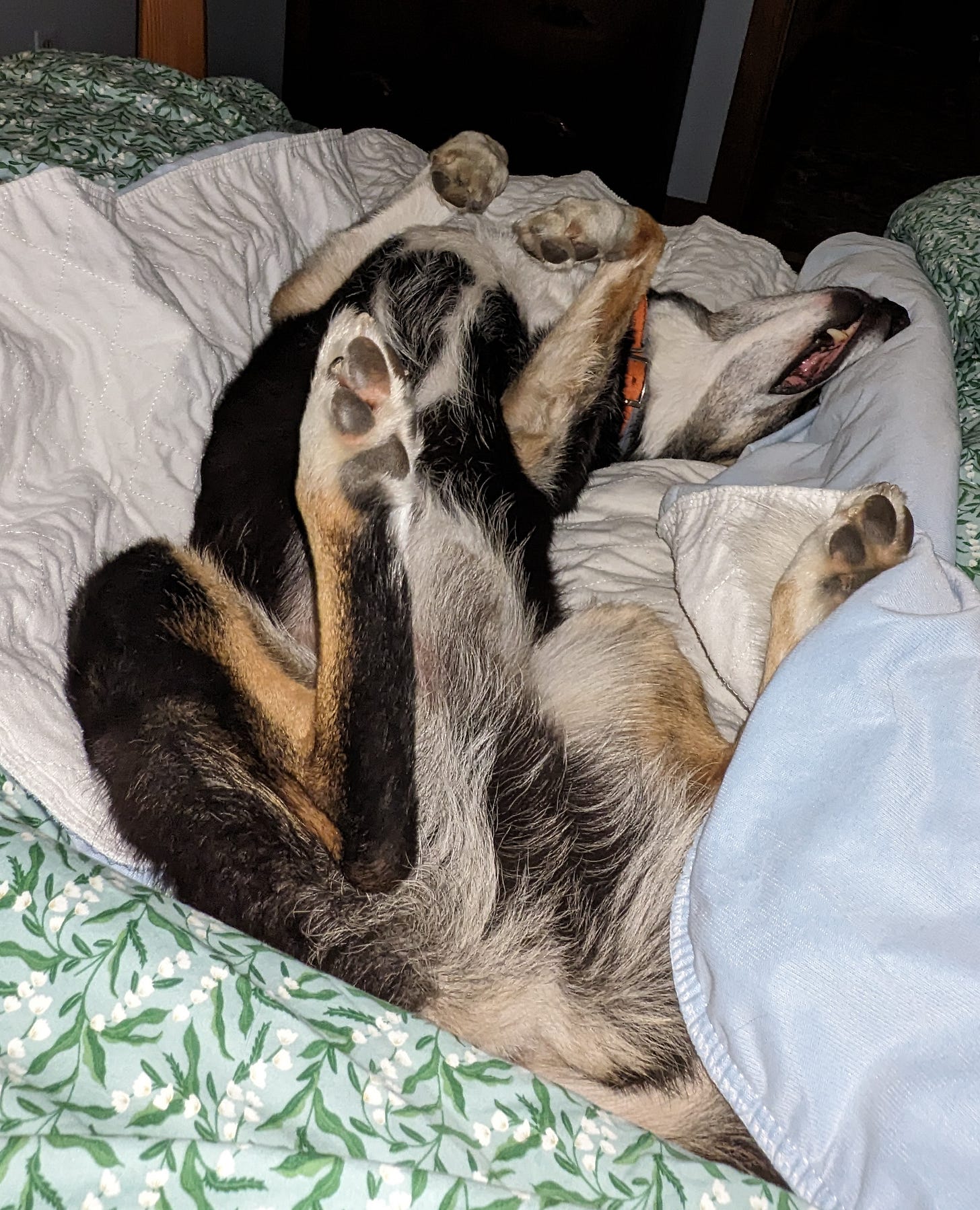
21. Upside-down dog
What’s on your list?
Happy Tales!
*Thanks to my writer friends Robin and Suzy for insisting I do this exercise. What would I do without you?
Or: How to Get Readers to Relate to Your Characters
How many times have you put down a book because you can’t get close to the main character? Maybe they give no sense of what’s important to them and thus come across as lifeless automatons. Or maybe they express themselves, but in a way that makes no sense.
This robot actually has a lot more life to it than some characters I’ve read. Photo credit: Rock’n Roll Monkey.
Worse, how many times have you gotten a query rejection in which an agent tells you they don’t find themselves invested in the protagonist? And you’ve wondered what is wrong with your writing? Are you really that terrible?
Both of the above-mentioned scenarios have happened to me. Tthe first not as much because I tend to plug away at books for far too long even when I’m not enjoying them. But the second thing—the professional rejection—has occurred more times than I care to admit.
I could use the excuse that writing is a subjective business and some agents simply don’t like my style. I do tend to write strange stories, with quirky characters set in strange worlds and situations. But if reading hundreds of books over the years has taught me anything, it’s that even when a particular genre of story or style of writing isn’t my favorite, I often can relate to the characters within it.
So what’s the secret? How do we get readers to “fall in love with” our protagonists?
We might as well ask: How do we fall in love with a new dog? (don’t worry, Tock. You are our One and Only for many more years yet. I hope). Puppy cuteness aside, many new dogs are a lot of work. They might be fully grown with their own personalities already set. They might have behavioral issues that make them difficult to handle. No matter their age, they are most definitely not a replacement for our other dogs. Each one has unique traits, and it can takes some time to get used to them.
Unlike our previous dog, Tock has only a few precise times of day when he will allow himself to be cuddled. It can be hard to wait!
What is it, then, that causes us to take that new creature into our home? To essentially sign a contract that says we will commit to the care and well-being of this furry beast for the rest of its life?
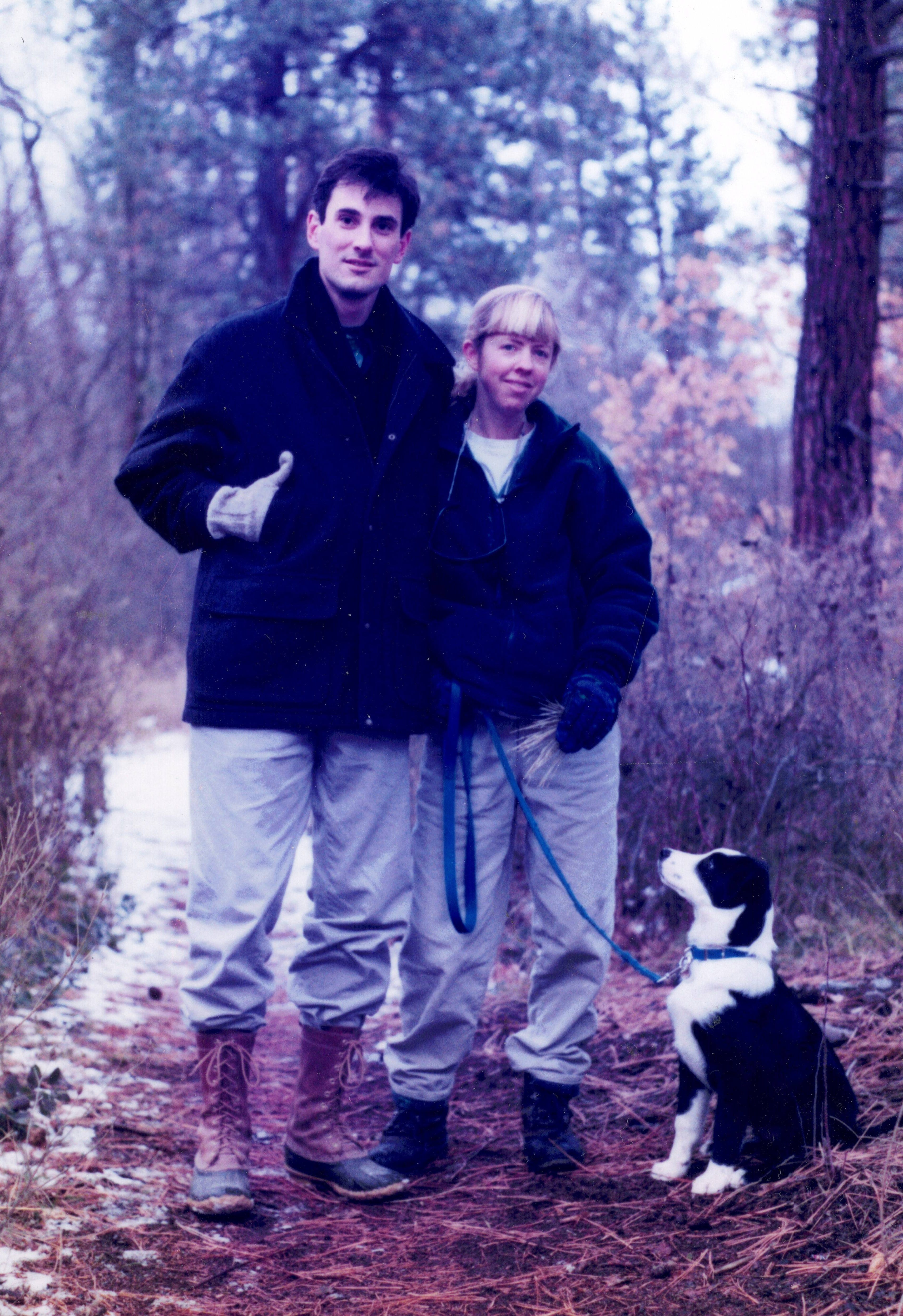
The answer, I believe, comes down to a way of being a particular dog possesses that makes us empathize with it. Think about the first time you gazed upon that litter of puppies, or on that one animal out of dozens or hundreds at the rescue facility. My husband and I still remember spotting our first dog, Tenzing, at the Humane Society. The little guy sat alone in a corner, clearly overwhelmed by the barks echoing from the cages around him. But the thing that drew him to us in an instant was the way he searched our faces, his chocolate eyes switching back and forth from one to the other of us. Clearly, he was trying to send us the telepathic message: Are you my parents? Will you get me out of here?
Tiny Tenzing
We adopted him in minutes. If he’d been in a book, I would have read past the first page. And by the time I finished Chapter One, my bond would have been so strong that I’d have kept turning the page to the end.
When agents talk about falling in love with a character, my guess is they’re expecting some sort of spark on that first page. By the completion of the first chapter, for sure. Unlike getting used to a new dog, we don’t have the luxury of months when introducing readers to our story. We need something fast.
We need to generate empathy!
One of the most tried-and-true methods for producing empathy in readers for a character lies in the Save the Cat method (see the many books by Blake Snyder). This is when a character demonstrates something warm-hearted, likeable, or thoughtful about their personality. They might literally save a cat stuck in a tree, or they might simply display a way of thinking about something that indicates they’ve got an ability to feel. We readers understand that even if the character seems pretty screwed up, they’re not all bad.
Photo credit: Braedon McLeod
To me, generating empathy lies in a combination of action (e.g., Tenzing’s eyes darting back and forth), thought (it was pretty obvious what he was thinking), and dialogue (it was too noisy to hear him, but it’s entirely possible that he was whimpering or at least snuffling a little). The trick is to put a bit of this on Page One, like sprinkling seasoning on a soup, and then add more as the story progresses. This will enable your reader to relate to the character in some small way, and to feel as though they’re developing a relationship with them.
But what about the rest of the story? How do you maintain that trust? No matter how endearing a character is initially, a reader’s only going to want to stick with them if the things that character does, feels, and says make sense in the context of their life. And not only in the present, but in their history. Their backstory.
Figuring out a character requires lots of thought.
You know how sometimes you do things that you wish you hadn’t—and you don’t know why? Or you suspect something happened to you in the past that messed you up—but you can’t quite figure out what? This is often true of a character in a book, too. The difference between real life and fiction is that in a story, you the author need to understand precisely why your character is acting, thinking, or speaking a certain way. You need to know that character better than you know yourself. Bit by bit, you can then impart a character’s historical context to your reader so they’re not completely befuddled by what the character is doing, saying, or thinking.
There are a lot of things I still don’t understand about myself. I don’t know why I have a revulsion to the sight of rows of seeds in a cantaloupe or rows of scales on a fish (actually, I think it’s at least partly genetic, because my son has it too. He’s the one who told me it’s called Trypophobia). I don’t know why I frantically yank at my coat if the zipper gets stuck (actually, I think it stems from accidentally locking myself in a closet at age four and developing a fear of tight spaces). Self-analysis aside, I truly don’t know why I feel like I have to apologize for everything, or why I need to work every second of the day until I collapse in bed and finally allow myself some time to read.
This perfectly fine picture makes me cringe. Photo credit: Martin Moore
As a dog owner, on the other hand, I strive to develop a thorough understanding of my dog’s personality and actions. Tenzing, for instance, began growling at children after an incident in which he was snorkeling for pebbles in a pool (one of his favorite pasttimes), and a group of schoolchildren surrounded him and began “helpfully” tossing stones at him. This terrified him, and though I pulled him out of the situation quickly, he’d made an unforgettable association between children and danger. It’s especially tricky with an adult rescue dog, for whom you don’t know all the things that contributed to their strange and often defensive behaviors. But by watching them closely or knowing a little of their history, you can make some strong conclusions about what might have led them to a particular mannerism. We knew our dog Moth had been forced to spend the first years of her life in a basement, and as a border collie must have been desperately bored and looking for work. I believe this explained her obsession with light spots on floors and walls. The poor thing would jab at them until her nose bled, so we had to make every effort to keep her away from them (and provide her with more suitable work in dog agility).
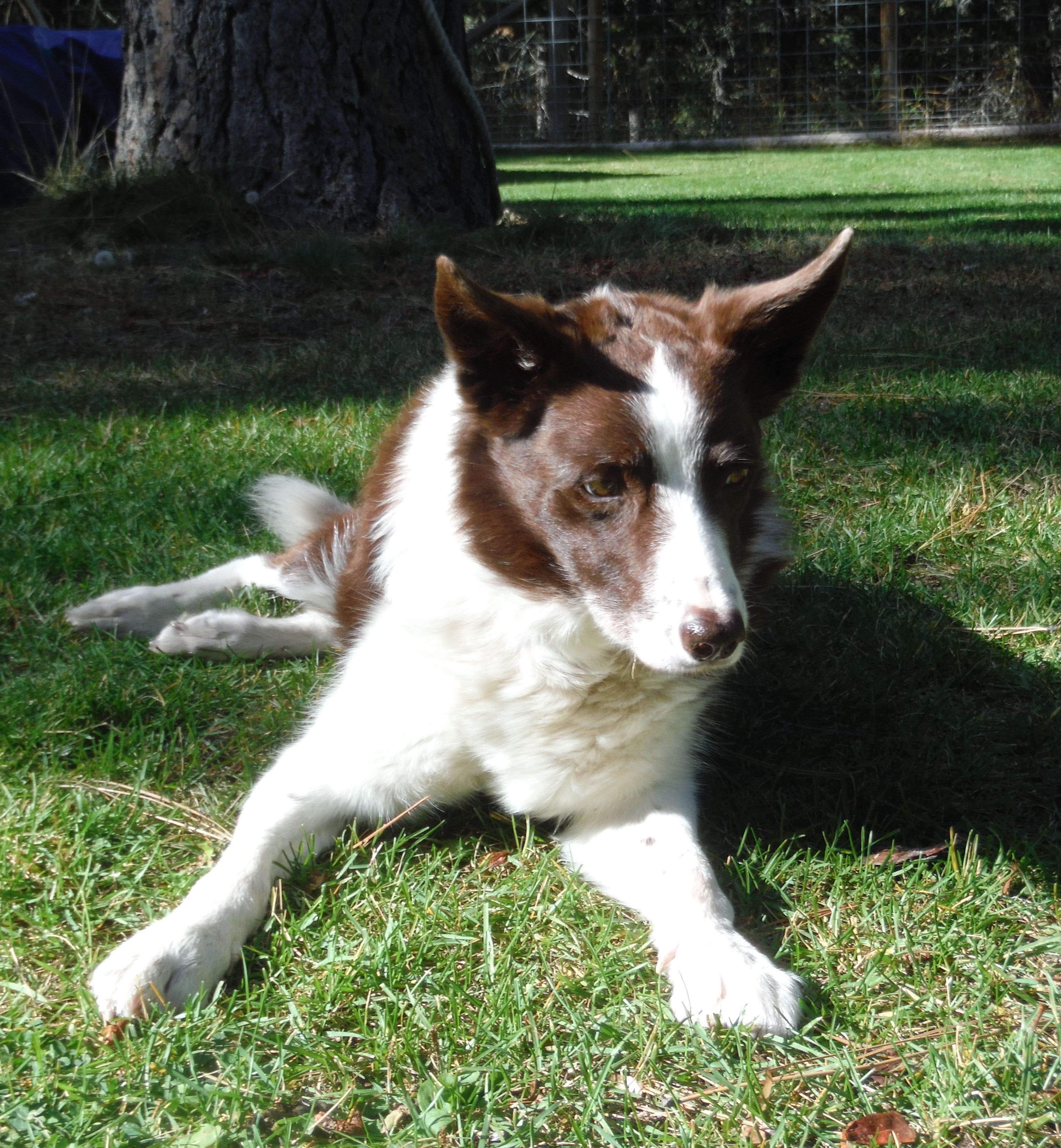
Even near the end of her life, Mothie spent her spare time gazing at light and shadows.
Like a responsible dog owner, a good writer yearns for a deep knowledge of their characters. When I begin a new draft, I work up detailed character sketches, complete with preliminary scenes of emotionally scarring incidents that show how they became who they are in the story. Even with those sketches entrenched in my mind, I invariably discover that my knowledge of my characters isn’t yet full enough. I have to step back from writing and think some more. Why are they acting the way they do? Saying the things they say? Enduring those thoughts that keep running through their heads? Only by knowing their inner histories can I write my characters in a meaningful way—and a way that generates empathy in my readers.
How about you? Do you toss books down in frustration when the protagonist isn’t relatable? Have you ever gotten one of those “can’t quite relate” query rejections? Here’s hoping our next attempts draw readers in rather than push them out.
We all know that dogs love routines. Their bedtime, their walks, their play sessions, and of course most of all their breakfast and dinner. Filling their days with structure truly seems to give them a sense of stability, of happiness, of purpose in life.
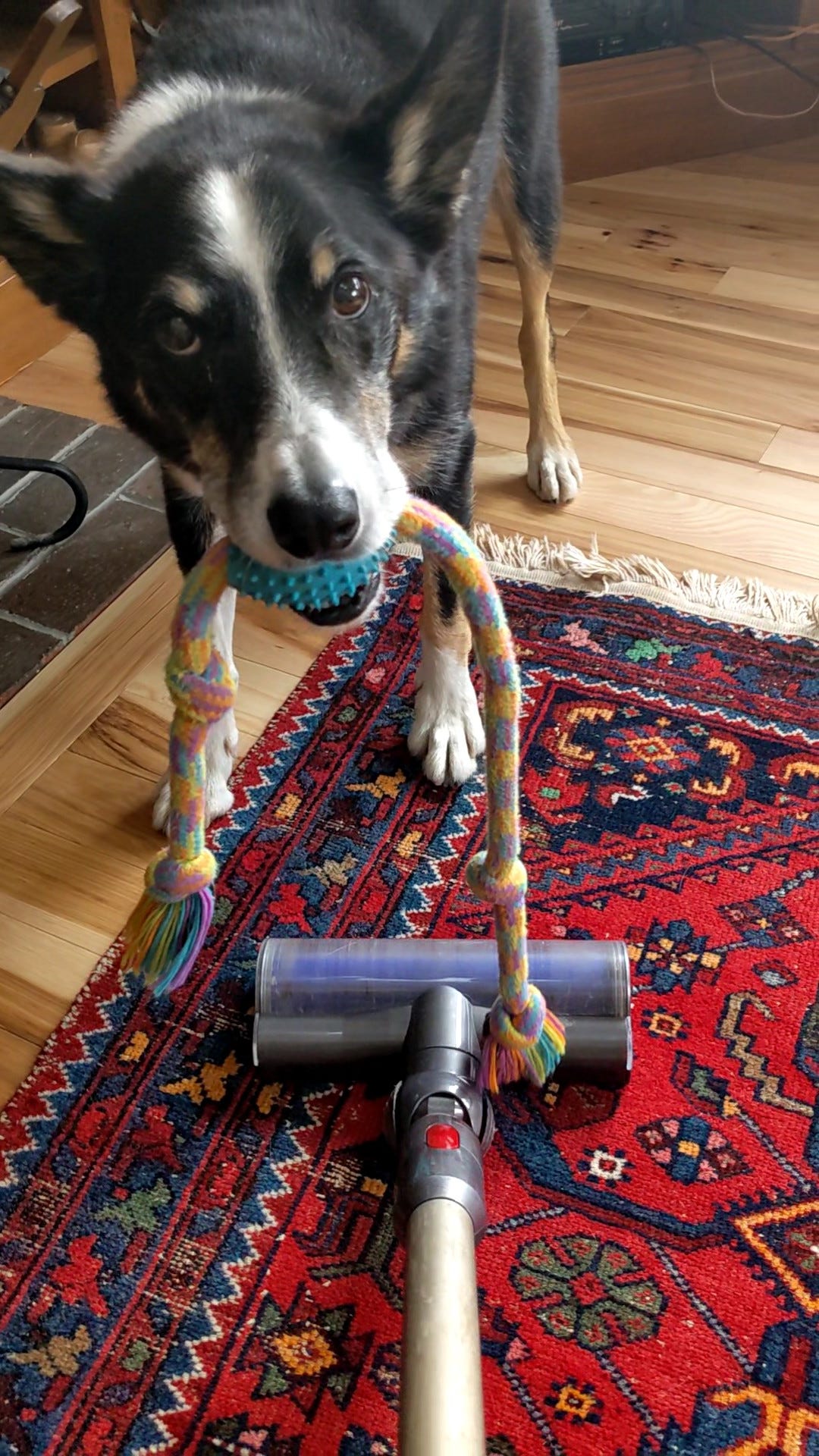
For Tock, vacuum time means playtime, always!
But what about people? Sure, routines are crucial in order for most of us to get things done, but do they really contribute to overall happiness? Personally, I feel a bit guilty for not living a varied and unpredictable enough life. I’ve been making an effort to spice up our daily existence with new recipes and short visits to places we’ve never been. It’s sometimes exhausting, but it keeps me from feeling as though I’m turning into a robot.
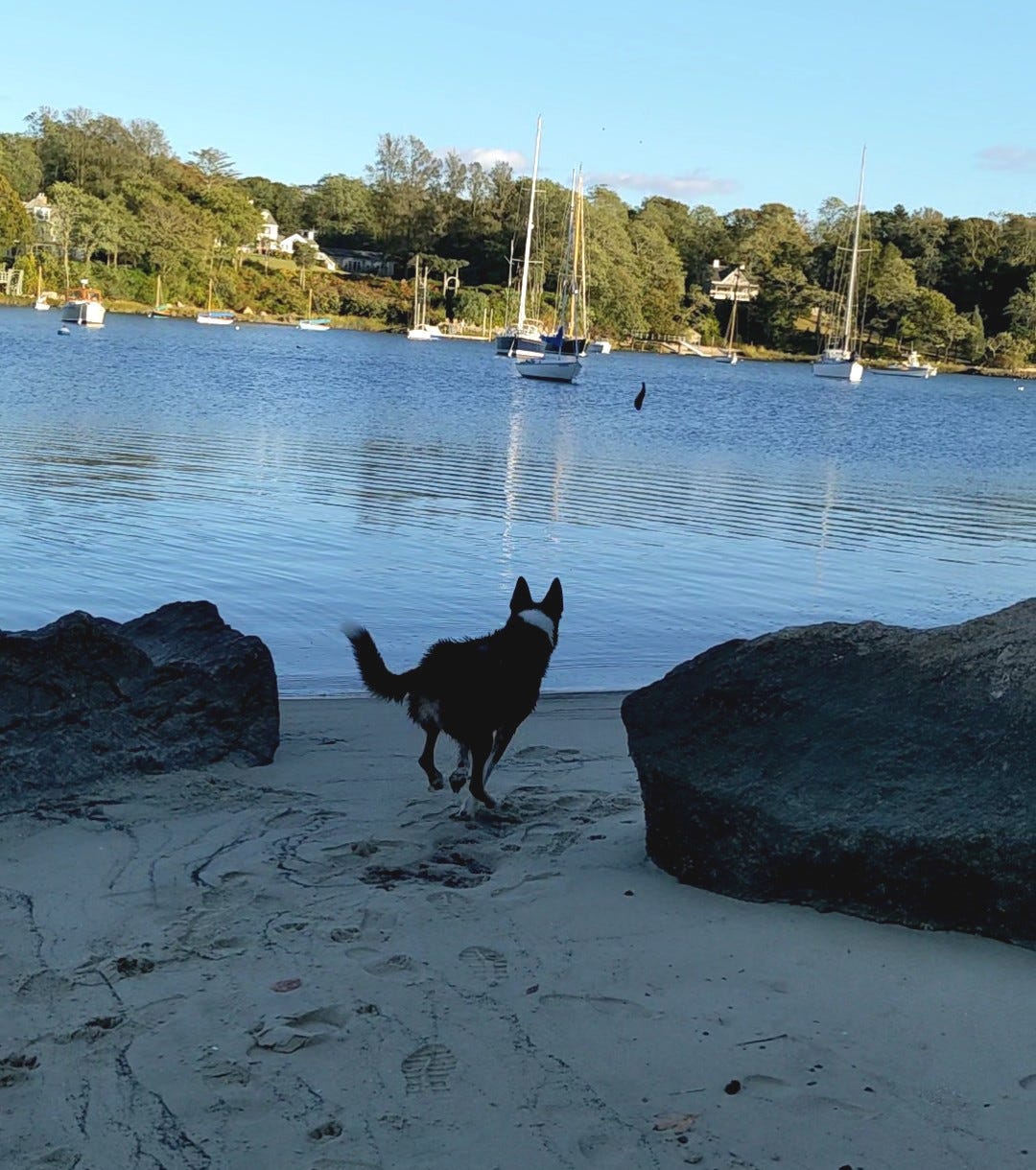
A lovely little beach we discovered on one of our early-evening adventures.
Though variety is fun and prevents life from getting boring, I firmly believe that deep down, we all crave a certain regularity. Not merely in obvious routines such as meals, work, play, and bed, but in the patterns that we see and hear throughout our lives: The pleasure of listening to a piece of music that’s about to return to its primary chorus or theme, for instance. We know it’s coming; we can predict when it will happen based on the chord progressions that come before it—and yet it is ever so satisfying when the notes resolve into the ones we expect. Or the joy a small child feels in listening to the repetitive cadence of a picture book, often memorizing those repeated parts first and reciting them aloud. Or the wistfulness that wraps around many of us as the leaves turn gold and begin to fall, reminding us that each season has its place (and helping me, personally, in accepting the coming stillness and coldness of winter). Or the contentedness that can arise from the performing of a methodical household task such as vacuuming. I really hate to admit to that last one because vacuuming and I have a particular hatred for eachother—yet there’s no denying that I feel a certain satisfaction in progressing with the machine from one end of the room to the other. The alternative option, other than not cleaning at all (gross!), would be to clean one spot, then dart away to clean a second randomly-chosen area, and so on. This makes no sense and is probably why I hate Rumbas—even though they spare a person from having to do the vacuuming, they waste a lot of energy bumbling around in constantly changing directions, never seeming to hit that one place that needs it most.
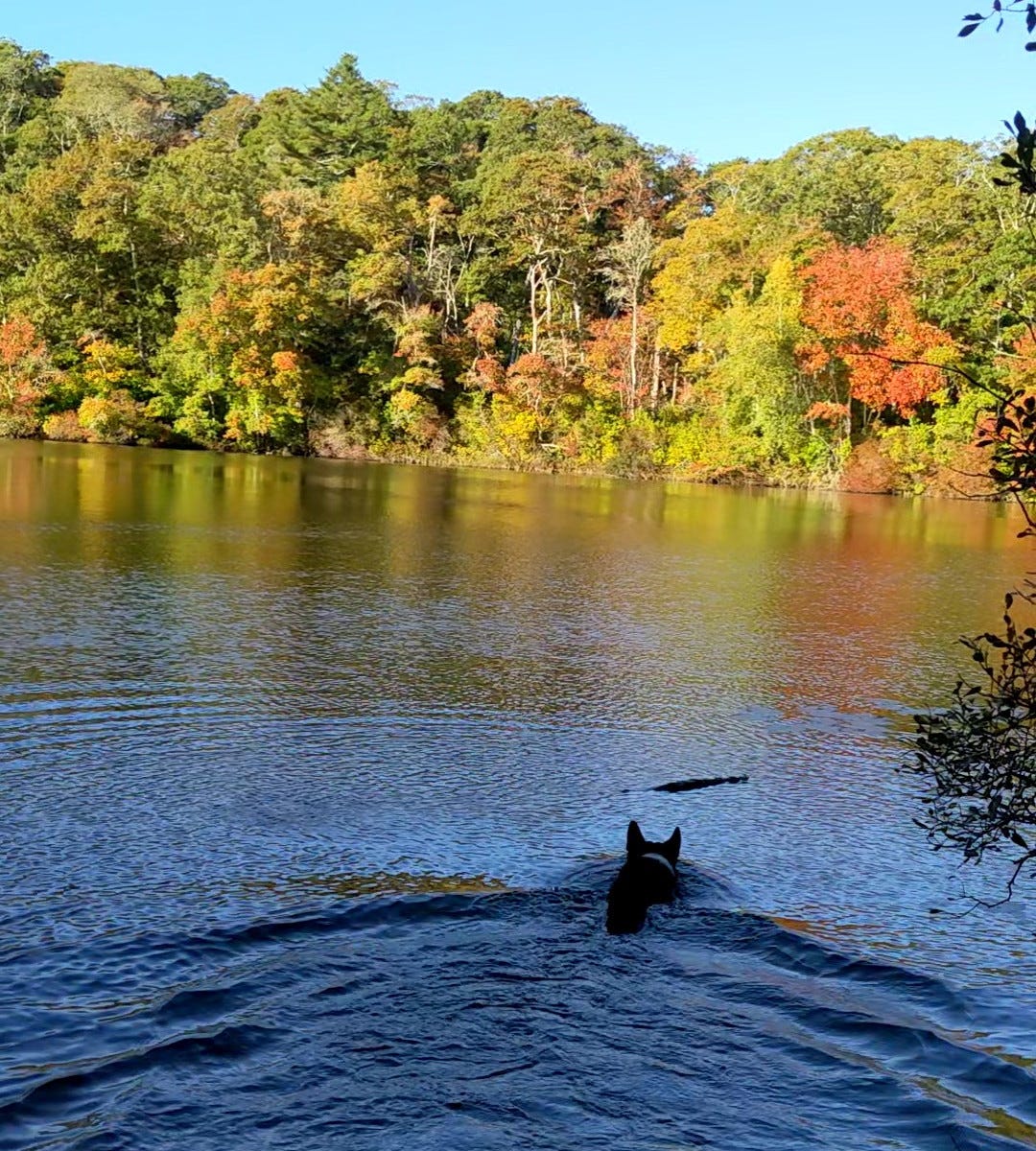
Tock’s favorite pond is especially vivid right now.
If your appreciation of patterns is strong enough, the very thought of chaos in your life—or in the world at large—can make you uneasy. I seem to have a talent for pushing my own buttons in the darkest, loneliest part of the night, when I often find myself dwelling on various vast unsolved problems in the universe (e.g., the concept of time, the nature of dark matter and dark energy, and what lies beyond black holes or the Big Bang). If I don’t want to freak out for hours and end up a zombie the next morning, I know what I have to do. I’ve gotta replace the thoughts of those tumultuous, alarming things I can’t control with ones I can.
Photo credit: Karan Suthar
Here’s my number one recipe for combating chaos and the discontent it sows: listen to a good audiobook. Lately, I’ve been working my way through Kwame Alexander’s self-read MG and YA stories in verse. By immersing myself in his beautiful phrases, his artful repetition of simple words, and his insightful thoughts that echo and build upon one another, I can decompress. His writing helps me feel as though there’s some sort of order to the madness, some hidden purpose to life, the universe, and everything. And though the plots of his stories are the opposite of boring, the cadence of the words relaxes me enough to make my eyelids heavy. (Note: if you’re serious about wanting to fall asleep, adjust the volume so you have to strain to hear it. Kind of like driving at night, the more you try to focus, the sleepier you’ll feel).
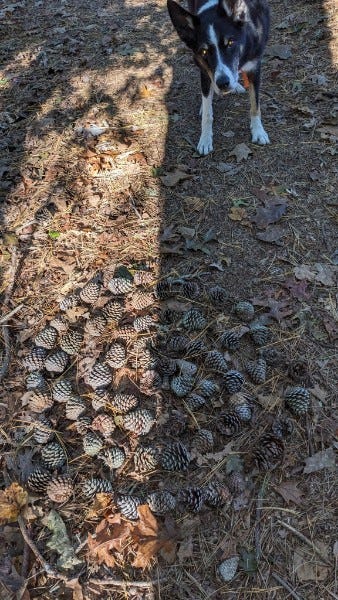
These cones were undoubtedly organized by a pattern-loving human — or was it a dog?
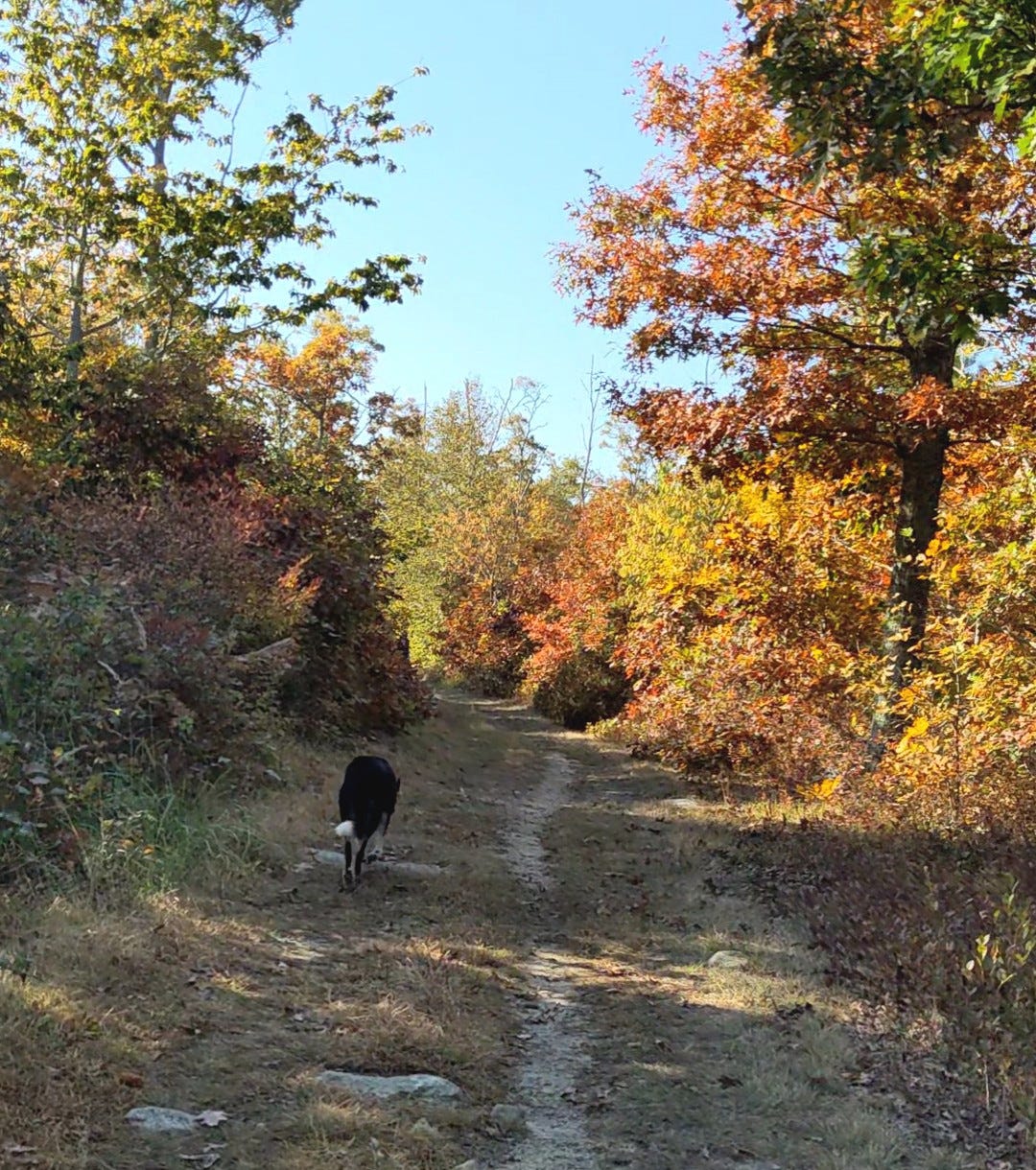
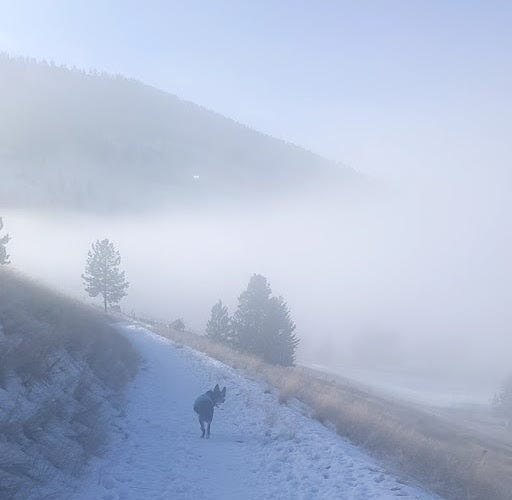
The beauty of falling asleep to patterns is that I wake refreshed, ready to appreciate them all the more. I’m grateful for being able to make use of them in my writing, from the repetition of carefully selected words, to the use of symbols, poetry, recurring character thoughts, consistent voices, and gradual development of backstory and themes. I’m grateful for the rising of the sun, the thinning blanket of mist on the field, the excitement of my dog for his morning adventure in the woods, the baa-ing of the sheep for their breakfast, the patter of leaves dropping to the trail like fat orange raindrops. I’m grateful for science, which in its broadest sense involves the search for patterns to explain natural processes. I’m grateful for my life, from its place in a symmetrically branched ancestral tree to the repeating strands of DNA that make me unique. My place on this earth may be small and insignificant, but it is my own, it is somewhat orderly, and to me, it makes sense. I’ll hold onto it as long as I can.
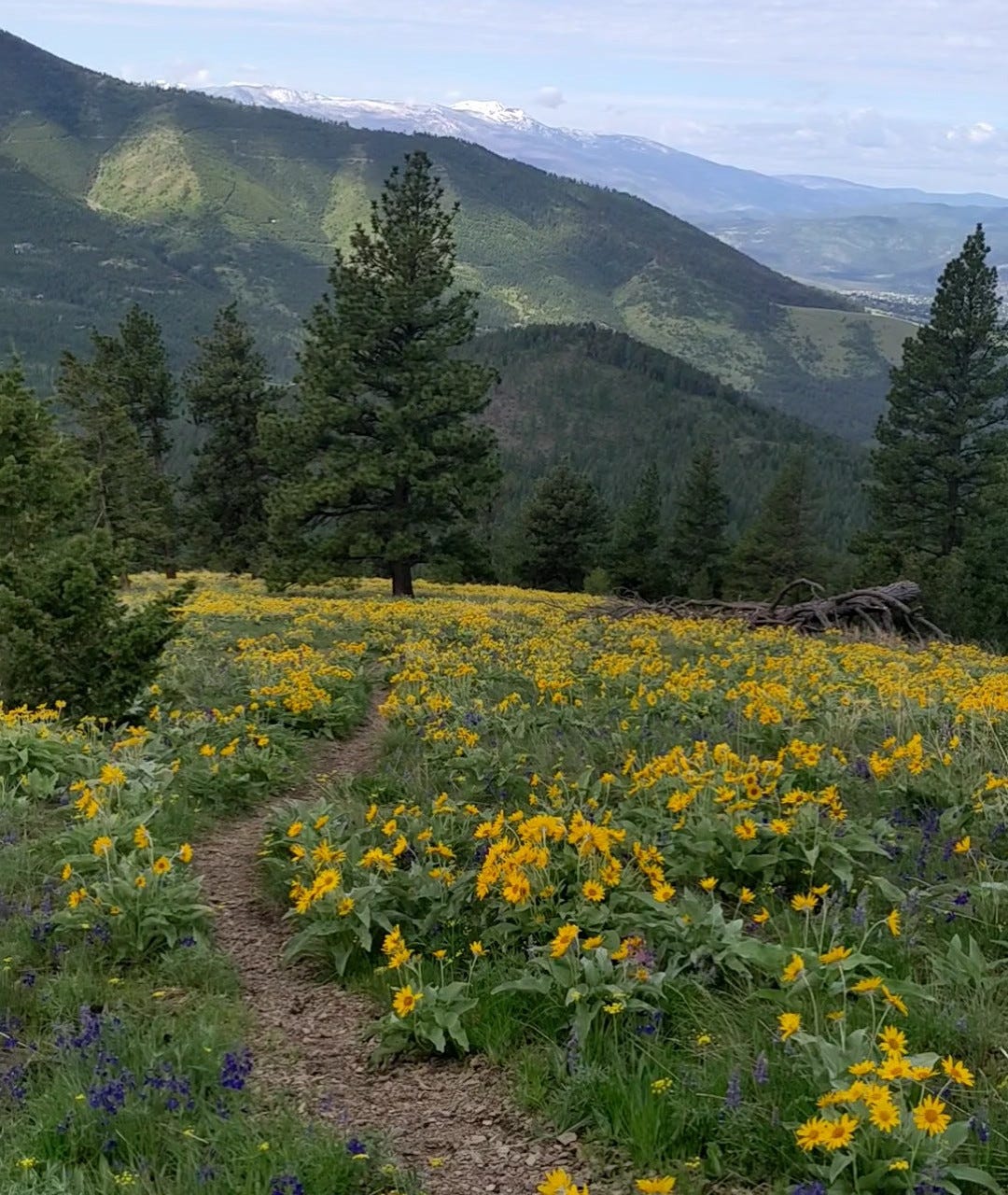
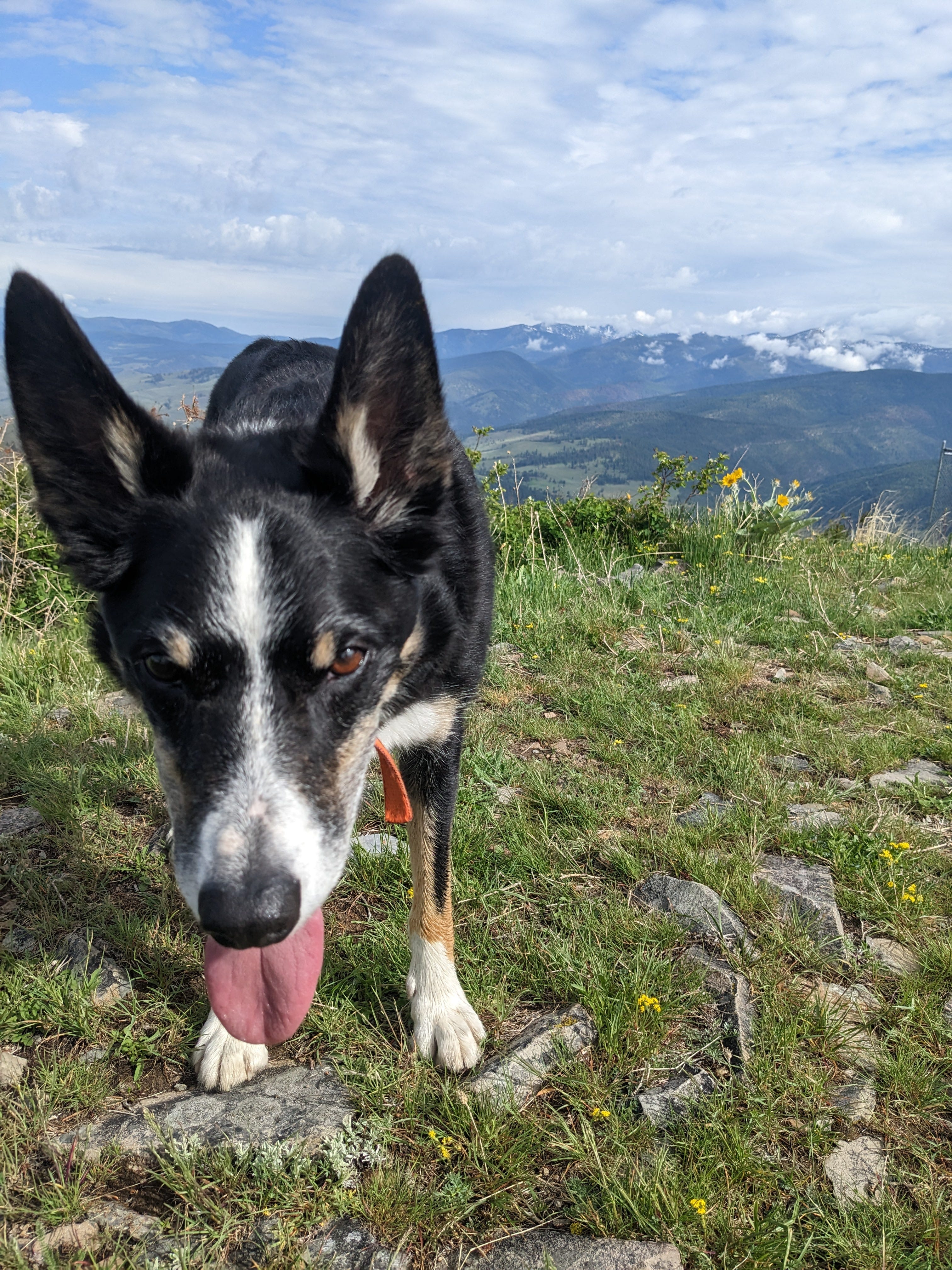
When I lived in Montana, the “Big Sky” state, I walked in the hills every day. These were grassy rises dotted with Ponderosa Pines, which prefer a lot of open space around their red-black trunks. Mountains rose not only beneath my feet, but miles away, blue with distance. Sometimes the grass was green and speckled with purple lupine, orange paintbrush, and yellow balsam root, sometimes it was brown and shriveled in the summer heat, and sometimes it was covered with a shawl of snow. But no matter the vividness of the hues, no matter the searing heat or the biting cold, my one constant was a sense of space. An expansive feeling, as if I had taken a big breath of helium over the course of an hour and a half walk and could practically float downhill toward home. My dog, too, seemed to feel this way, galloping and leaping far from me for pine cones, rarely slowing in the crisp dry air, even on the hottest of days. We always arrived home tired but exuberant. My head would spin at the thought of the distance we had covered and the far-off allure of hills we had yet to climb. Maybe tomorrow…
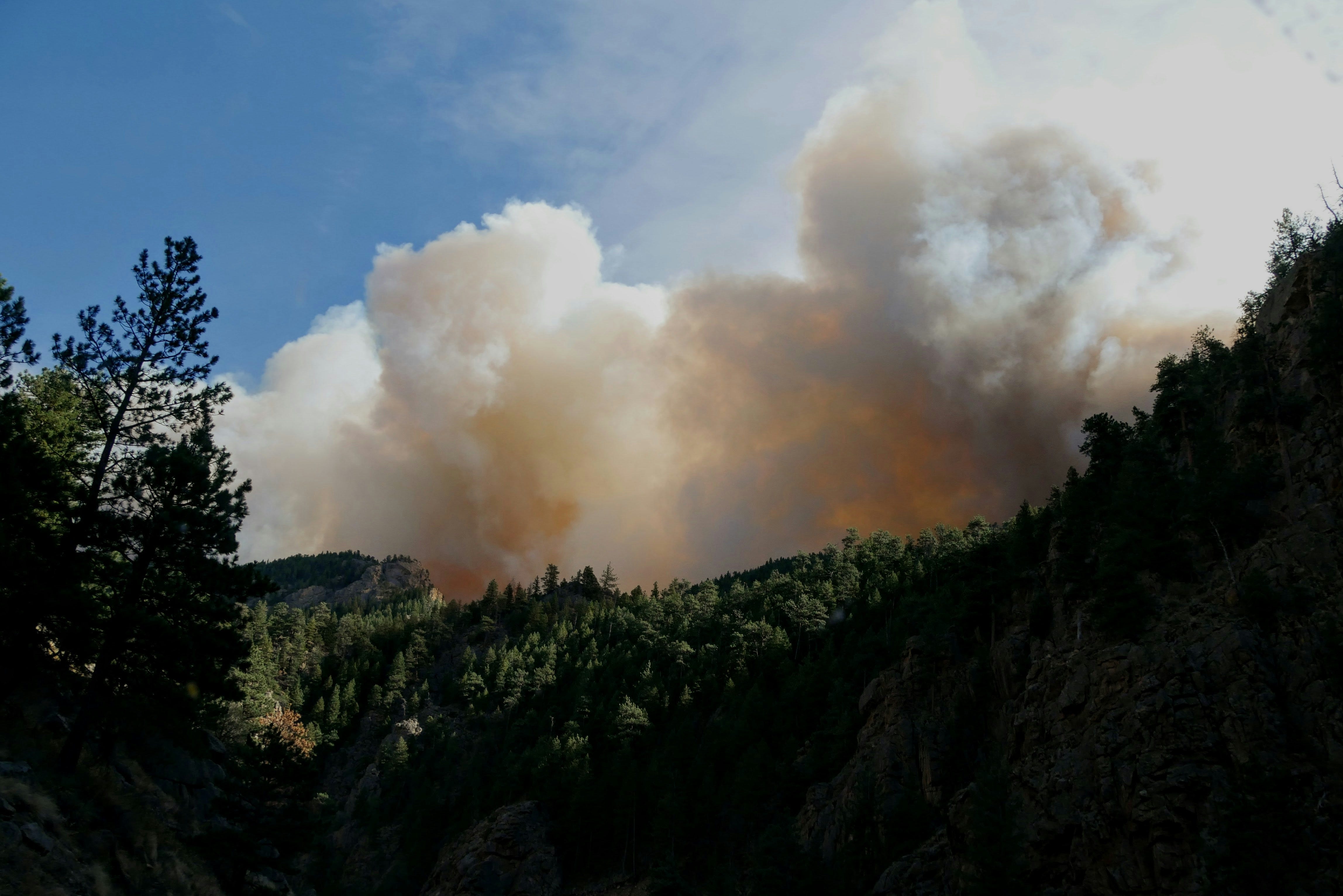
To me, this experience of traveling while keeping a loose focus on the horizon mirrors how I feel when I draft a new novel. From that very first step onto the metaphorical path, I have a lofty goal in mind. The top of a hill becomes the “what-if” that my main character is heading toward. What if a musical prodigy suddenly loses her ability to play? What if a phobic kid discovers he has to get rid of his safe space? What if a girl wants to sing, but is forbidden because it’s too distracting? I take some loose warm-up steps and my mind releases the premise, the inciting incident, and the theme. I see the major obstacles my protagonist will face as clearly as spotting a plume of fire on a slope.
Photo credit: Malachi Brooks
As I approach the top, chest heaving, legs burning, I begin to understand how my main character will take a long hard look in the mirror and come to grips with some difficult self truths. I scrabble higher still. The mountain no longer seems impossible to climb. I step to the summit — the climax of the story! On my way back down the hill, the final resolution unfolds. I’m now able to link my characters’ emotional journeys and all of those critical plot developments into a full story. Even the setting becomes more alive. I can see the entire thing! As soon as I get home, my fingers fly across the keyboard as fast as my feet.
Wrong turns happen, of course. Sometimes I end up on a completely different summit than the one I envisioned when I started out. This is not only the reason I spend so much time plotting out a story in advance but the reason it’s so fun. My creativity never feels constricted in any way – not during this plotting stage, nor during the actual writing of the story itself. There’s always room for change.
The time for a constricted view comes later in the writing process: the editorial stage. Though revision starts and ends with a big-picture look at the whole story, the majority of the work lies in much smaller sections. It’s crucial to read closely with an eye for detail and an ability to dismantle the writing chapter by chapter, scene by scene, even line by line.
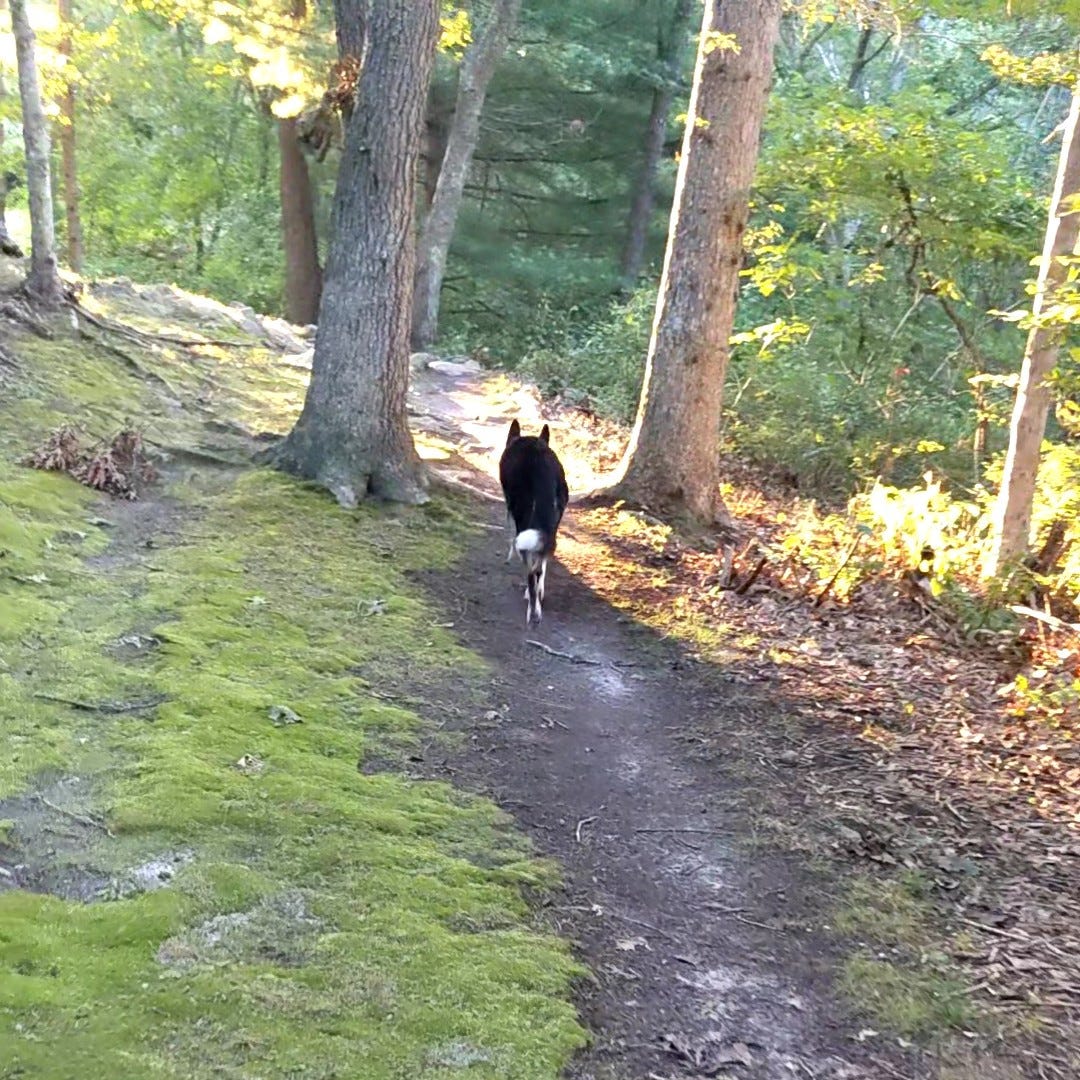
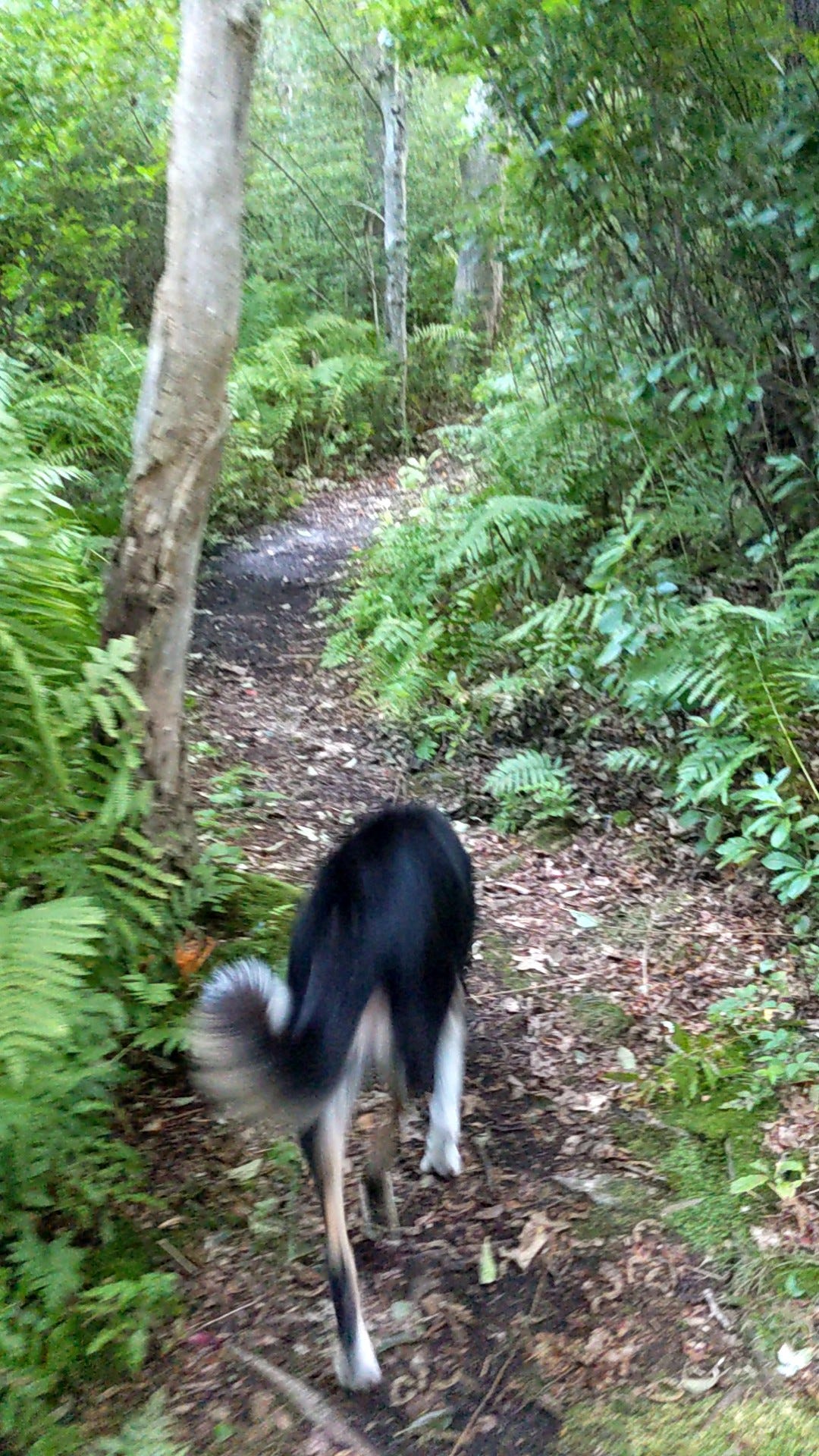
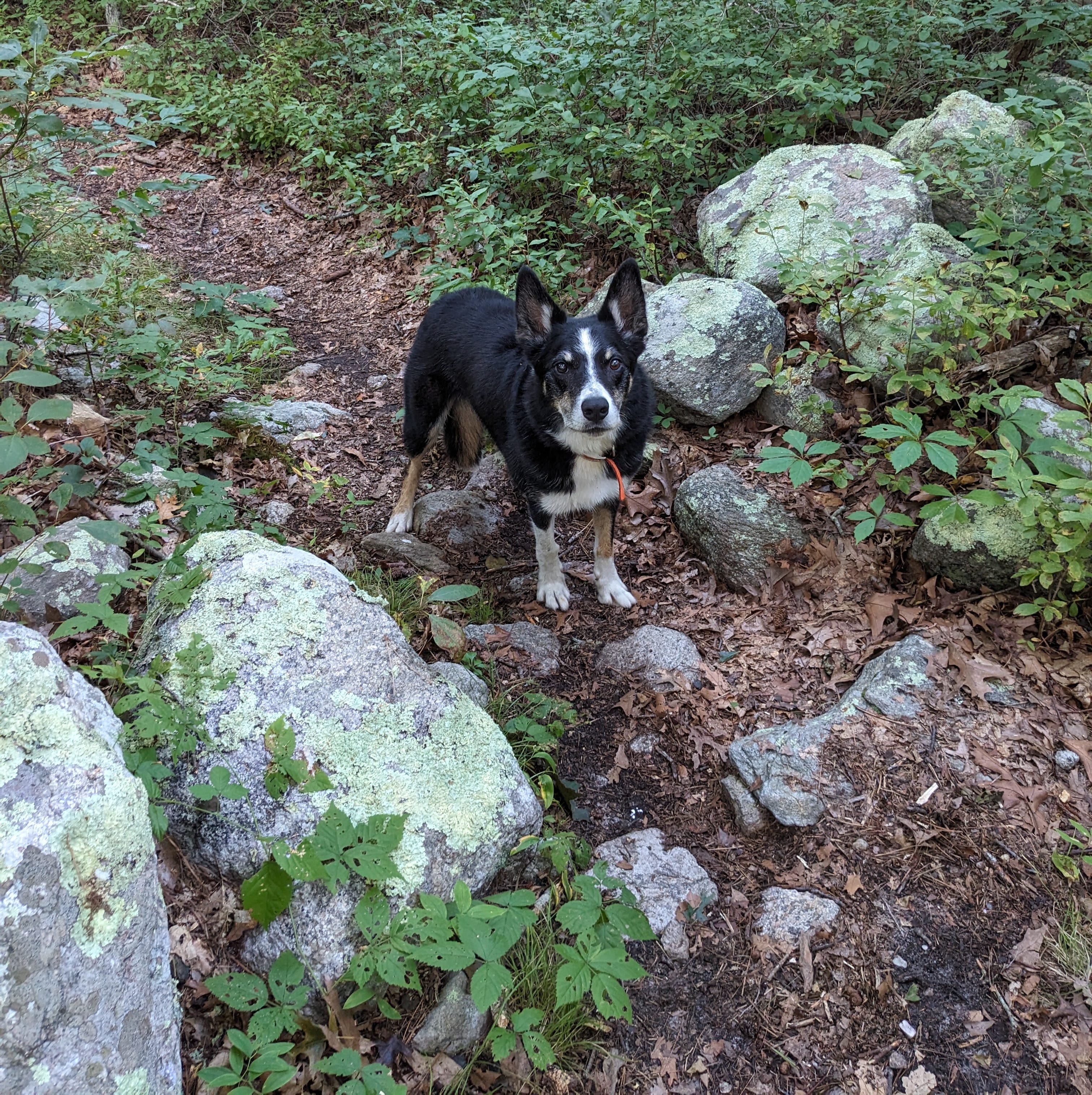
My new daily walks in the woods on Cape Cod are the perfect example of close focus. As soon as my dog and I plunge into the dense vegetation, we lose sight of the sky. We’re immersed in a jungle of branches, vines, and leaves. We follow narrow paths beneath tilted rotten trunks, twisting to avoid the sticky, insect-ridden webs that stretch from one side to the other. My dog bites at deer flies. I swat at mosquitoes.
When vegetation brushes my arms, I think of the tiny, nearly invisible ticks it harbors, carrying all sorts of nasty diseases that can lead to joint pain, fevers, organ failure, and death. Unlike Montana with its bears, mountain lions, and wildfire, the dangers here are so small they can’t be seen with the naked eye: a parasite, a bacteria, a virus. My mind travels inward to dark, anxious problems that I know I must solve. What does my protagonist really want? How can I make her more relatable? Is his voice consistent from one page to the next? Except for a ferry foghorn and a Barred Owl’s hoot, sounds in the woods are small and muffled. A mosquito’s whine, the thud of a foot atop damp leaves. Even the air is difficult to breathe, close, still, thick with humidity.
Such is the slow, painstaking process of revision. If you feel trapped in the minutia of your story, you are not alone.
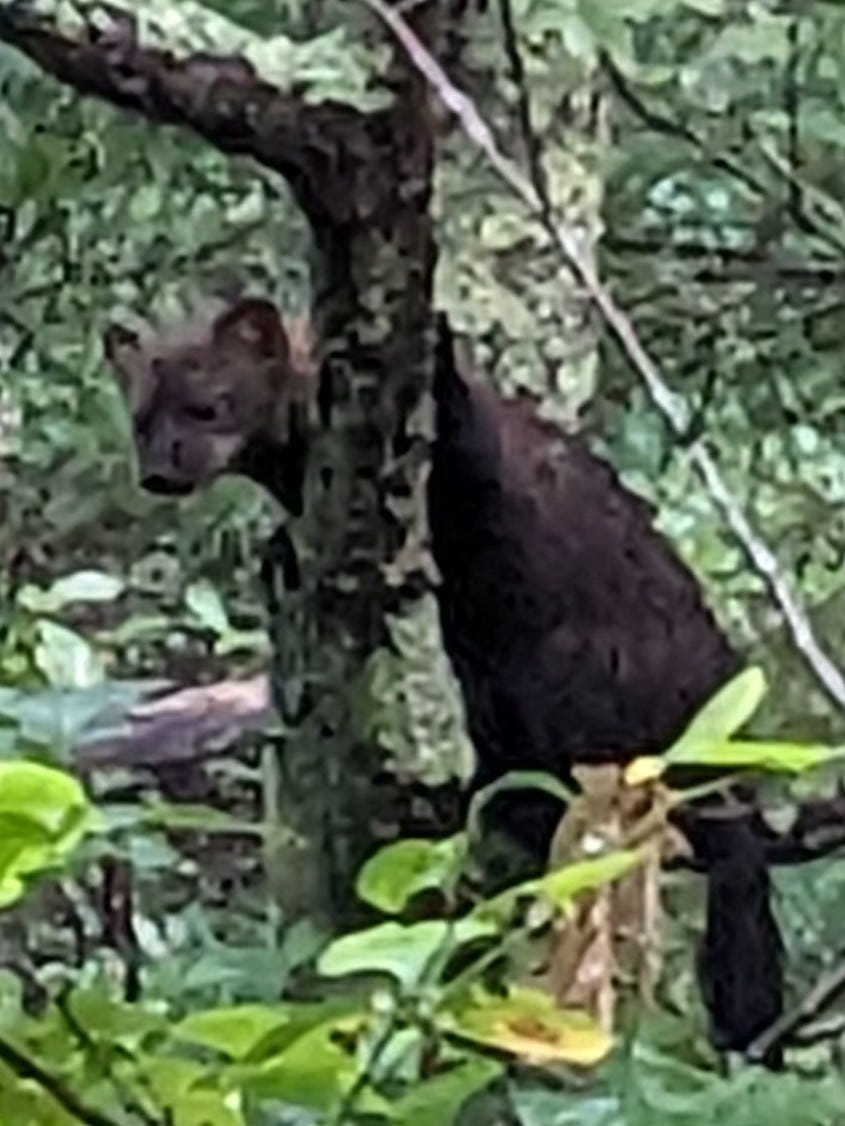
Yet great beauty lies in the closeness. In some ways, I would argue, it is more vivid and special than those distant spectacular views of mountain peaks. The impossible green of new leaves. The bright pink Lady’s Slipper peeking from beneath a blueberry bush. Mushrooms everywhere, sporting unreal colors on their fruiting bodies. The nutty aroma of dead leaves, so potent in places that my stomach growls, hungry for baked goods. The meandering line of an old stone wall, appearing on one side of the trail and disappearing on the other. The fuzzy face of a young fisher clinging to a tree, seemingly as curious about me as I am about it. The kingfisher skimming the pond’s flat surface, the osprey scanning for fish from its high snag, a chorus of invisible frogs. Something rustling the underbrush: a deer, an otter, a turkey, a gloriously red-brown coyote. I stop to soak in the surrounding jungle with all my senses, my face dripping with sweat or rain. Often I can’t tell which. Though the elevation gain is small compared to climbing an entire mountain, the roller-coaster ups and downs of the trail are just as exhausting. Maybe more so, in the heat of summer.
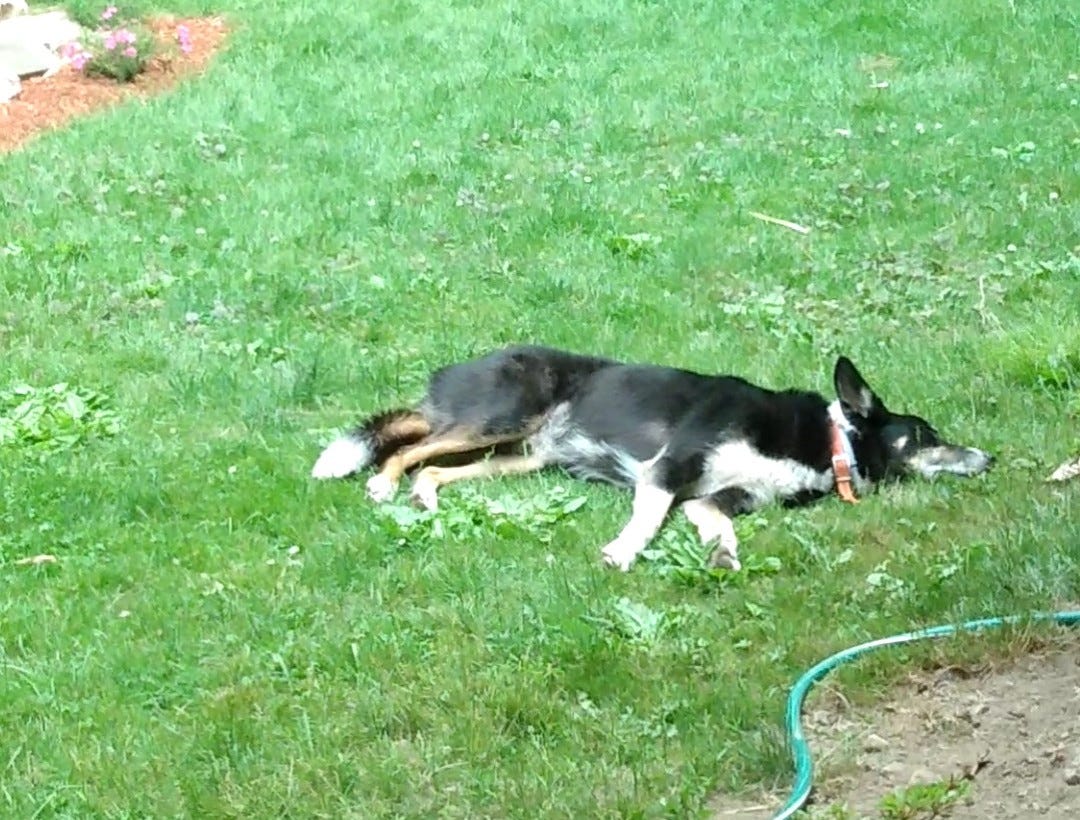
This slow, strenuous progress is probably why many people dislike revision. But I’ve come to love it. And when I’m finally ready to step back and read the whole manuscript again, to see whether it makes sense, it’s like stepping from the shade of the trees into the sunny field, brushing away the spiderwebs, knowing that soon I’ll wash all the bugs off in the shower, my dog collapsed on his side in a happy stupor. For both of us, only the sense of accomplishment and memories of forest beauty remain.
What’s your favorite part of the writing process: loose focus or close?
Have you ever felt as though you’re floundering, uncertain what to work on next? Perhaps (1) you’ve finally finished that first draft after months (years!) of effort, let it sit for weeks (months!), and now haven’t any idea what to do with it. Or (2) you’ve perfected your story (Seven revisions! Countless brainstorming sessions with critique partners!), to the point that you know if you work on it any more it’s only going to get worse—but the thought of querying is enough to freeze you from the inside out. Or (3) maybe you’re lucky enough to have moved past those hurdles and you’re actively querying, negotiating, revising (again!), publishing, or marketing, but everyone* wants to know what’s next and your muse isn’t merely hiding, it seems to have jumped off a cliff and swum out to sea. *By “everyone,” I mean you, plus at least one other person, if you’re lucky.
Photo credit: K Mitch Hodge
Never fear. I’m going to go out on a limb here and say that if you haven’t experienced at least one of these gut-wrenching dilemmas, you’re not a writer. In fact, I might as well wobble my way to the end of that bouncy branch and say that if you haven’t experienced this in any pursuit you love, then you haven’t lived.
So … let’s address Dilemma #1, when you’re stymied after finishing your first draft. Well, I have a little confession to make. I never succeed in letting my story sit for long before transitioning into Editorial Mode. I have such an over-zealous work ethic that I can’t help but jump almost immediately into revising what I wrote, the same way I feel compelled to walk my dog every single day despite rain or shine, wind or blizzard.
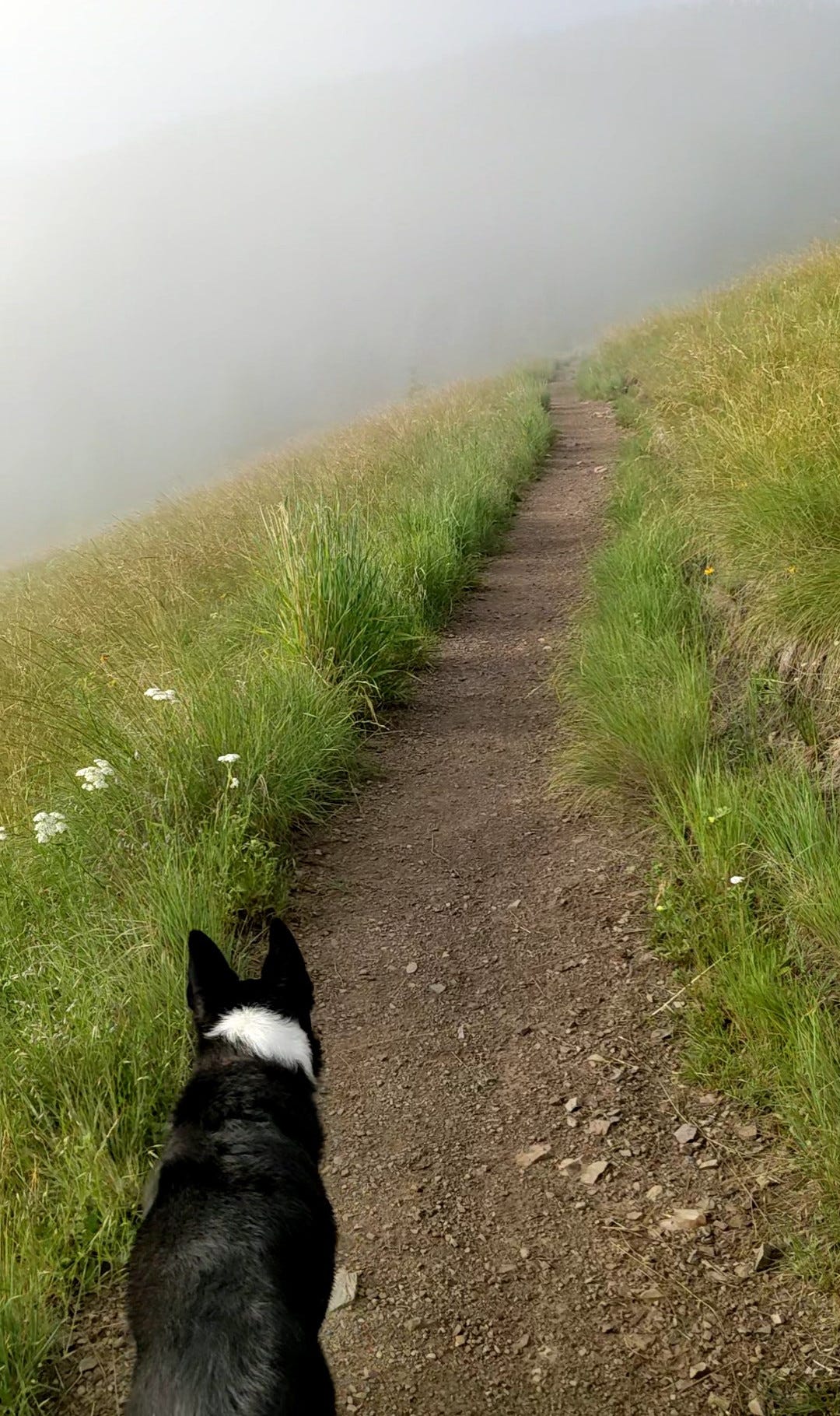
Tock and I enjoy our walk no matter the weather.
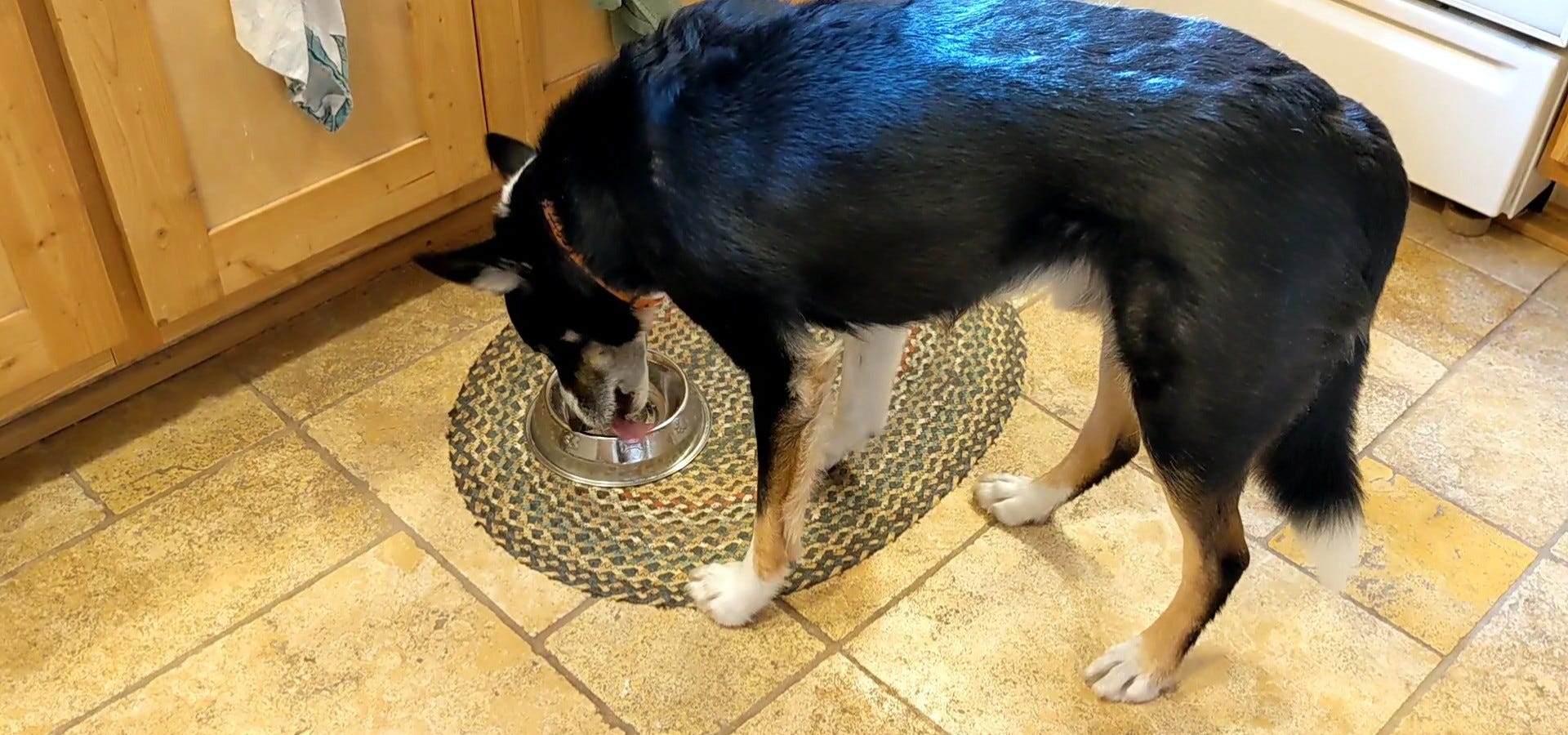
Though my turnaround from writing to editing is quick, the process I use is gentle. This is because my revisions don’t begin with actual changes. Instead, I start with something that is so fun I want to do it. I look forward to it, the same way Tock faceplants into his bowl of breakfast or dinner kibble.
And what is that super fun step? Kind of like a dog sniffing where they peed the previous day, I get to read what I wrote. At last, I can see my story as a whole piece rather than merely a painful collection of sentences, paragraphs, and chapters. With sort-of completed arcs of character and plot, my story sort-of resembles what someone might want to read someday. It shows me that though I may yet have lots of work ahead, I wrote a story. I did it! Hooray for me! It’s a major confidence booster—and we introverted, insecure writers need all the ego boosting we can get. Most importantly, I make notes as I read on where the world and characters need development, where the plot drops into sinkholes, where the pacing sags or speeds too fast, and where things simply don’t make sense. These notes, in turn, give me a launching point from which I can step into real revisions. And after this full immersion in my manuscript, I not only can revise it, I want to!
Spotting holes in the plot is the first step. Photo credit: Simon Hurry
But what happens once you’ve revised so much that you’re sick of it? I realize that I’ve gotten to this point when I start to question why I wrote the darned thing in the first place. It’s best if you don’t nitpick at it quite that long. Before all pride and joy in your creation vanishes, accept that it’s time to move on. Assuming you want to publish traditionally, this brings us to Dilemma #2.
Querying.
Photo credit: Sander Sammy
To me, this is the most terrifying, blood-shedding step in a writer’s life. You only get one chance with most literary agents to put your stuff in front of them, and if they reject you, you can never again try to persuade them to take on that particular manuscript. Even the rejections themselves are hard to bear – mostly form letters or no response at all. I don’t know which is worse: knowing with certainty that it’s a brutal “no thanks,” or not knowing and thus retaining some hope until, months later, you finally have to mark it down as a rejection by default.
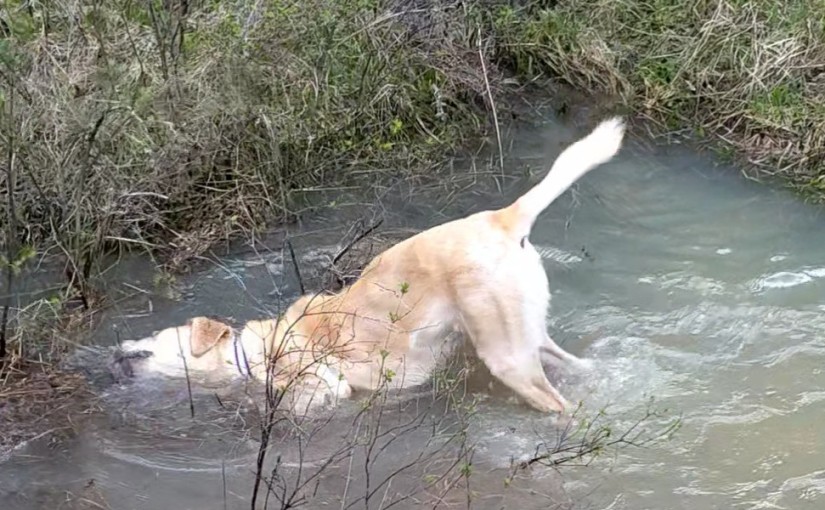
I have nightmares about querying. I think it’s safe to say that prostrating myself in front of an agent is my least favorite activity on the planet. So what do I do? As so often is the case with me, I look to my dog for inspiration. He’s always been a scaredy-pup, startling at big birds flying overhead, or a skunk waddling out of the bushes like happened last week (did Tock investigate and get sprayed? Thankfully, no. He scurried past it and waited for me a respectful distance away). He used to worry about swimming, standing for minutes on end gazing forlornly at a stick in the water just out of his reach. He still takes his time, studying the stick for a few seconds to a minute before paddling out to it. But he’s learned to swim farther and farther these past couple years, and eventually retrieves the sticks, every time.
The most frightening thing that Tock recently experienced was when a large unleashed dog charged down the trail toward us and jumped on him. Not in a friendly way. In a split second, the dog had my poor puppy on his back and was standing over him, snarling and lunging at Tock’s neck. In the next split second, I got over my shock at what had just happened and called for Tock to come to me. He wriggled out from beneath the dog, ran to me (fortunately uninjured), and we hurried away. I was so anxious to make his experience seem less stressful than it surely was that I didn’t even stick around to chastise the aggressive dog’s owner, but walked briskly away, rewarding Tock with treats all the while for his smart decision. But I worried that now Tock would view meeting new dogs the same way I view querying: One hundred percent terrifying, one hundred percent something to be avoided forever.
Still, I knew that Tock didn’t want to give up his daily walk due to fear of a savage beast, the same way I don’t want to abandon my dream of becoming traditionally published. We headed out the next morning—a little more watchful, a little more careful (I leashed Tock when we saw another dog approaching in case he’d developed fear aggression as a result of the attack, and kept his voluntary encounters very short). Tock was tentative that day, meeting dogs with his tail at half-mast rather than upright, silent rather than emitting the tiny happy whimpers he usually produces. By day two, his tail was back up, and by day three, he was whining with excitement again. He did it! He overcame his worries about another random attack. Hooray for Tock!
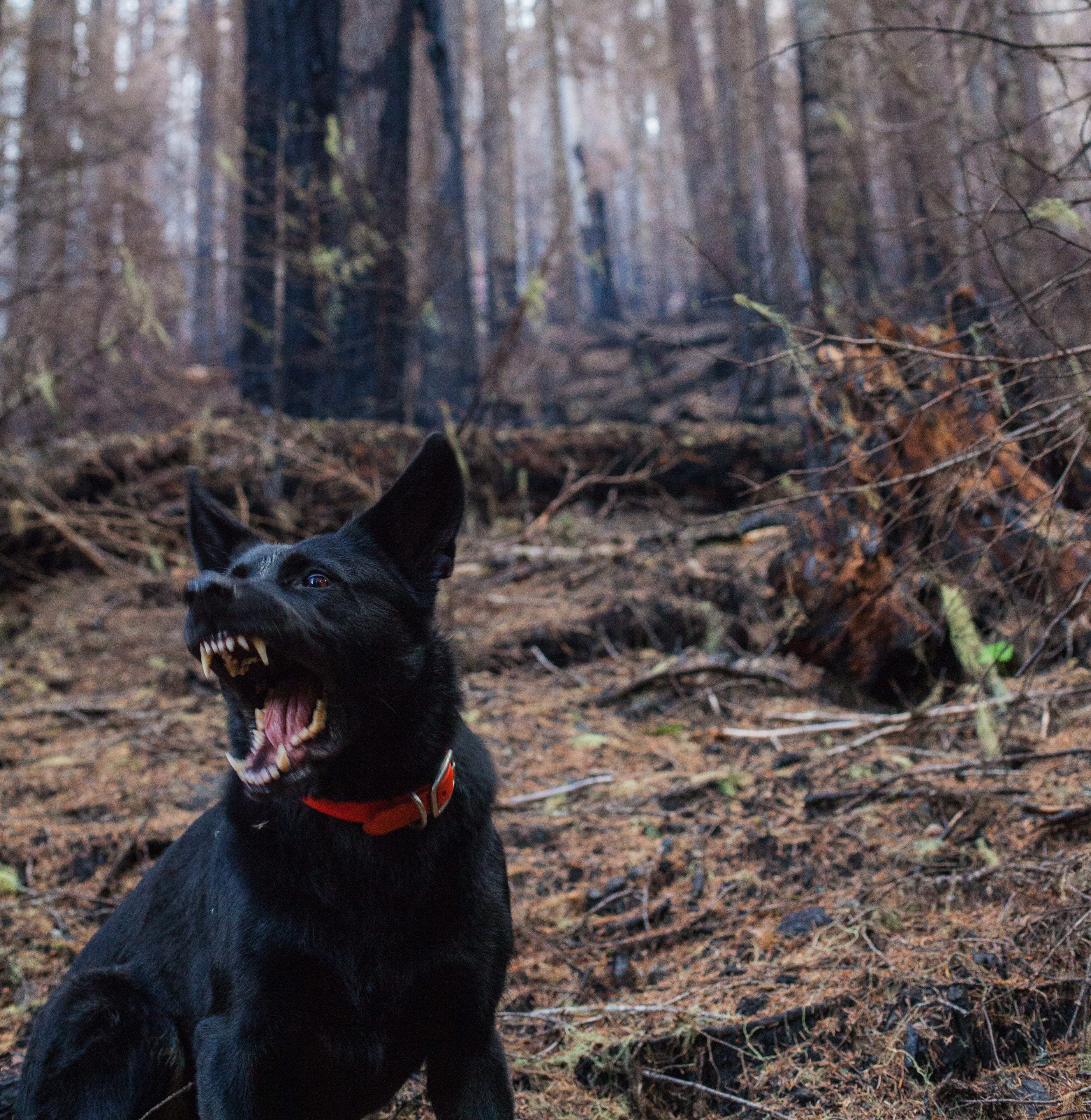
And if my darling boy can put himself back out there despite his fear, so can I. No matter how many rejections I’ve suffered in the past, I simply need to pick out my preferred agents, organize and tailor my queries to them, and hit send. It’s a psychological hurdle that I must overcome—will overcome—for my latest manuscript if I ever want a shot at publication in the traditional way. The worst that will happen is another form letter. It’s not like I’m going to get bitten in the neck by some long-canined, drooling, bloodthirsty monster.
Right?
Happy Tales!
Note: Since I’ve already addressed Dilemma #3—writing something new—in a different post, I won’t address it here (see Stepping Out of Your Comfort Zone, https://substack.com/home/post/p-137672913e).
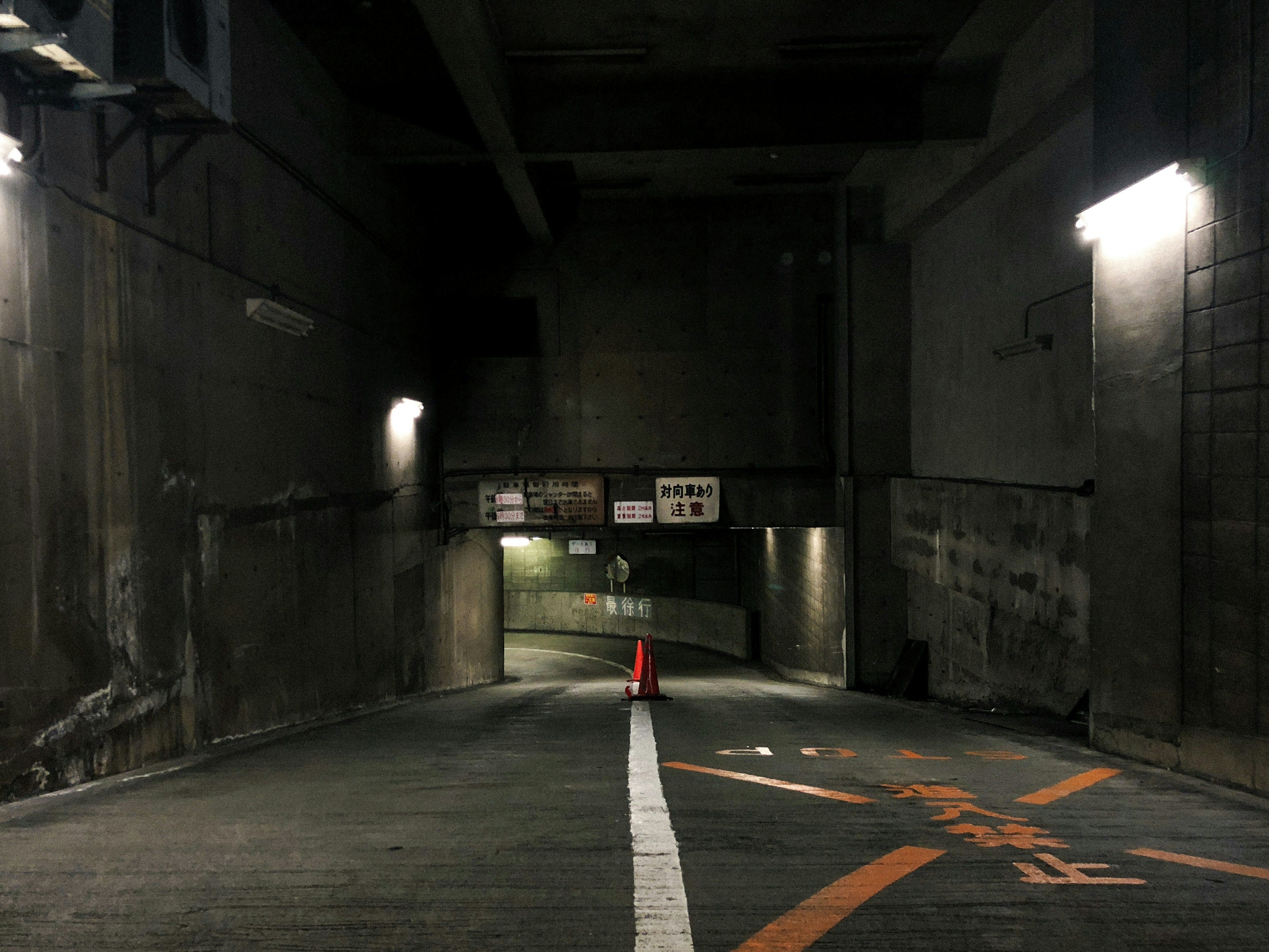
More than three months after embarking on my own Hero’s Journey, winnowing the innards of a house down to the most crucial ones, packing those up, enduring Covid for the first time, bidding farewell to friends and students, mountains and pine cones, selling the house and buying another one thousands of miles away, the process of unpacking interrupted by five visits to emergency rooms and twenty-three days in three different hospitals (not me, but someone beloved to me), navigating big-city traffic and a claustrophobic parking garage with not nearly enough spaces, circling around and around in the dark, wondering if I would ever have time to write again, certain each day was a new low point, wondering if I would write again even if I had the time … after all these difficulties, my hope for a new life shrank from a flame to a spark, from a spark to an ember, from an ember to a faint memory of something bright but unreachable, a fuzzy star on the edge of the galaxy. Some days I don’t think I could remember it at all, in fact.
I was lost.
Photo credit: Nuno Silva
But even though writing became impossible, I never stopped thinking of myself as the main character in my real-life story. And that’s what saved me. It allowed me to look at my situation with some detachment, even amusement at times. We writers aren’t nice to our heroes, and I was the perfect flesh-and-blood example! We’re told to be cruel to our heroes, to keep making situations worse and worse. It’s completely acceptable to shove the poor characters alone into a new land, surrounded by enemies, shivering in torrential gales, uncertain what to do next, plagued by the thought that if they’d only made the right decisions they wouldn’t be in this mess, downtrodden, defeated, despairing. Stripping all hope from a hero makes for good reading, right?
Well, not entirely. It’s true that a strong sense of desperation is critical for the “All is Lost” scene, which typically occurs about three quarters of the way through a story. This scene leaves the hero certain there’s absolutely no way they can achieve their goal. They are one hundred percent screwed, and their hope for any sort of future has one hundred percent vanished. They are primed to enter the “Dark Night of the Soul,” which in story parlance is when everything the hero formerly thought was important to themselves is stripped away, forcing them to confront the truth.
Photo credit: Eberhard Grossgasteiger
But what about the rest of the story? What about all the parts that lead up to this terrible time: the inciting event that pushes a hero into a new world or a new way of thinking and acting, the difficult barriers they must surpass, the people or creatures they meet along the way, the bits of their past that they may either cling to or reject out of hand, the interesting things they learn during their journey? And how about the parts that follow the Dark Night of the Soul: the emergence of a wiser protagonist and the final showdown in which a hero uses their new skills or understanding to achieve some sort of resolution? Should they feel hopeless during these times?
My answer to this question is a resounding no. What allure would any story have if it provides no hope of something the hero can do, think, or say that will lead to a more promising future? Even if those things aren’t what readers would have anticipated or selected themselves, even if the future isn’t the happy ending they thought might happen, we need to feel as though the hero has some agency, some desire to mold the course of events.
We need hope.
Tock is very good at hoping for a variety of things
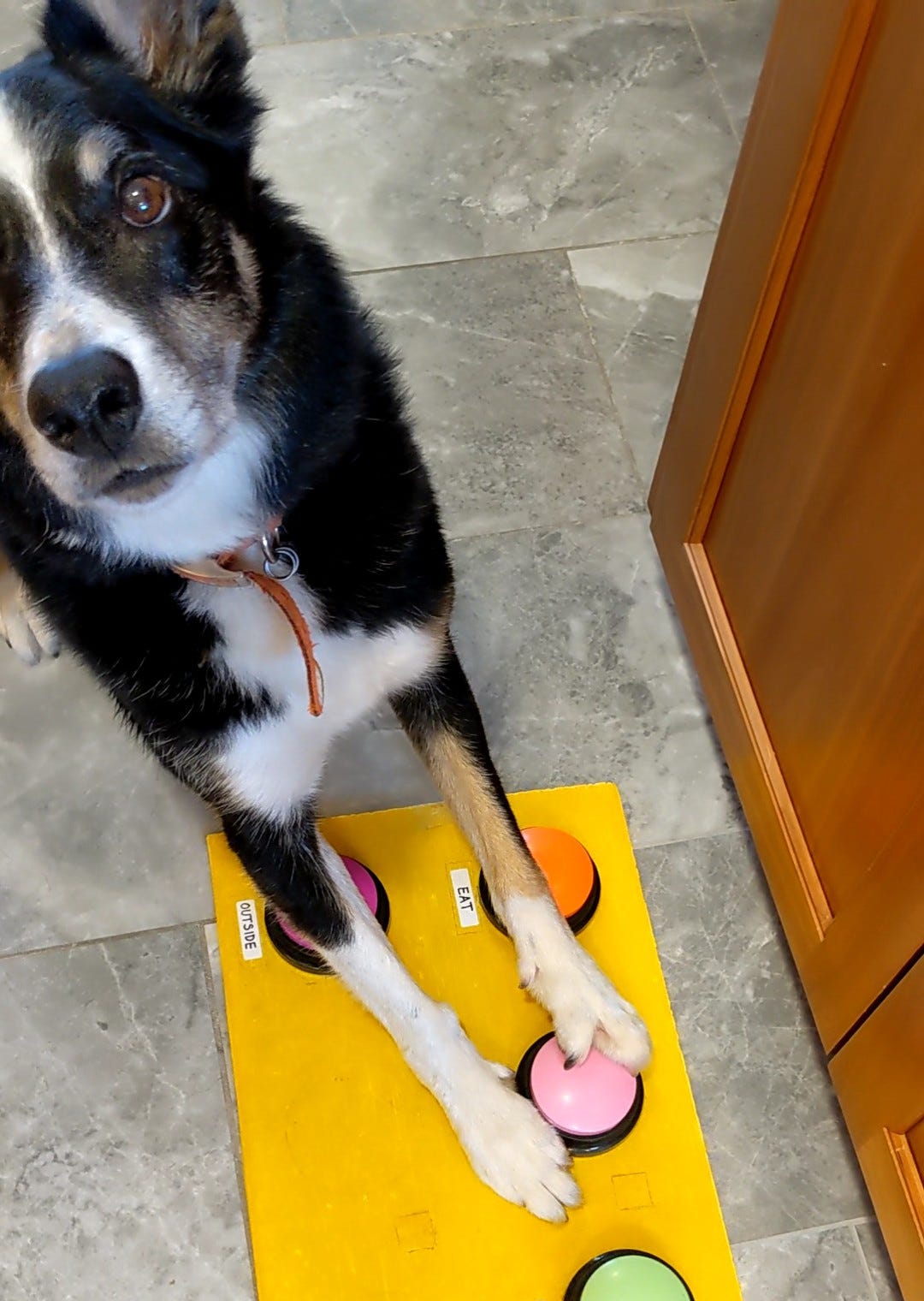
Sure, a string of calamities may grip us and give us empathy for a character — but only to a point. In the big picture, we get tired of characters who flounder endlessly in their own despair and negativity. We’ll empathize better with characters who keep trying. It doesn’t matter that most of their attempts will be misguided and make matters worse rather than better, like those of a hungry dog who paws at its owner’s leg and receives a reprimand rather than a treat. We appreciate that spark no matter the outcome. And eventually (if your dog is my dog), it’ll stop pawing and try something else, like staring at the treats on the counter, or pressing one of its talking buttons, and it’ll get a reward. Maybe not a treat, if the dog fails to press the “eat” button, but something equally interesting, such as a trip “outside” or “play” with a favorite toy.
Tock accidentally presses “Love You” instead of “Eat,” which will result in a head scratch rather than the treat he was expecting.
Dogs are true masters of hope (as for me, I hope you knew I was going to get to dogs eventually). Though they’re not striving for some overarching goal that’s going to change their lives or the world, they demonstrate hope for simple things every single day. I can safely say that in addition to compartmentalizing my troubles into a Hero’s Journey format, the act of witnessing (and helping) my dog achieve his desires for food, walkies, and play has helped me through my own rough patch. He’s a fabulous example to me of how to write a character that never ever gives up. He reminds me that hope nourishes a story rather than the other way around.
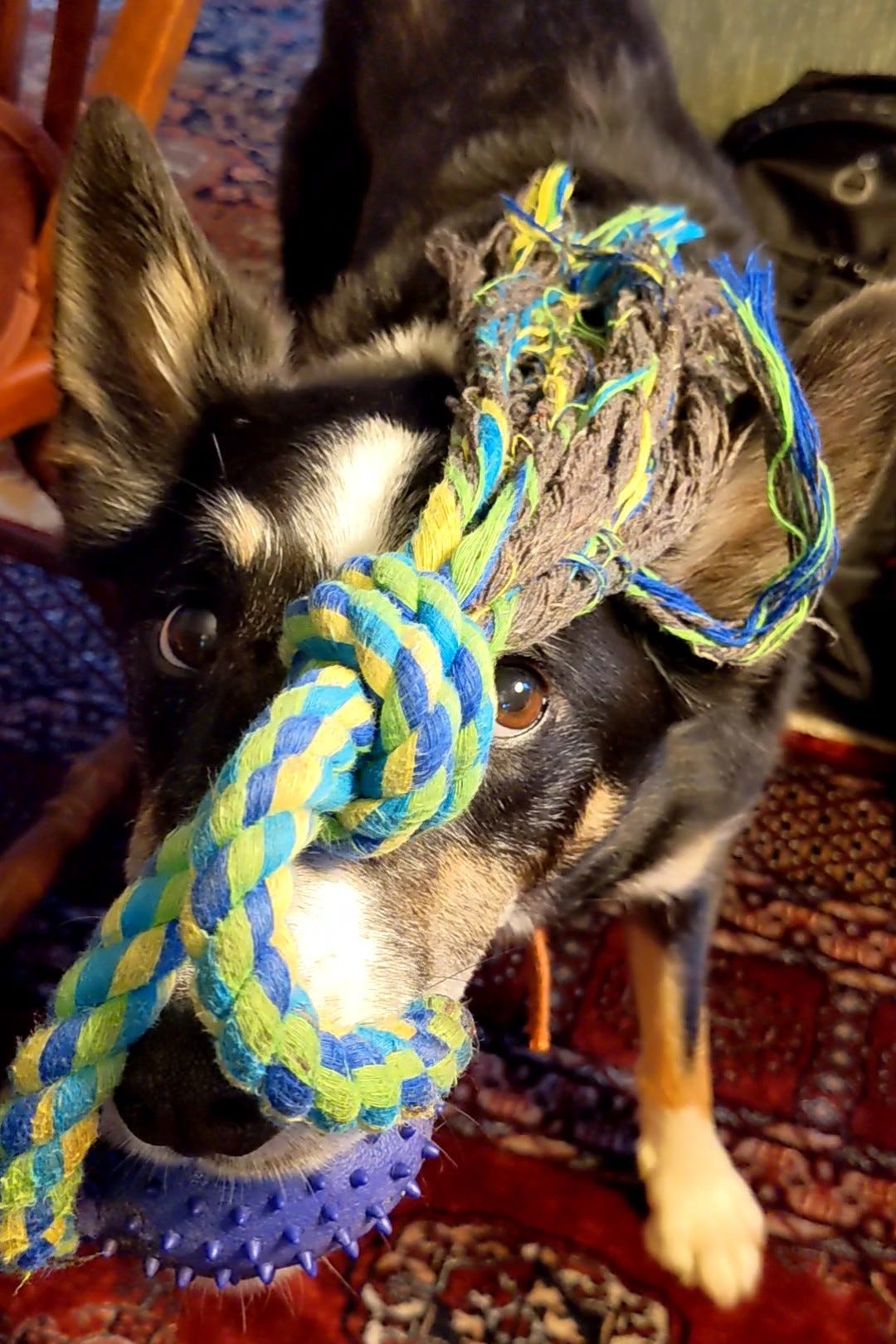
And so, as I make some tentative forays back into the writing world, I will cradle that hope in my palm. I will nurture it from a memory to an ember, a spark, a flame. I will cherish my life as much as those of my characters, and I will remember this every time my dog tells me he wants his breakfast, or a romp in the woods, a swim in the pond, or a tug-of-war game with a favorite toy.
How about your characters? Do they give up too easily? What helps them to keep going? And how about you?
Yesterday, I was walking up a trail when I encountered a person who asked me to hold my dog so she could pass. “Sure!” I said, and called Tock away from a bush he was sniffing about twenty feet off the trail. Once he got to my side, I snapped on his leash and held him there until the woman had hurried by.
Now, this was not a trail with a leash requirement, nor was my dog exhibiting any sort of alarming behavior toward others on the trail (complete disinterest, in fact). But from the woman’s rather unexpected request to the nervous way she went past my dog, she was clearly feeling out of her comfort zone. Though I was surprised at seeing a person with such a fear of dogs on a path where dogs often outnumber humans, I’m impressed that she was brave enough to visit it, and to take the action she needed to get past her fear.
Photo credit: Jakub Kriz
Like a dog-anxious person on a very doggy trail, we all have to do things we’re not comfortable with or not used to doing if we want to make any forward progress. It happens to me on narrow trails that cut into steep, treeless slopes, where vertigo literally causes my feet to freeze in place. And as a writer, it happens to me every single day.
Photo credit: Michael Loftus
No time is more difficult than when I sit down to write the first couple chapters of a new novel. No matter how many weeks I’ve already spent outlining the story, developing the characters, and researching the setting, I still feel a pretty big mental block at actually starting to write. I’m overwhelmed with the thought that whatever I do is going to have huge implications for the rest of the story. I’m overcome with doubt that I’ll have the talent to create entirely new characters in a brand new world.
Photo credit: Evgeni Tcherkass
So if I’m to take inspiration from the worried trail-walker, I need to come up with a plan that’ll get me past my writing roadblock. For some writers, this might consist of simply waiting, putting the writing off for another day or week or month until their story starts to flow into their fingertips.
Not me. If I did that, I’d probably never write another word. I’d turn into a mummified husk of a writer staring at a dusty black screen, fingers permanently frozen to the keyboard. Ugh. I’d rather end up petrified while sitting on a sun-warmed rock by an alpine lake, thanks very much.
Now this would be a terrific place to remain stuck forever!
My plan for stepping out of my comfort zone happens in two steps:
(1) Akin to the dog-fearful person planning in advance to ask for help from those hikers who are crazy enough to own such slavering, vicious creatures, I seek help from my main characters so I can get as close to their eventual voices as possible. I do this by writing some first-person “prequel scenes,” which take place long before the story will occur, and in which my MC’s basic misunderstanding about the world develops (thanks to Lisa Cron’s Story Genius for this brilliant idea). There’s a lot less pressure in writing these scenes than in composing the actual story because they’re not the actual story. Not yet, anyway (full disclosure: I often end up incorporating bits and pieces of them into flashbacks).
(2) After playing around with character voice and motivation in this way, I’m ready to walk past the metaphorical scary dog. I open the document to the blank page and force myself to write. Word after word after word. I’m not saying this is easy for me. It’s terrifying and often feels painfully slow compared to writing later in the story, when I’m comfortable with all the of the character voices and how they relate to one another. But it gets my feet moving along the trail to a place where I feel much safer and happier.
Photo credit: Nick Bolton
This combination of preparation and a little bit of sheer will power goes for any fear I might have. But what if you just can’t muscle your way into writing? Or what if the stranger-dog situation is reversed? What if it’s the dog that’s scared? I actually have a particularly fearful dog who gets nervous when he encounters “unfamiliar” things. I put that word in quotes because something that’s unfamiliar to him is generally not at all unexpected to me, from a visit to the vet to having to enter a barn through a large sliding door. Occasionally, a previously visited stump in the trail that’s turned extra black from rain or extra visible from lack of leaves will cause him to leap back in surprise with a little growl. Oh my goodness, it might attack us!
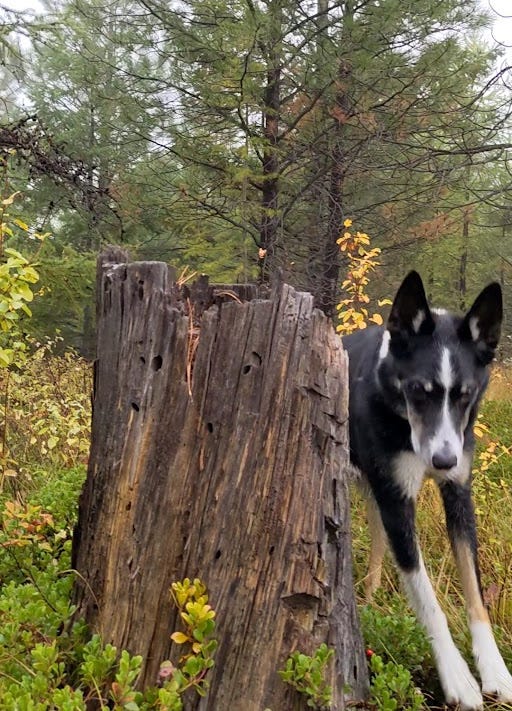
Racing past a scary stump.
I jest, but these are very real terrors to my dog. And since he’s pretty much joined at the hip to me, going wherever I go, I must own his fears and find ways to mitigate them. If you’ve read one of my previous posts, Backstory’s Bad Rap is Underserved, you’ll already know that I deal with Tock’s fear of the vet in the two-step manner I’ve described above. But for most of his fears, I have the option to replace that second step with an alternative that is always, always better for getting a dog over their terror: (3) the use of reverse psychology, or more generally, thinking outside the box.
For the scary barn door, for example, I found another entrance into the barn through a much smaller door. Tock was perfectly fine with going in that way. And once he did, he had no problem exiting—and then re-entering—through the big door. For a suspicious stump, I wait for him to take a single step toward it, and then reward him far away from it, so he realizes that doing one tiny difficult thing reaps great rewards in a safe place. Incidentally, this reverse psychology is the same approach I use for agility students’ dogs who are terrified of the teeter.
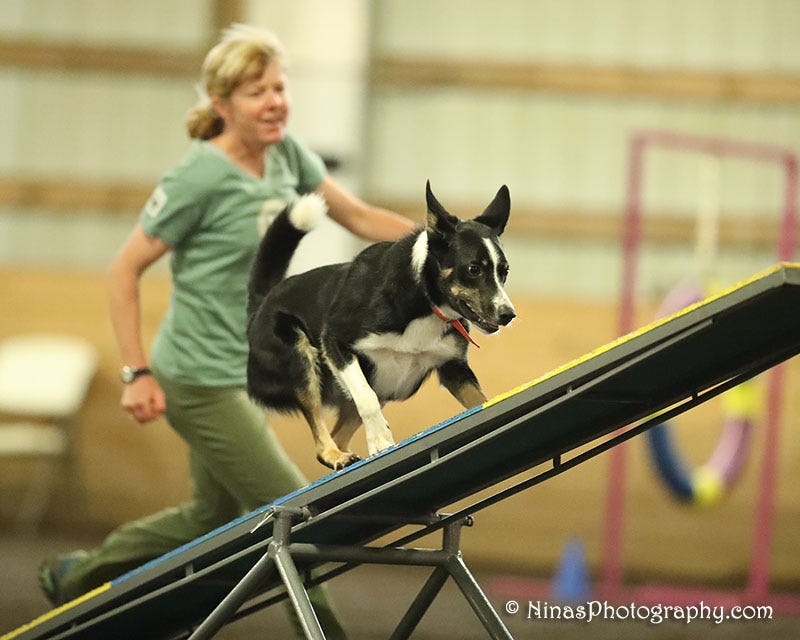
Some dogs are born scared of the teeter’s sudden tip, or the banging noise it makes when it hits the ground, or the height they have to ascend before the board tips. Others become scared due to a frightening experience, such as using a teeter that tips much faster than the one they were used to. Either way, asking for a tiny approach to the teeter, followed by a fun reward elsewhere works wonders (thanks to Leslie McDevitt’s Control Unleashed for this method).
Just as the second step of my Two-Step Approach needs gentling and modification to help dogs overcome their fears, it may need tweaking for you, too. If the setting of the new world causes you to stop and puzzle about it excessively, skip it for the moment and move straight to interiority or dialogue. This allows you to get directly into your character’s head in a manner that you’re already comfortable with (remember those prequel scenes?). Another way to sneak words out of your mind and onto paper is to write more prequel scenes that get closer and closer to the time the story takes place—until they are the story.
What techniques do you use to step out of your comfort zone, past the danger, and into a brave new world?
How to boost your confidence en route to your goal.
I don’t speak in superlatives very often, but the absolute best way to train a dog is through a process called shaping. The basic idea is that you don’t tell your dog what you want, but you reward them for doing it anyway.
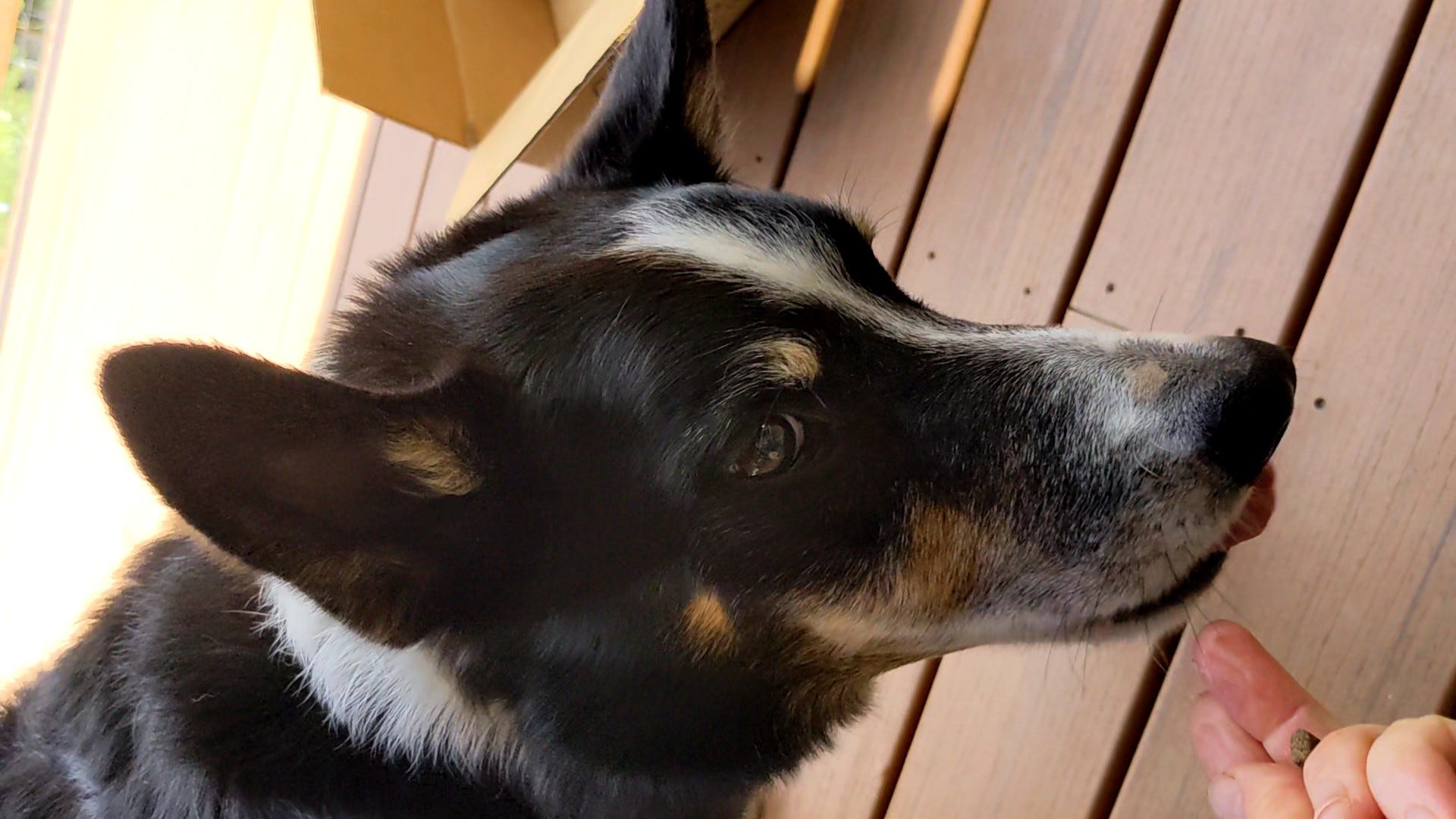
Tock gets a treat for doing something I wanted.
“Hold on,” you’re probably saying. “Why would a dog do something for you—a trick, a recall, a stay, whatever—if you never tell them to do it? Let alone how to do it.”
Thank goodness I’m here to tell you. The trick to shaping is that you start small.
Photo credit: Summer C
Of course, I don’t mean small in the physical sense, but in terms of easiness. The same principle holds for writing. If you’re like most people, you’re not gonna sit down and write a novel on command when someone hands you a pen—especially if you’ve never written anything beyond a high-school essay until this point. No, you’ll start with something easier—a paragraph, a journal entry, a page.
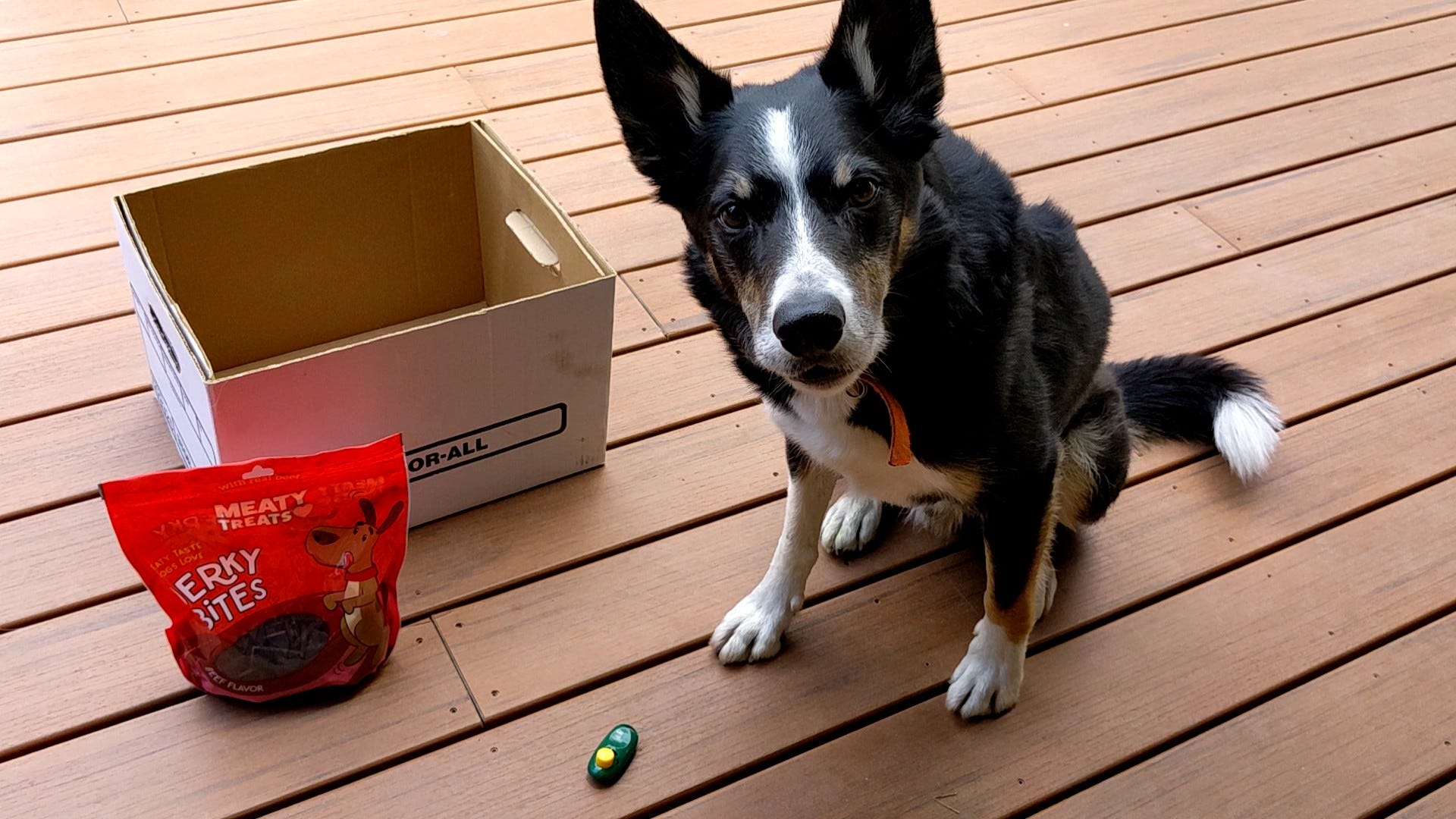
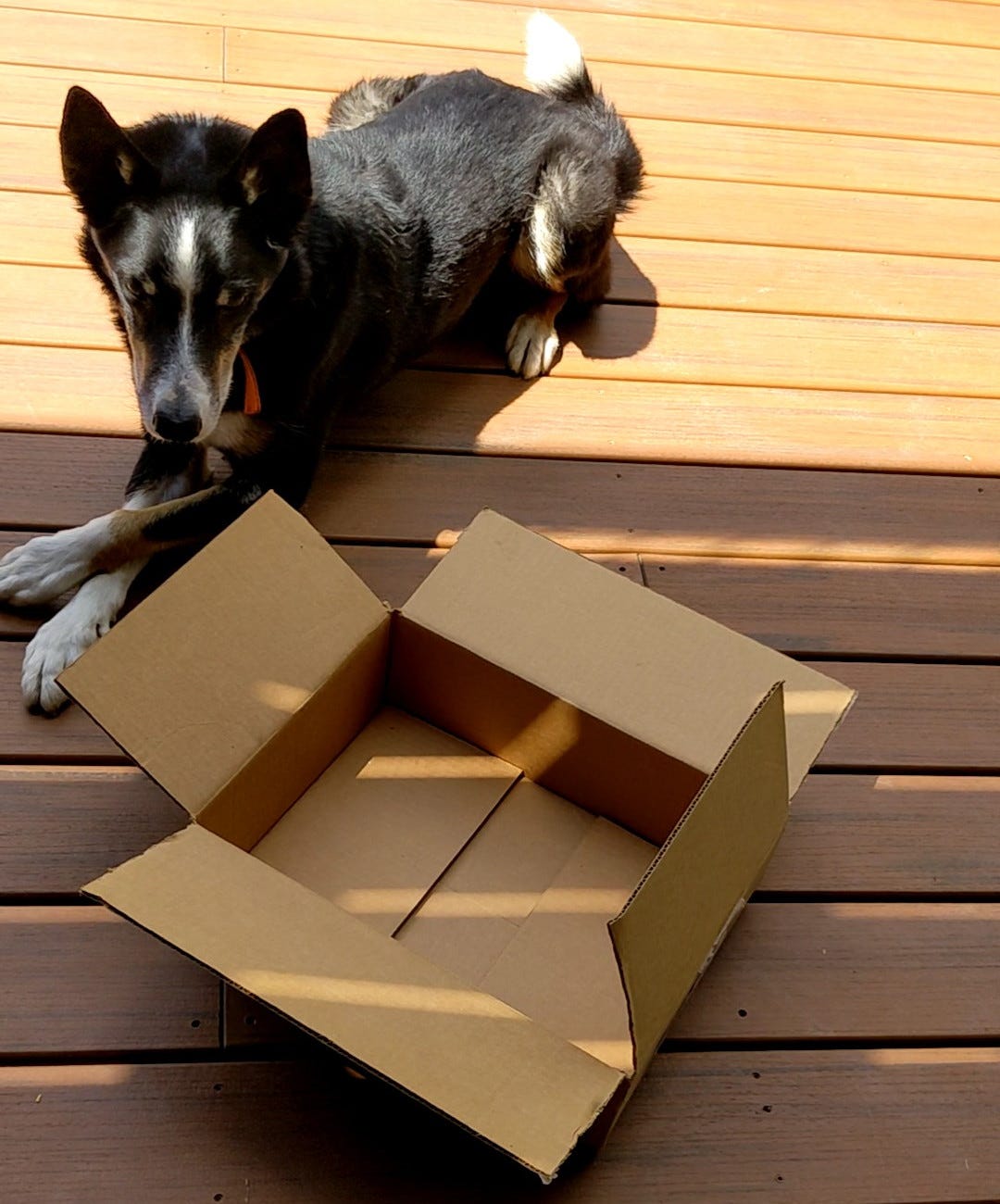
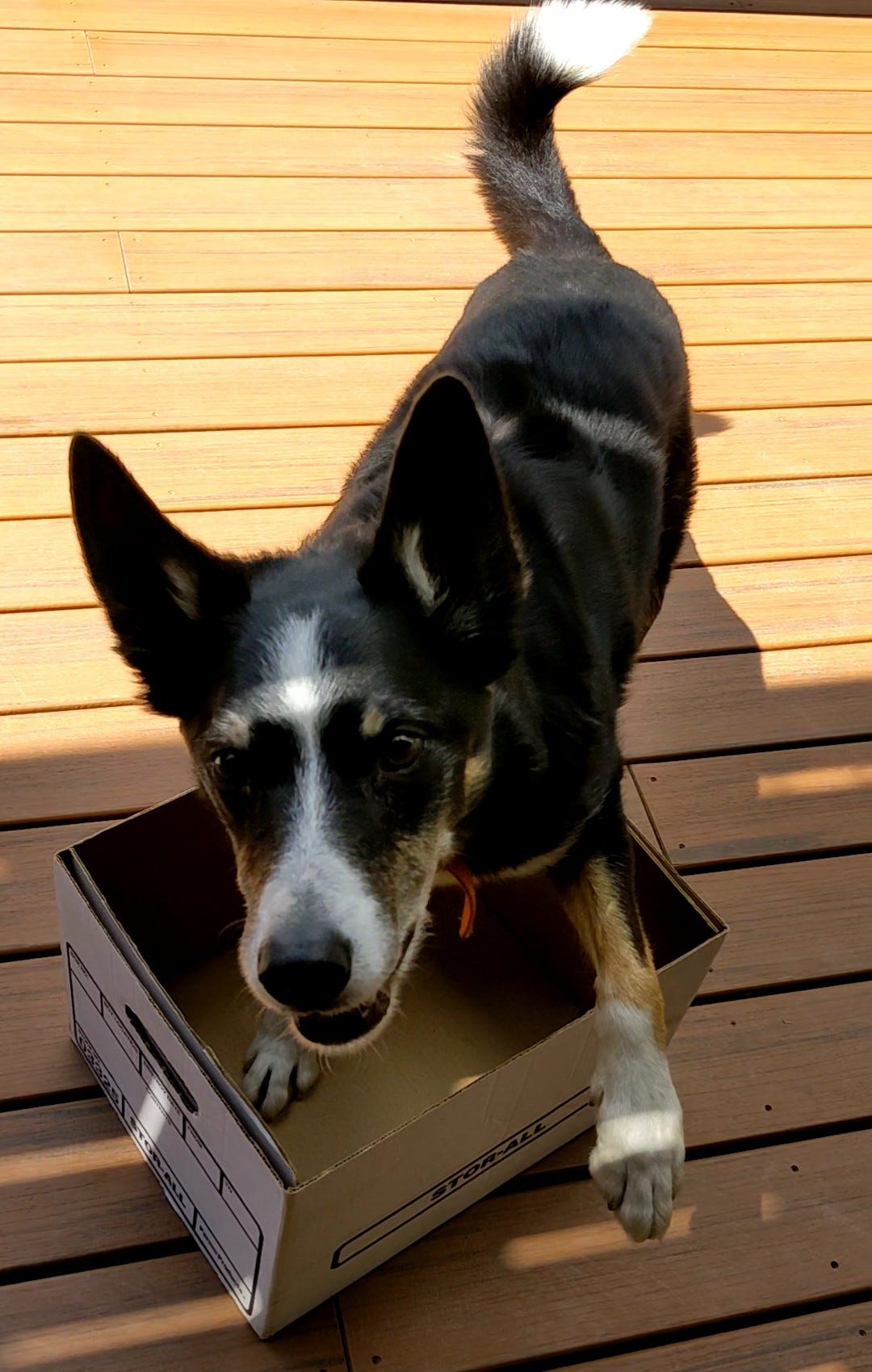
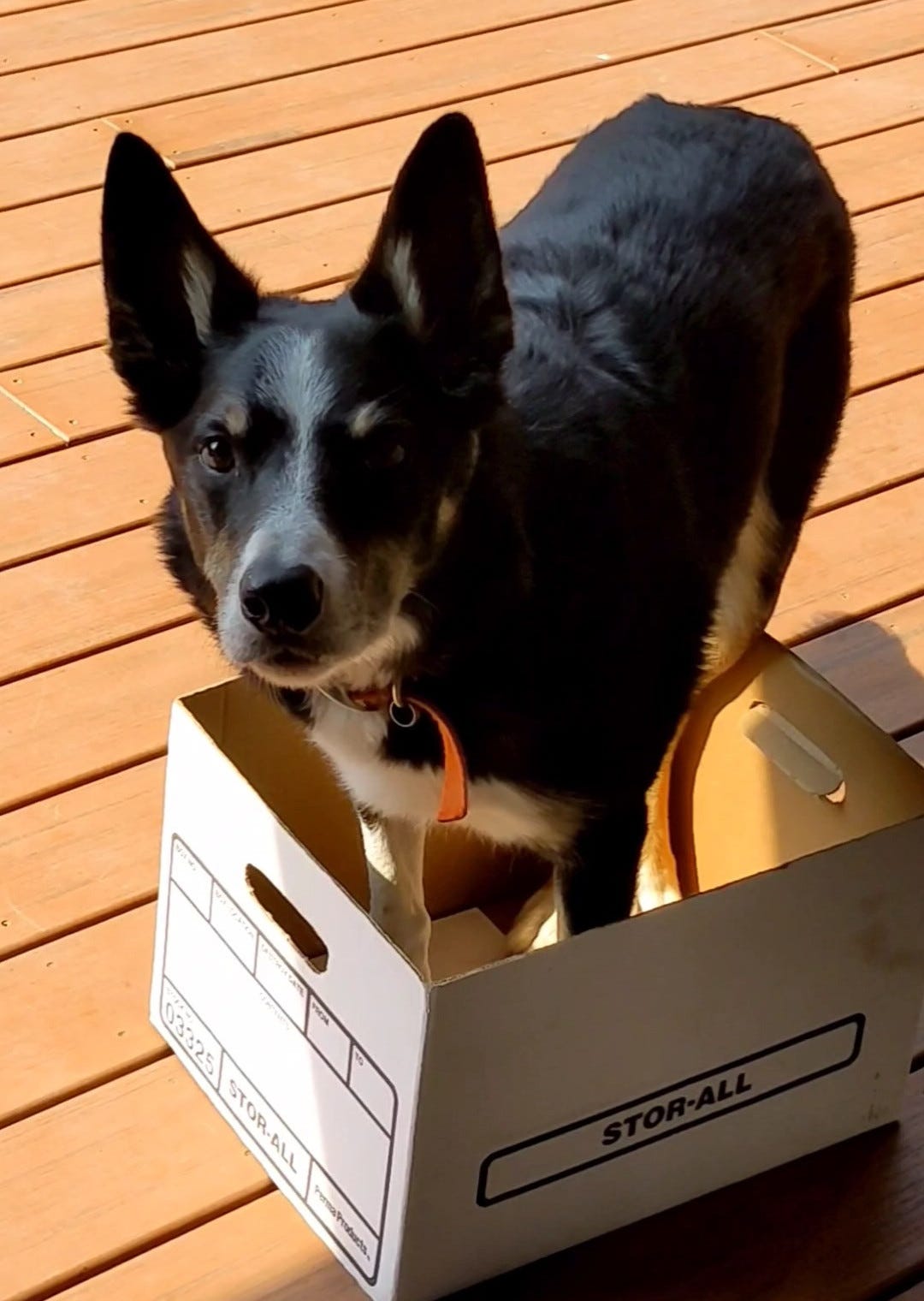
As for your dog, let’s say you want him to stand in a tiny cardboard box. Collect (1) a box that’s not tiny, but is roomy enough for him to fit inside comfortably, (2) a bag of treats, and (3) your dog. An optional item you can bring to the training session is (4) a clicker (I’ll explain more about that in a moment. For now, all you need to know is that it’s a handheld button that emits a loud click when pressed).
All you need to train a dog to get in a box.
The second thing you need to do is very simple: put the box down near the dog. Unless your dog is totally distracted* or terrified of boxes,** he’s gonna check it out. The second he looks at it or sniffs it, press the clicker (if your dog has never experienced a clicker before, you should start by simply pressing the clicker and rewarding, over and over, until the dog has learned that the click means “you’re gonna get a treat!”). Instead of or in addition to the clicker, you can say a one-syllable word like “Yes!” or “Good!” Whatever sound you choose, you’ll use it to mark a behavior, the same way a camera click takes a snapshot to preserve the perfect pose.
*The solution for a distracted dog is to do your training in a boring room with no distractions. **The solution for a terrified dog is to start with something that doesn’t resemble a box. A piece of cardboard, for instance.
Photo credit: Sam Williams
In my parallel writing universe, I’d guess that this external marking of a dog’s behavior is analogous to making the conscious decision to write about … something. To sit down (click) and scrawl or type (click) with a purpose other than exercising your fingers. At the start, when you’re terrified that you cannot possibly write a single thing, just a bullet point for an outline or a sentence for a story will do.
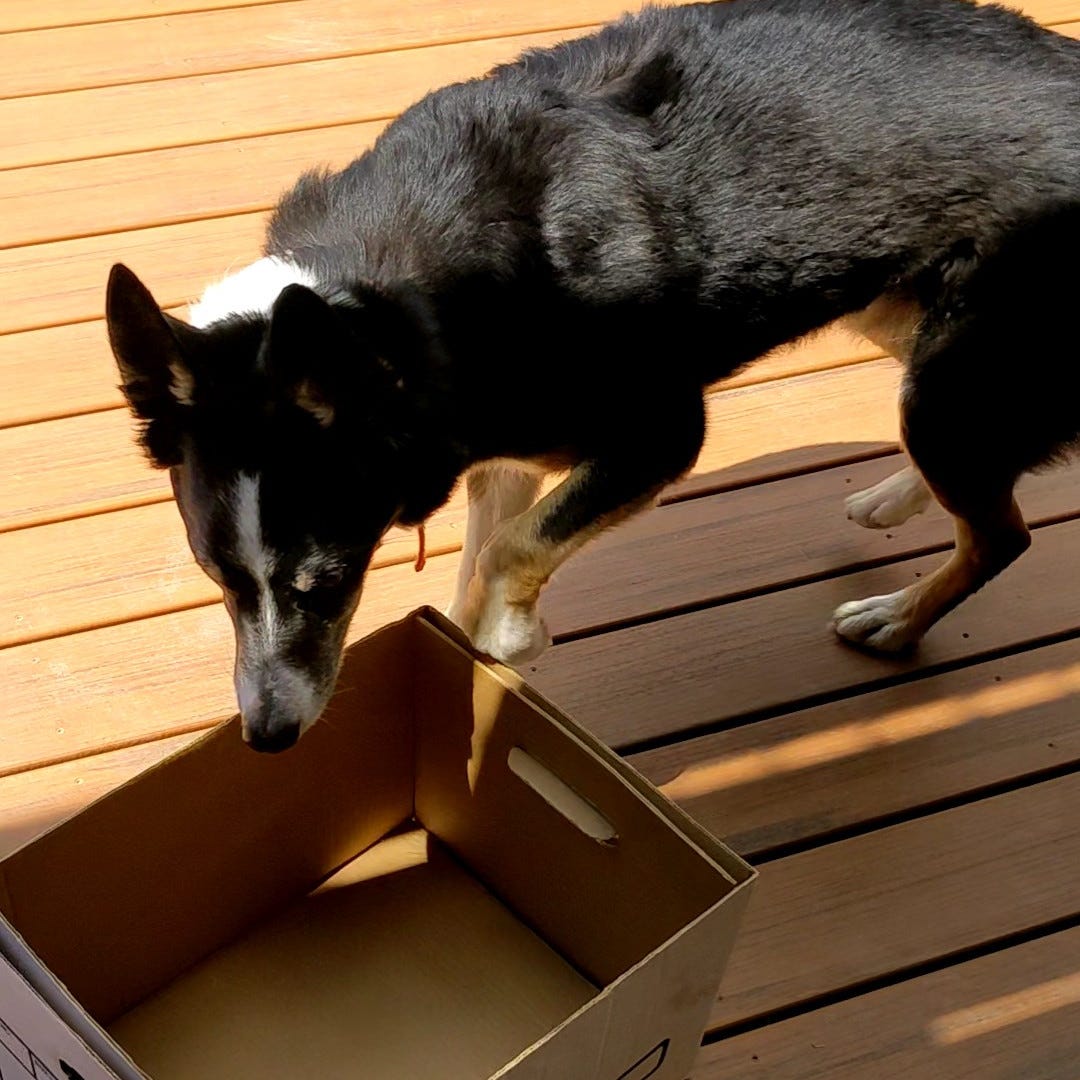
Back to dogs: immediately after clicking, reward your dog with a treat. You can then either pick the box up and put it down again, or simply wait for the dog to do something with it again (either look at it, sniff it, or walk toward it, depending on the dog). After about five times, assuming your dog is hungry, he’ll have caught on that interacting with the box is quite valuable to him.
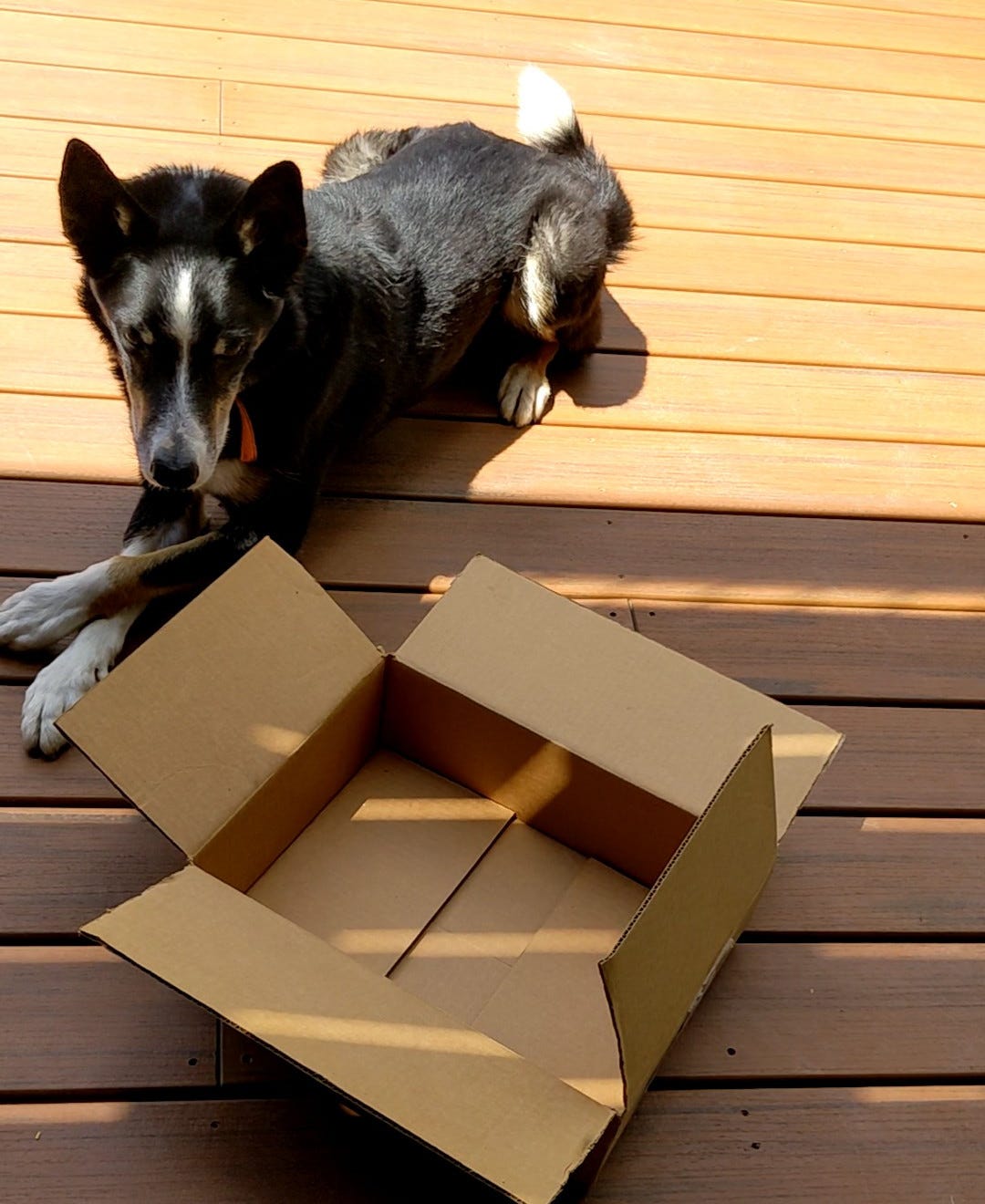
Tock checks out the box when it’s put down near him.
Clearly, writers aren’t going to stuff themselves with a piece of chocolate after every sentence. But when I’m finished writing my sentence, paragraph, page, or chapter, and I know I’ve accomplished a small goal of sorts, I allow myself to read what I wrote. Seeing that my labors produced a tangible result—no matter how much fixing or replacing will be necessary later—is the perfect reward for a writer.
If I rewarded myself with my favorite treat every time I wrote a sentence, I’d no longer be able to move—or sleep. Photo credit: Taisiia-shestopal
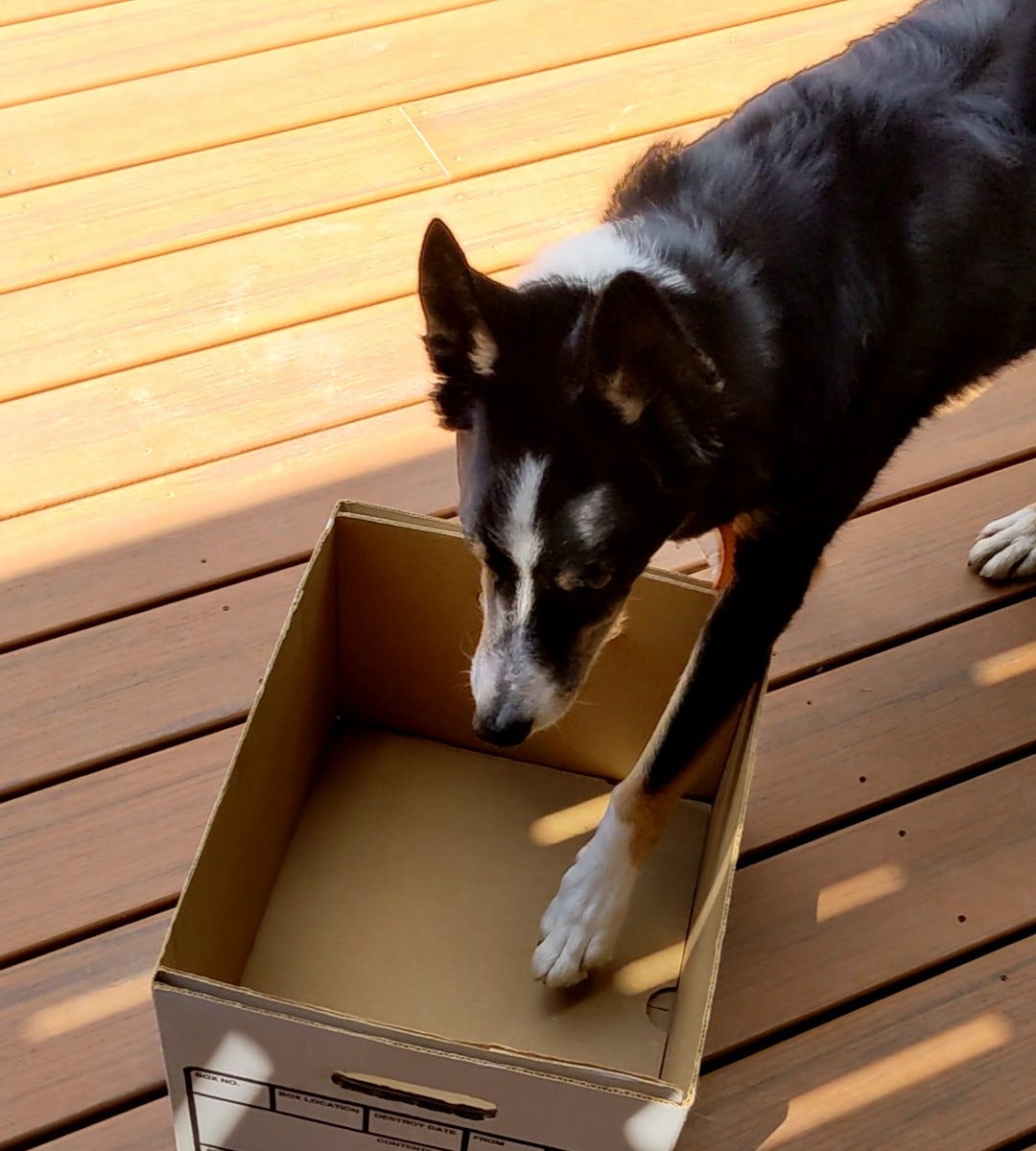
Once a dog has caught onto the game of doing-something-for-a-treat, this is where shaping gets fun. Now you’re going to raise your criteria for the click. Rather than stagnate at that one level of behavior, you’ll expect further progress. If your dog was looking at the box for a reward, wait until he sniffs it to mark the behavior. If he was sniffing it, put it a little farther away and wait until he steps toward it. If he was already stepping toward it, wait until he paws at it. Then until he puts a paw inside the box. Then two paws, then … you get the idea.
There are two important things to remember about this stage of shaping: (1) it requires great patience to wait for your dog to try something new, and (2) if your dog gives up or goes into mental meltdown, you’re raising the criteria too fast.
Tock tries a different trick in the hopes that it’ll earn him a treat. It doesn’t.
If you’re a writer, these things might sound familiar. You know the tremendous patience and dedication that it takes to craft a story. You know just how much you can push yourself toward your goal without becoming overwhelmed and demoralized—and stop writing altogether (like 99% of people who say they’ve got a novel inside them to write, but then never end up writing it). You learn your craft in stages, you write some, you learn how to read your material critically and perfect what you’ve written. Eventually, you will write a complete work and be able to type THE END. Only now can you label it for what it is: a story!
Likewise, a trick that a dog learns through shaping only gets labelled once it’s complete. Your dog not only hops eagerly into the box, but stuffs himself into successively smaller and smaller boxes until he’s performing the behavior you had in mind all along. “Box!” you might call it, or “Get in!” You’re ready to ask him to repeat the performance in other places, with other boxes of various shapes and sizes, and you’re reasonably confident that he’ll do what you ask.
Best of all, shaping has created a thinking dog, who voluntarily offers harder and harder behaviors all along the way to the finished product. He knows that when you get out your clicker and your treats, all he has to do is start offering behaviors and he’ll figure it out. Training him to do other tricks becomes an easy feat.
Success: all the way in!
Though the book we want to write is bound to take longer than the trick we teach a dog, we too can use the principle of shaping to simplify the process. All we have to do is start with an easy goal, accomplish it, and move on to something harder. We’ll learn how to write the first description of setting, dialogue, backstory, action … and keep upping our skills so we can write more. We’ll knock off the first page, first chapter, midpoint, climax, book. And because we’ve taught ourselves how to do it, why stop with one book? We can do it again, and again, and again…
(Or: How do you know when your story has reached the “Goldilocks Zone?”)
Photo credit: Cleanlight Photo
When is a story good enough to stop working on it?
This is one of the most pressing questions facing the author of a revised manuscript (correction: a revised-and-revised-and-revised-to infinity manuscript). If you’re a conscientious and possibly obsessive writer who wants to produce the best possible experience for your reader, you won’t stop after the first couple drafts, regardless of how much organization and preliminary revision effort you’ve already put into them. You’ll keep re-visiting it, at first maybe making sweeping changes, followed by smaller and smaller alterations, sending it out to alpha readers, beta readers, critique groups, and paid professionals. Even after you’ve ceased finding anything wrong with it beyond an occasional typo, the people you solicit to look at it will make suggestions for improvement, every single time.
After looking at your manuscript so much that you no longer have any idea whether it’s good enough, and in fact might be getting worse with all the attention, I recommend a very simplistic formula to figure out the answer, which will place your work in one of three categories. It relates back to—big surprise here—going for a walk.
1. Your story’s too cold: Readers can’t connect to the unfeeling, underdeveloped, or commonplace characters, the plot meanders without actually going anywhere, the world lacks the spark of details. This is me when I first step out the door to go on a walk at dawn. The purplish air, even if it has the promise of heat in a few hours, turns my fingers to ice and my hands and forearms to the texture of cold marble. I’m so immersed in trying to stay warm that I enfold myself in my hood and pockets and trudge along looking only at my boots. I could be walking to the end of the driveway or I could be climbing Mt. Everest. How would I know? I’m too sunken within myself to notice.
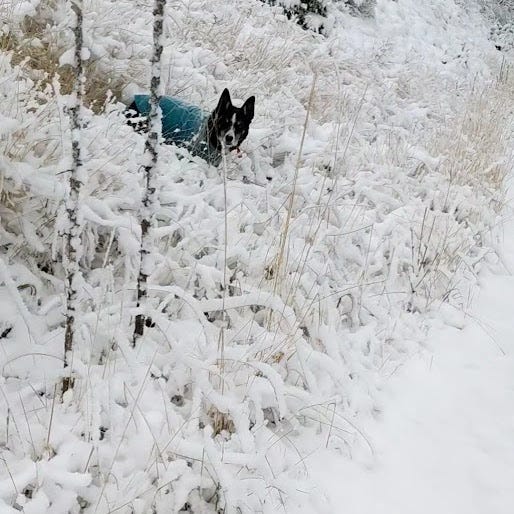
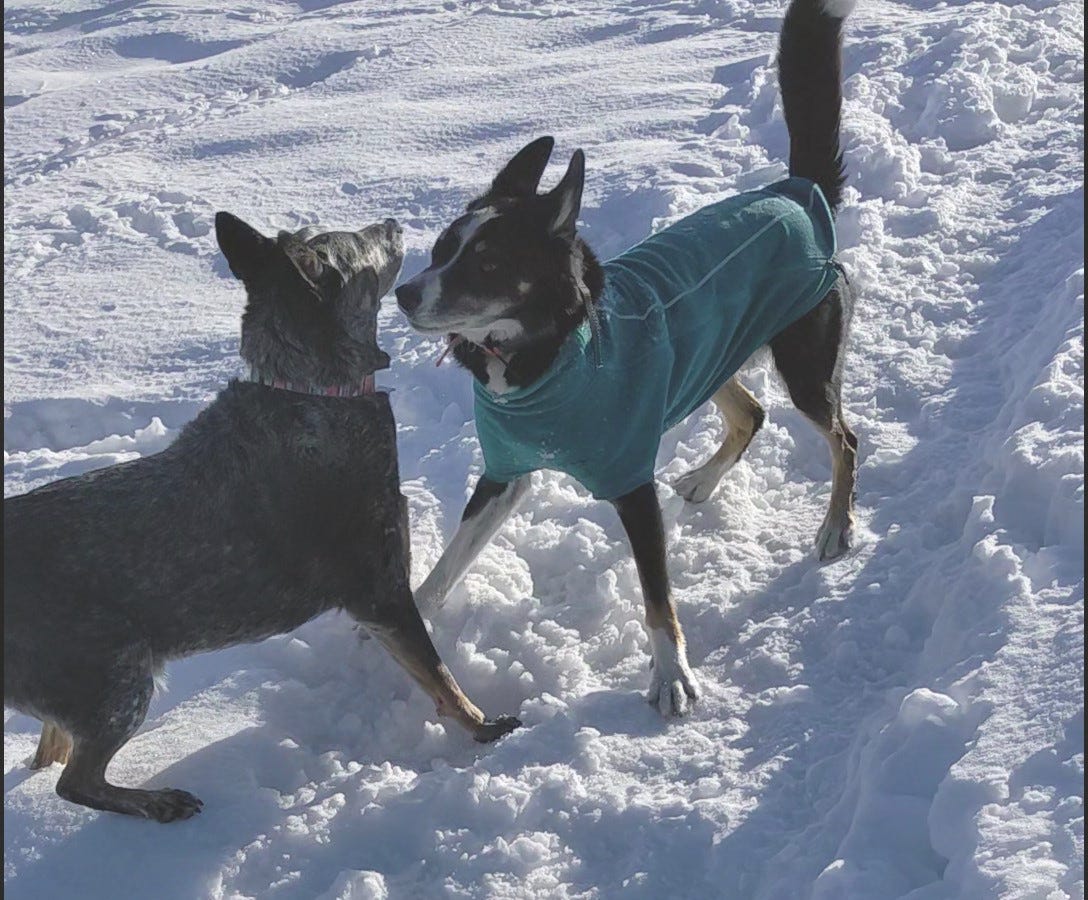
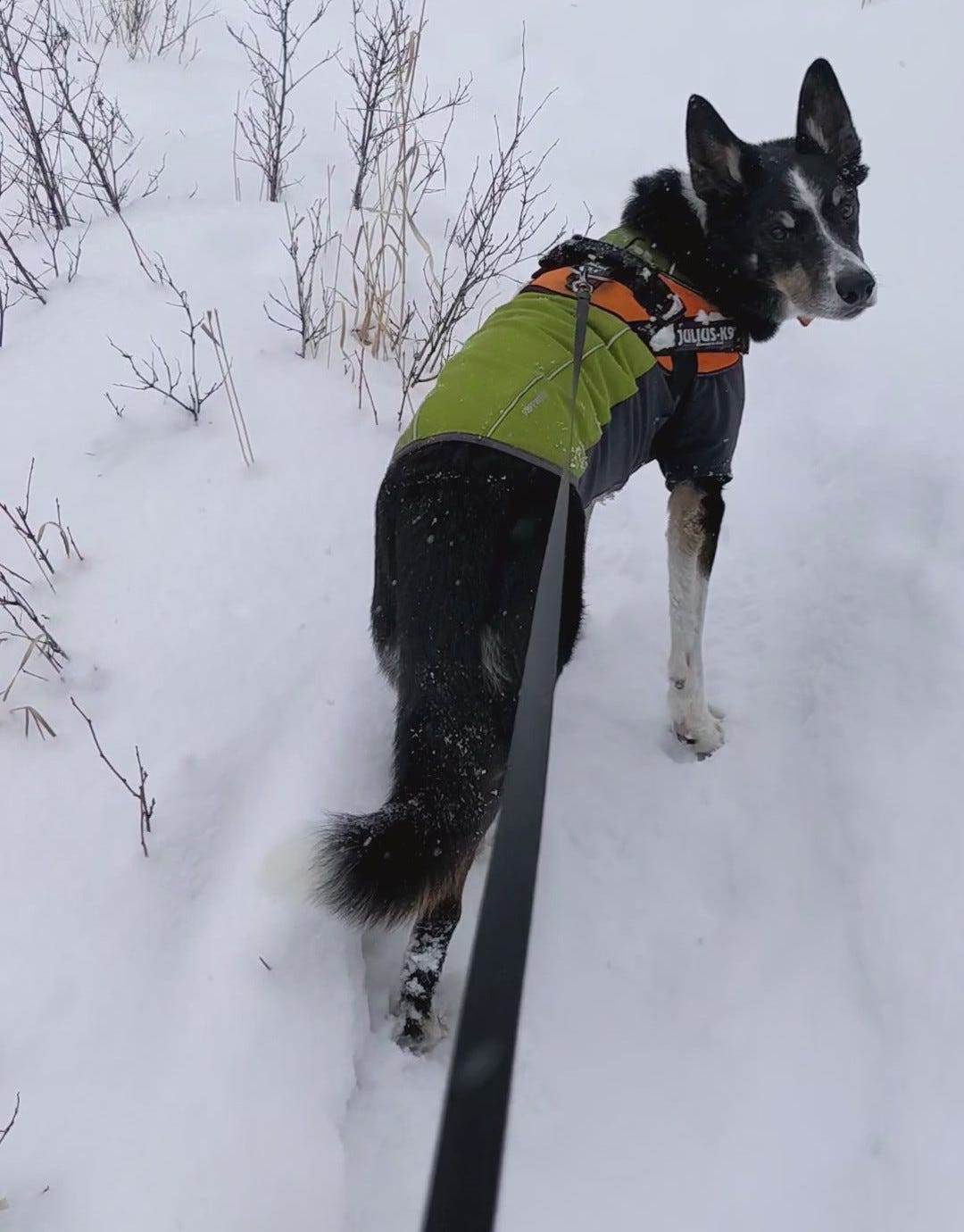
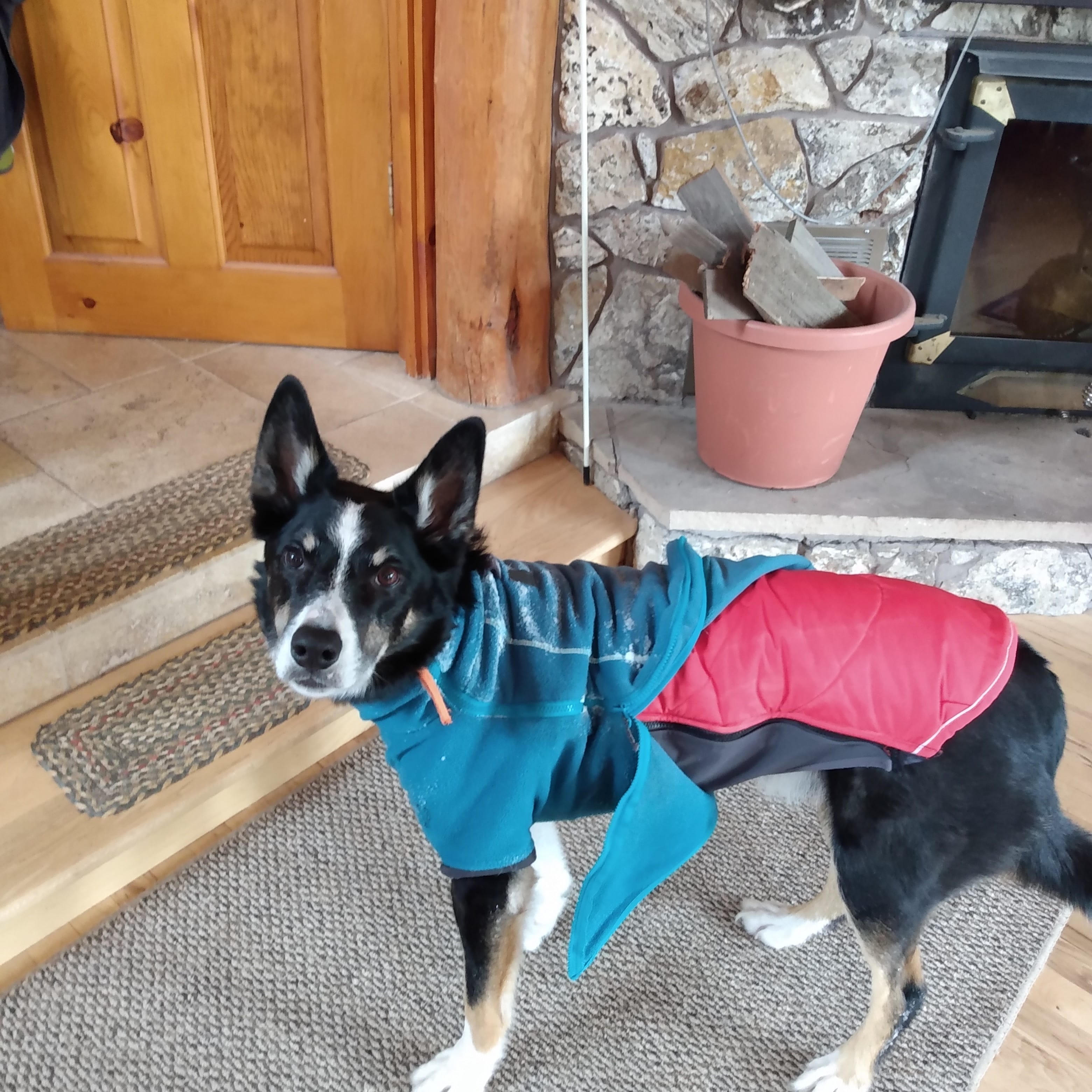
Because of his short fur, Tock, too, wears a jacket when the temperature dips below freezing . Sometimes two jackets, if it gets down into the teens.
2.Your story’s too hot. You have so many characters and plot lines that readers can’t keep track of them all. Reviewers suggest that perhaps you have more than one book within your pages. The scenes overflow with backstory, info dumps, unnecessary dialogue, or superfluous adjectives. This overheated state creeps up on me about ten minutes into my walk. I find myself ripping off my gloves and wiping my sweaty hands on my pants. The sun hasn’t yet made its appearance and probably the air temperature hasn’t begun to change, but internally, I’m beginning to feel insufferably warm. My gaze jumps from one rock or tree or viewpoint to another, and I struggle to focus.
On hot, dry days, dogs need plenty of water breaks. Here, Tarzan & Tenzing take refreshment during a long-ago hike.
3. Your story’s just right. I prefer this phrase to “perfect.” Words, phrases, scenes, and stories are subjective, and every reader is going to like and dislike different things about them. Our stories won’t ever be perfect, because that state simply doesn’t exist. They’re not mathematical formulas. But readers will be most likely to enjoy them if there’s a nice balance of characters and plot, a thoughtfully paced mix of dialogue, interiority, and action, if there are enough details to see the world and understand why the characters do what they do, and if the character and plot arcs resolve themselves in satisfying ways. For me, this Goldilocks Zone on a walk happens most often on a calm, sunny-but not-too-hot day after I’ve reached a ridge or a lake basin. It’s a place where I can walk on mostly flat ground, still getting some brisk exercise in the invigorating fresh air, but not so much that I’m out of breath.
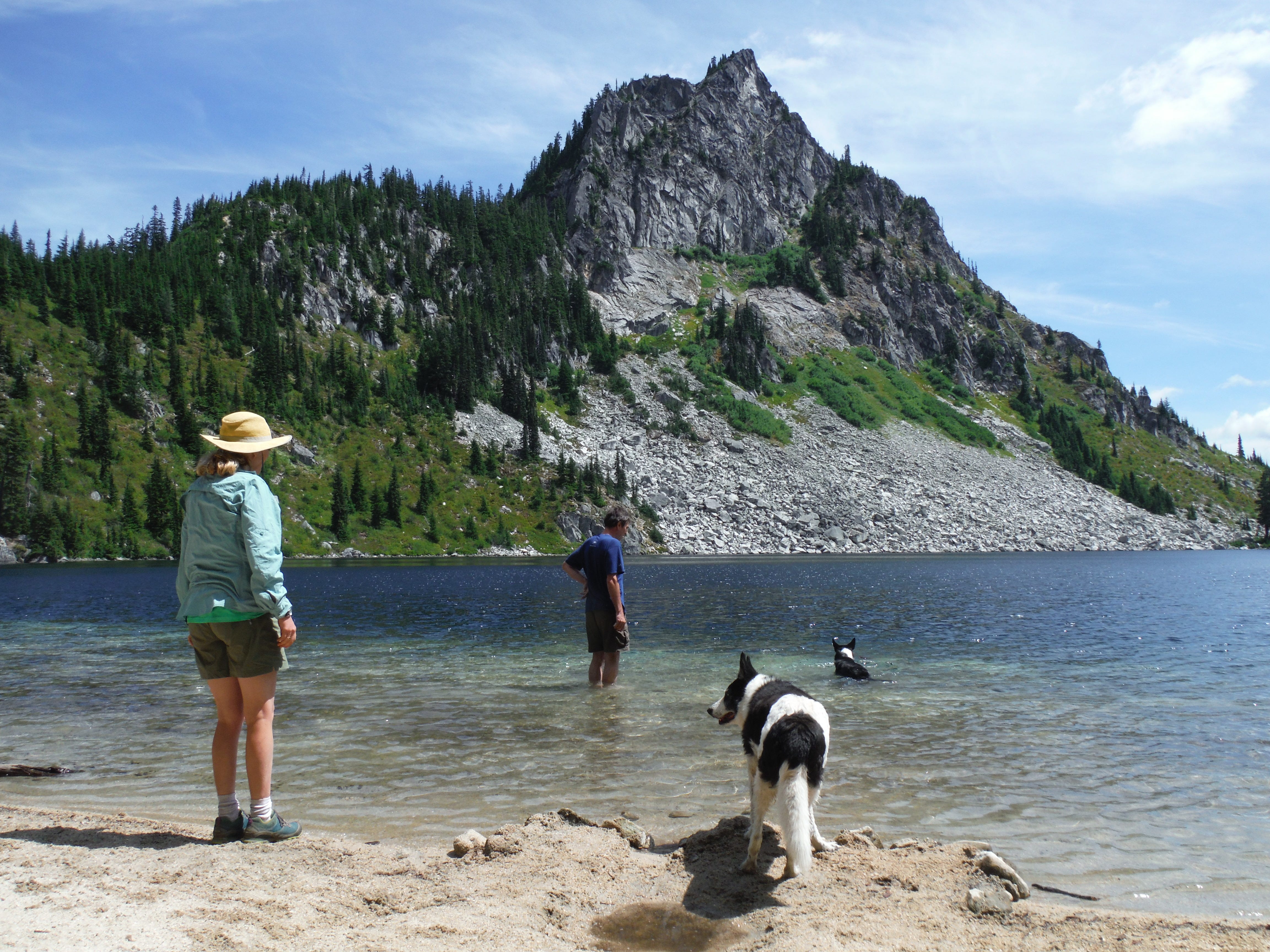
An alpine lake: my personal Goldilocks Zone
At some point during the revision process, it’s up to us writers to decide when we’ve gotten into the “just-right” zone. Any more tinkering beyond that point might start to suck the life out of our story, because we’re so far past that first euphoric flush of actually writing it. Yet I feel I’m a bit hypocritical to talk about this happy zone because I often have trouble turning off the self-editing mode for my own manuscripts. Even after I’ve reached the point where I have to re-visit my premise just to remind myself why I wrote the darned book in the first place.
Maybe I struggle with putting an end to revision because I hardly ever reach that state of satisfaction with the clothes on my back. Here’s my excuse: I live in the Rocky Mountains. Morning air is cold and often breezy, especially in the winter (wanna come for a walk with me at 12 degrees F—not counting wind chill—anyone?). Hills are steep and plentiful. Flat sections of trails are rare, especially near my house where I mostly walk. So no matter the season, I start out with multiple layers of clothing. Even in mid-summer on a warm morning, I need a little brisk exercise before my hands lose their chill and regain their function. And when it’s far below freezing in the winter, I’ve been known to wear five layers on my torso and two on my legs. Still, I’ll warm quickly and feel the need to tug my arms out of my sleeves, ending up at a single layer.
Ready to brave the wintry woods
My husband says I have poor temperature control. I say I’m being smart. Secretly, I know he’s right … to some extent. My body temperature seems to fluctuate a lot more widely than his, and my extremities routinely segue from frozen and numb to overheated and sweaty, over and over during the course of a walk, depending on whether I’m walking up or down hill. I envy him for only having to wear one or two layers, every time.
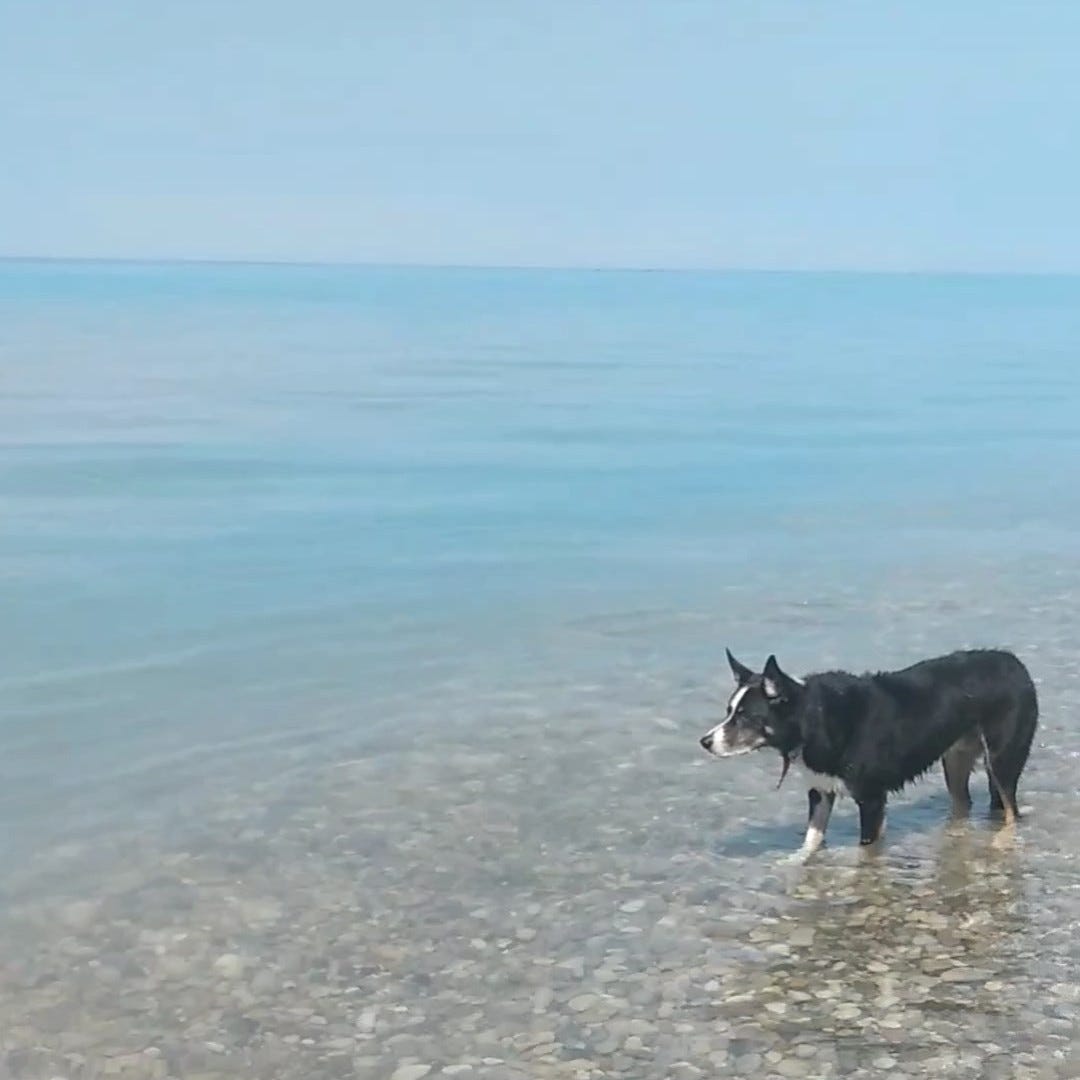
I’m even more jealous of my dog. Sure, he wears coats because I put them on him and he jumps into lakes because I throw sticks for him, but he’s pretty much always in the Goldilocks Zone. His fur coat, though short, is quite suitable for a range of temperatures. With the thick undercoat he grows in the winter, he probably doesn’t need a jacket nearly as much as I think he does. If Tock were a writer, he’d compose one, two, maybe three drafts … and be done. No more nitpicking and dithering; he’d be happy with what he produced and move on.
I can’t help but think about wild animals in this context, too. They don’t have owners to dress them and care for their every need. What if the summer is especially hot and dry, or the winter is filled with unpredictable and severe storms? What if animals can’t adjust to these changes in their environment in time? Evolution of adaptations is a long, slow process—far slower than the current pace of climate change. Most creatures have evolved to survive perfectly in the Goldilocks Zone of their current habitat, and they lack the ability to strip off their layers, or flee to a place with more shade, water, or warmth. Or less of those things. If they were writers, forget the revisions. Their stories might end before they finish the first draft.
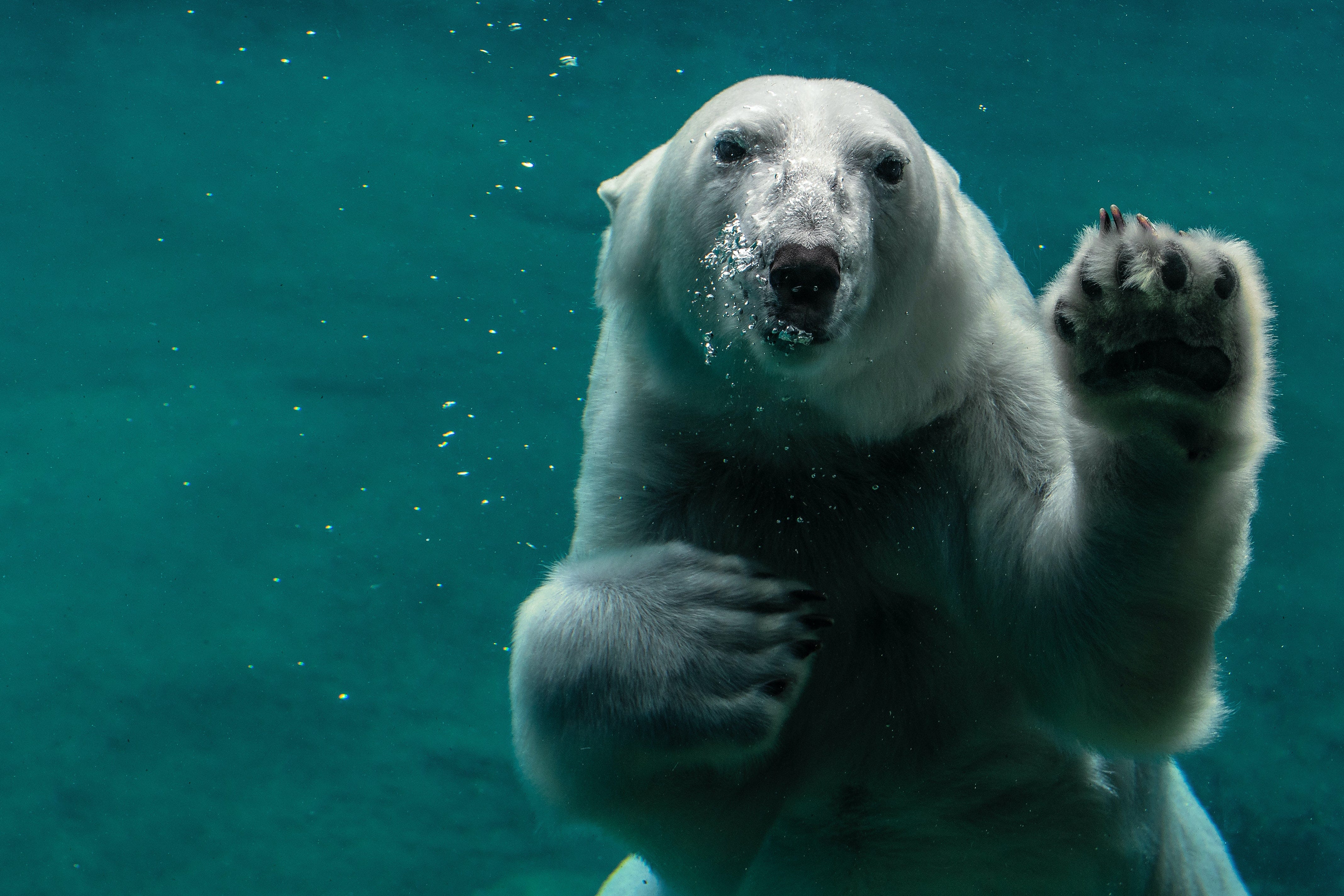
Polar bears are the most famous of the many species that are running out of time, living on a planet with an ever-shrinking Goldilocks Zone for their particular needs. Photo credit: Peter Neumann
Astronomers are on a quest to find other planets with the same large-scale Goldilocks Zone as Earth, where temperatures allow the existence of liquid water. This is primarily part of the effort to search for extraterrestrial life, but I suspect many people think the hunt is valuable for another reason: as a way to find other places humans might relocate to when we’ve outgrown our home planet. To me, this is akin to throwing your story in the trash and starting over. Similar to Planet Earth, populated with almost nine million species, a draft is an incredible accomplishment, filled with thousands of words that have been organized to work in harmony. Let’s keep these stories, no matter the scale, and figure out how we can make them “good enough” for everyone to enjoy.
Even though they don’t speak, dogs have an incredible ability to understand language. I can hardly think of a dog who doesn’t get excited when they hear the words “walk,” “dinner,” or “get it!” Conversely, they’ll put their tails between their legs when they hear words like “no,” “bad dog,” or “leave it.” And if they’ve been trained well, they’ll respond quickly and correctly when they hear “come,” “sit,” or “down.” They demonstrate that they can distinguish between these words through their appropriate responses to each one.
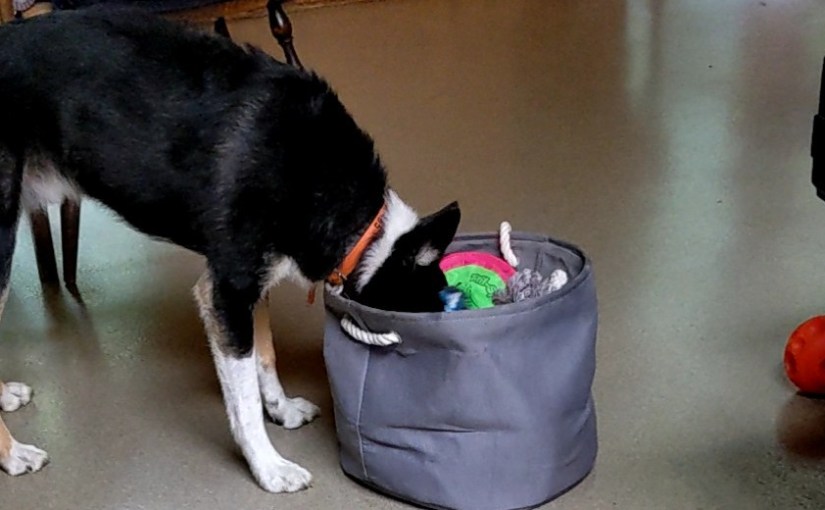
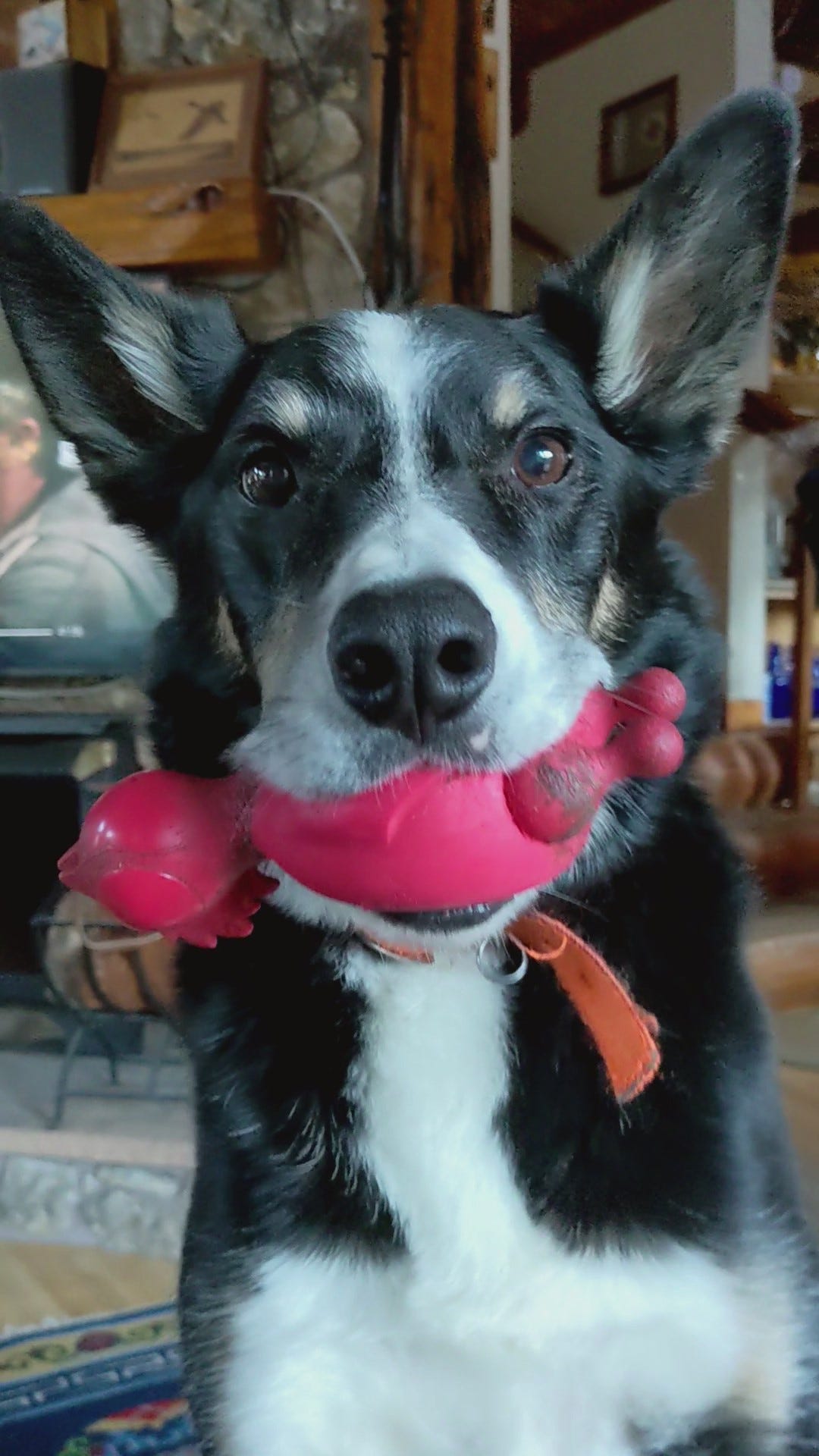
Tock fetches his rubber chicken when asked, even if it’s hidden in a pile of toys in another room.
Naturally, this canine affinity to words is super exciting to someone who writes. I can spend enjoyable day upon day searching for the perfect words for my stories … and I like to give my dog that opportunity, too. In agility training, I invest a lot of time in deciding which words to use for commands—for my students’ dogs as well as my own. Our time running a competition agility course is short—from thirty to sixty seconds, usually—so we don’t want to blather on, using three words when one will do, or hollering out a word that’s difficult to enunciate or one that could be confused with other commands we’re also using. We need the right word for each situation, telling the dog exactly which obstacle to take, how to take it, or where to run.
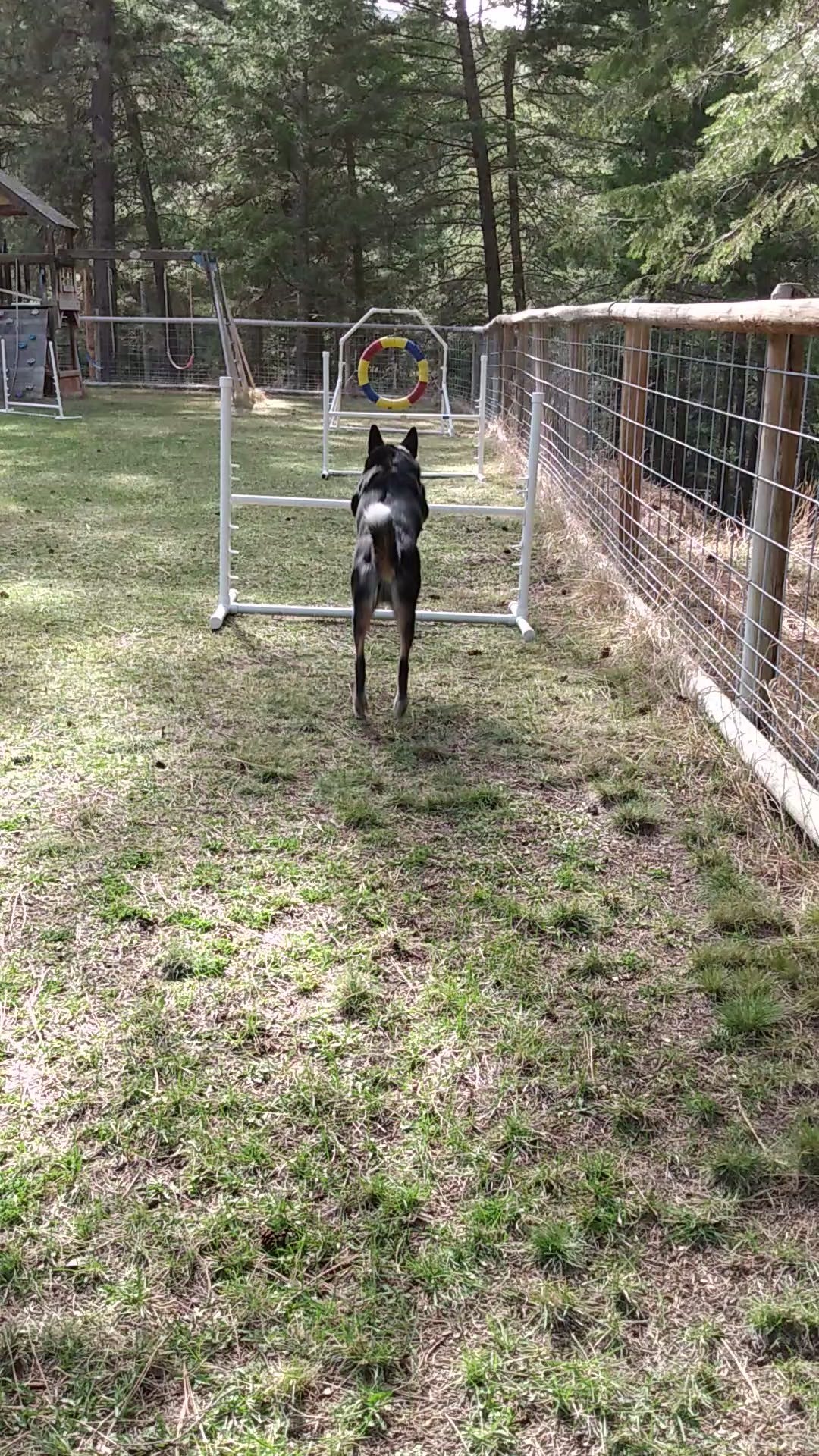
Tock responds to the “Dig” verbal cue. My dogs learn 4 commands for different turns, which they receive as they commit to an obstacle, alerting them to collect their stride so they’re ready to turn. “Right” means turn 90 deg to the right, “left” is 90 deg to the left, “dig” is a tight righthand wrap (much more than 90 deg), and “tuck” a tight lefthand wrap. The prefix “Go” before any of these words tells my dog that I’ll be crossing behind him as he takes the jump ahead of me.
Humans are intensely verbal creatures, and the more our dogs can understand us, the happier we are in our interactions with them. From the dogs’ perspective, words provides them with a way to learn and grow even as they age. You may have heard of the border collies who’ve mastered 200 to 1,000 or more words for their toys. Even more impressive, though, is the latest evidence that shows dogs have the capability to learn new contexts for words, and to put words together into novel (and appropriate) phrases that they’ve never heard before. And the coolest thing is that dogs can learn to communicate using these words, rather than simply hearing them as commands.
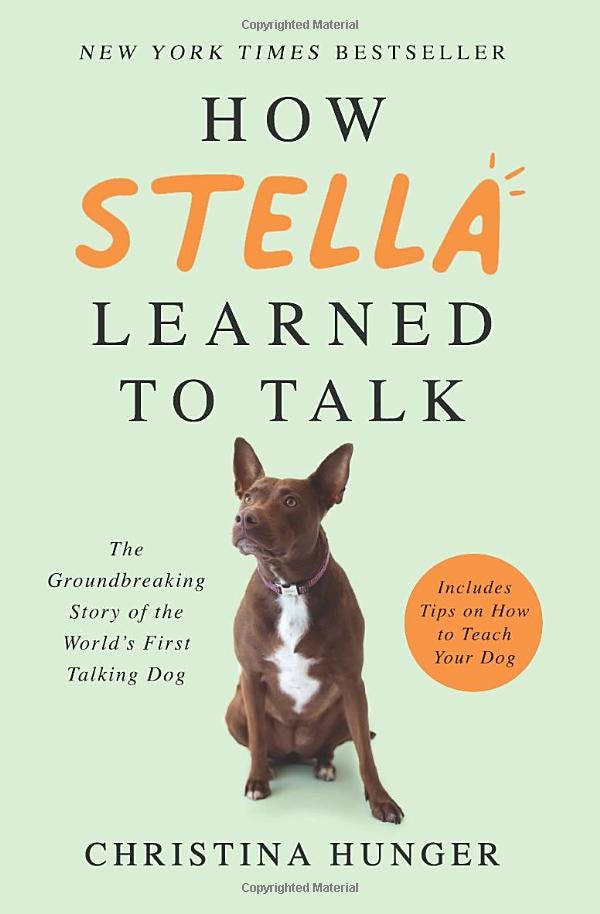
Thanks to Christina Hunger’s book, Tock is learning to use his knowledge of words to get what he wants.
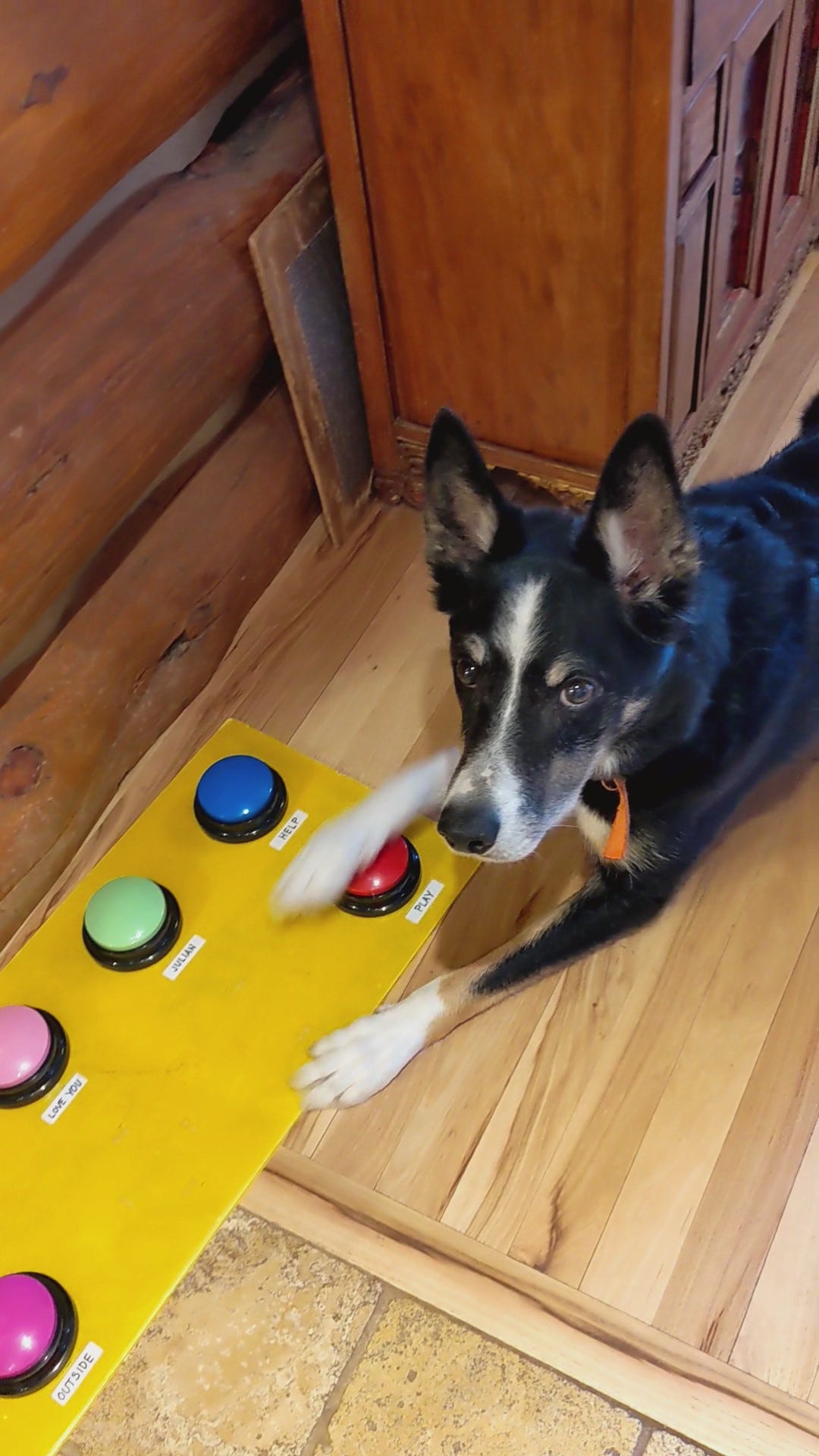
Tock mastered his first “talking” button within a week, though at eight years old, it’s taking him awhile to understand that he can ask for things whenever he wants and not just when I expect him to.
If you’ve read my previous posts, you’re probably wondering how I’m going to tie canine word use to some sort of writing advice. I will not disappoint, so here goes: I think that the satisfaction gained from the ideal word has a positive effect on the relationship not only between humans and dogs, but between writers and readers. As my critique groups know all too well, one word I write quite a lot in my comments for other people’s writing samples is “vague.” It almost always applies to word choice. Verb choice, in particular.
This attention to verbs is probably no coincidence for me. In the dog world, I’m constantly looking for new verbs to describe actions my dog uses that I, in turn, could put to use in agility or on Tock’s button board. But I’ve found that many writers get lazy when employing verbs, saying things like “she came forward,” or “he moved across the room,” rather than a more descriptive verb that gives us additional information. How do these characters come or move? Are they skulking, trotting, hurrying, bounding, or stumbling?
Another problem that brings out my metaphorical red pen is when writers employ boring verbs to describe characters engaging in the repetitive motions that we all do a million times in a day. These include words such as “looking,” “staring,” “gazing”, “turning,” or “pointing.” Now, I’m the first one to admit that finding substitutions for these words isn’t easy. How can we show what our characters are seeing without using them? My first choice for a solution is simply that: show it. Just describe the thing they’re looking at, and the word “looked” is implied. The reader knows the character had to look at it in order to see it, and thus the verb itself isn’t even necessary. My second choice is to find a more interesting way to describe those actions. You could describe a character’s eyes, and then we know that another character is staring at or gazing into them. You could use a verb phrase, such as “he spun on his toes,” or “she prodded his chest with her finger,” to indicate turning or pointing.
Stemming from their sheep-herding history, border collies are famous for giving “the eye” at something they want. Tock uses this technique at least fifty times a day. Probably a hundred.
I need to digress here with an important note: verbs for written dialogue are the one exception you’ll want to make to the use of “interesting” words. This is because dialogue tags (such as “said,” “shouted,” and “whispered”) ought to remain as invisible as possible so our brains can simply read the spoken exchange without interference from the tags. Words such as “whined,” “snapped,” and “interrupted,” tend to distract readers too much from the characters’ back-and-forth. Also, a lot of verbs are mistakenly used as tags that aren’t in fact dialogue words at all. It’s best to save actions such as “smiled,” “giggled,” and “sobbed” for complete sentences separate from the dialogue.
So as usual, my advice is pretty simple. The next time you’re writing an action scene, remember your dog! Think up bright, memorable verbs or verb phrases that encapsulate the situation in the most concise but appropriate way possible. Your dog will get a clearer understanding of what’s going on … and so will your reader.
Here,Tock has been given his “Go On” command. Can you tell what that means?






















 Flights of Fancy