Where do you sit on that lifelong seesaw of work and play?
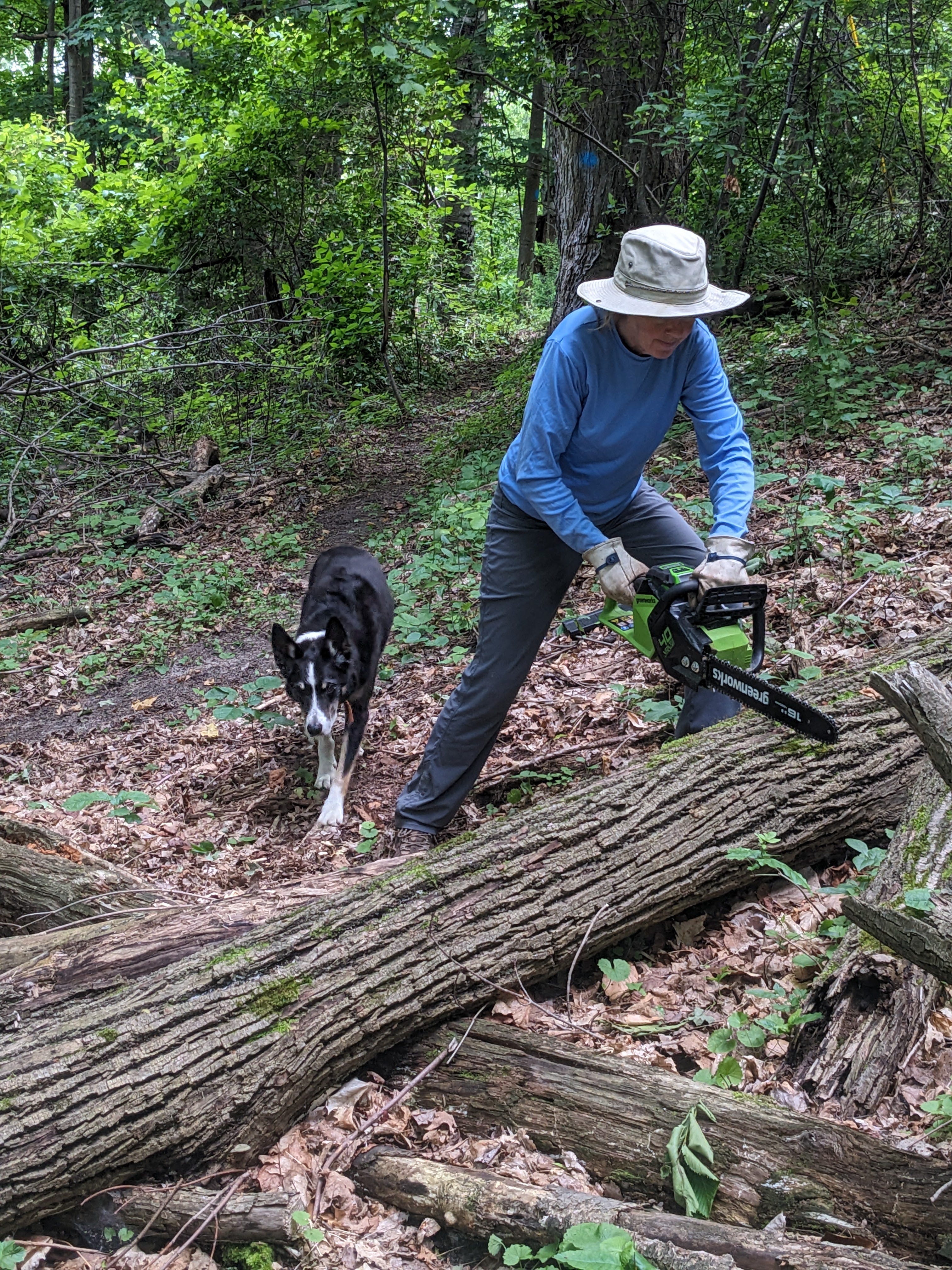
My husband and I differ in a lot of ways, but there’s one area in which we are extremely similar: we’re prone to becoming maniacally devoted to the job at hand, whatever it is. Could be cleaning, chainsawing, or computer work. Could be fixing some broken household item, painting the bathroom, playing Scrabble, boating, or brush cutting. Once we start doing something, we want to keep on doing it until it’s either done or as perfect as we can possibly get it.
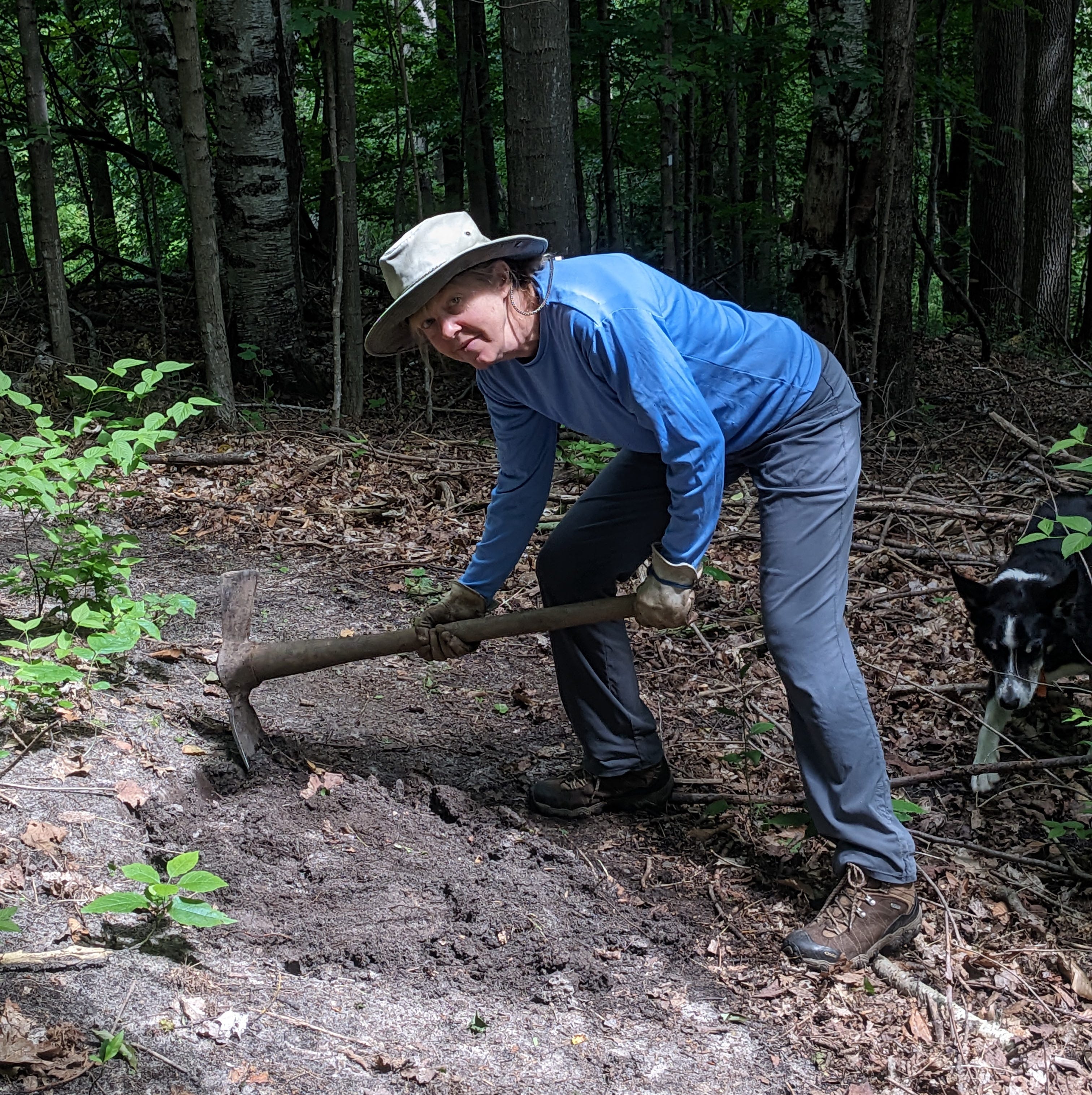
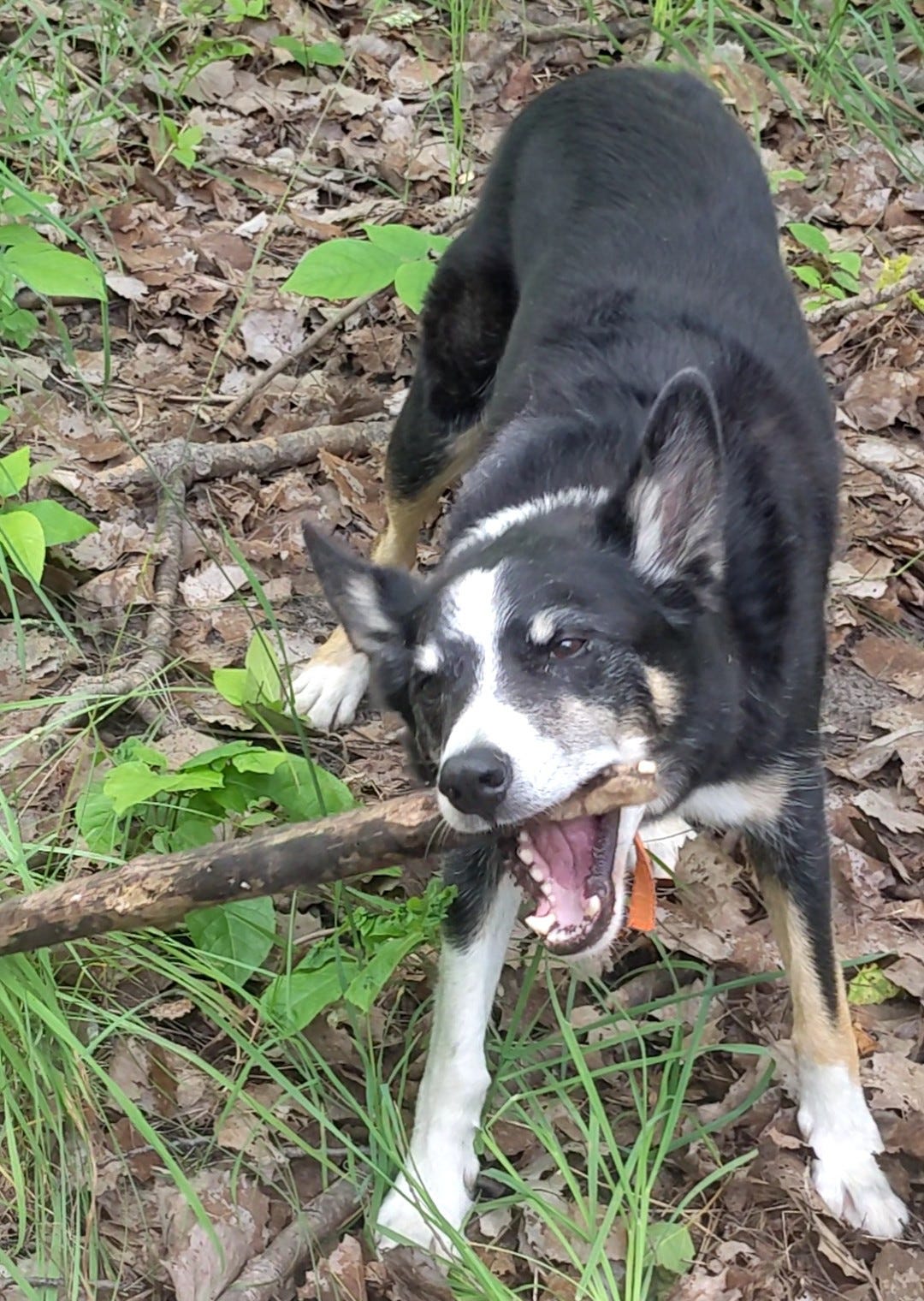
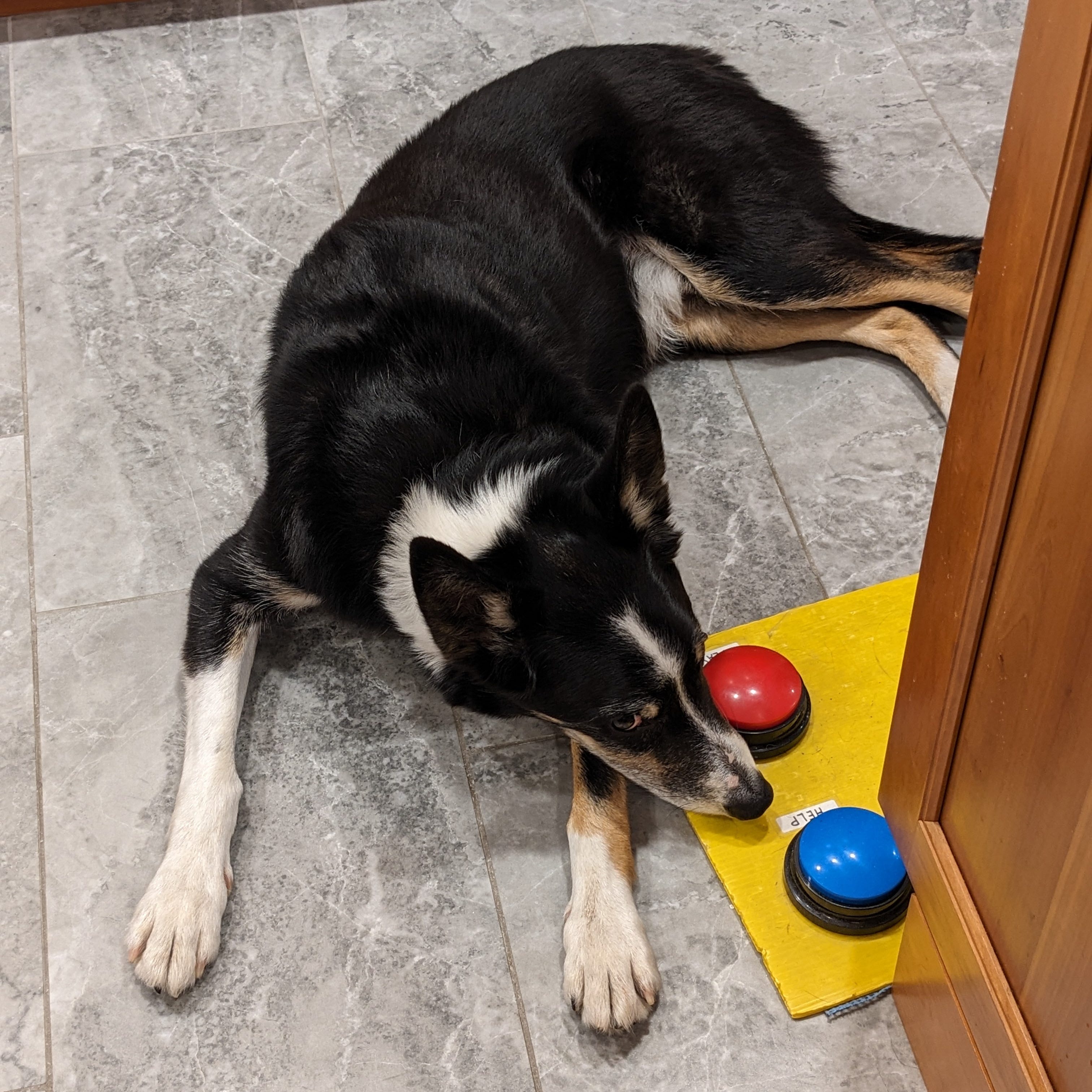
I call these behaviors Border Collieisms. Our own border collie will keep herding as long as there’s anything to herd (in his world, this includes pinecones, sticks, and tennis balls). No matter how hot, exhausted, and frustrated he becomes with a giant stuck stick or a ball lost beneath the couch, he carries on. We do the same, though not with sticks unless it’s to remove them from a trail we’re building.
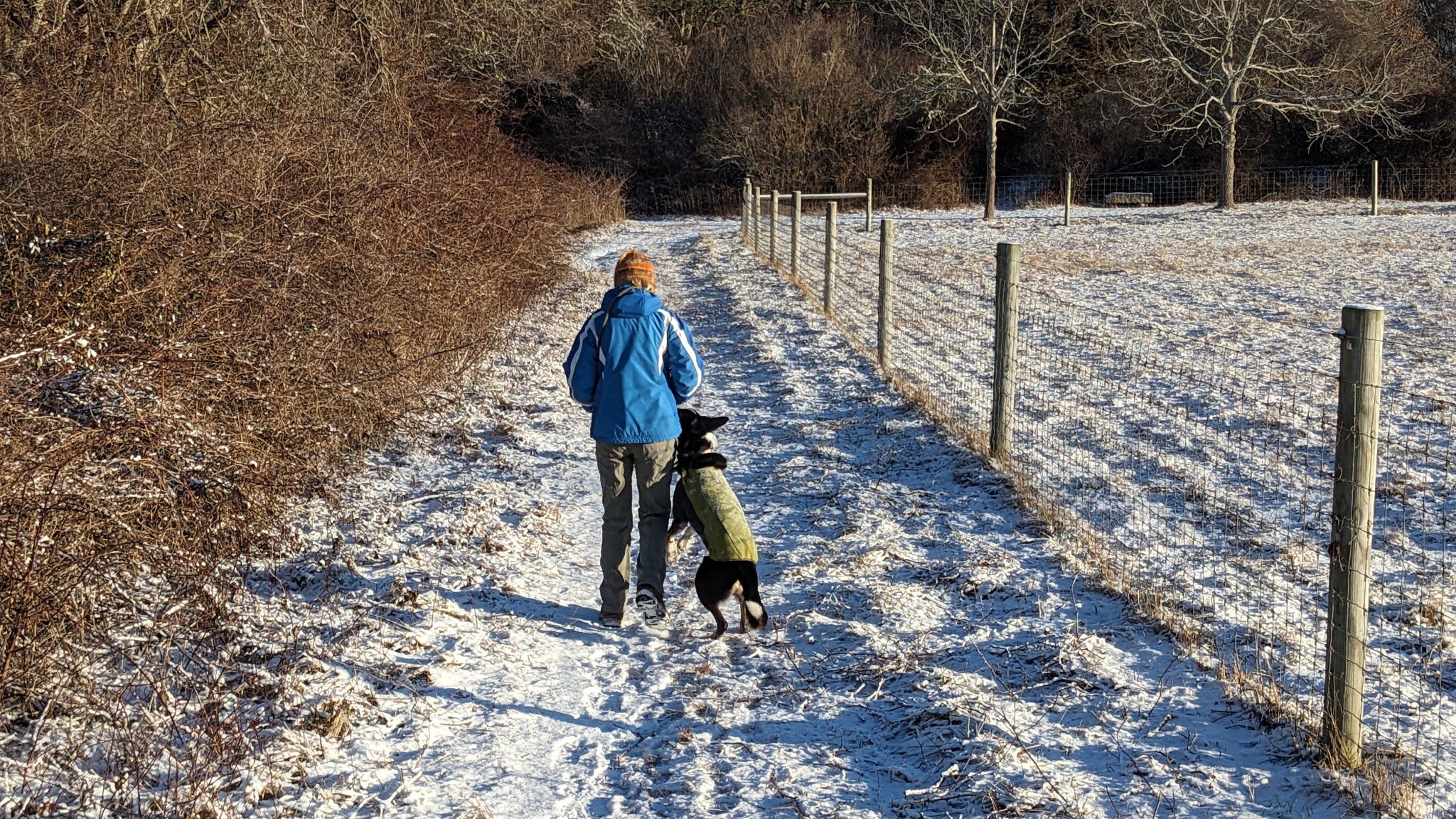
Tock loves trail building. Sticks are constantly flying his way!
I’m not sure whether we wanted a border collie because he reminded us of ourselves—or whether he trained us to become like him. Probably some of both. I’m also not sure whether the Border Collieism tendencies we display are good or unfortunate. Again, probably some of both.
Everyone says that to be happy, you have to find balance. But how is that possible when you seem to spend all your time obsessing over something? Ironically, one of the things I obsess over the most is writing a well-balanced story—one that has even pacing and the exact right amount of world-building versus plot versus character development. So I guess I’m sacrificing my personal balance in the interest of writing the perfect story, right?
Wrong. First of all, there’s no such thing as a perfect story. You can never edit it enough, to the point that every single rough edge is ironed out, every single typo or grammatical error is deleted, and every single reader will love it. Second, what if nourishing my Border Collieisms makes me happy? What if striving over and over to perfect my words in story after story brings me joy?
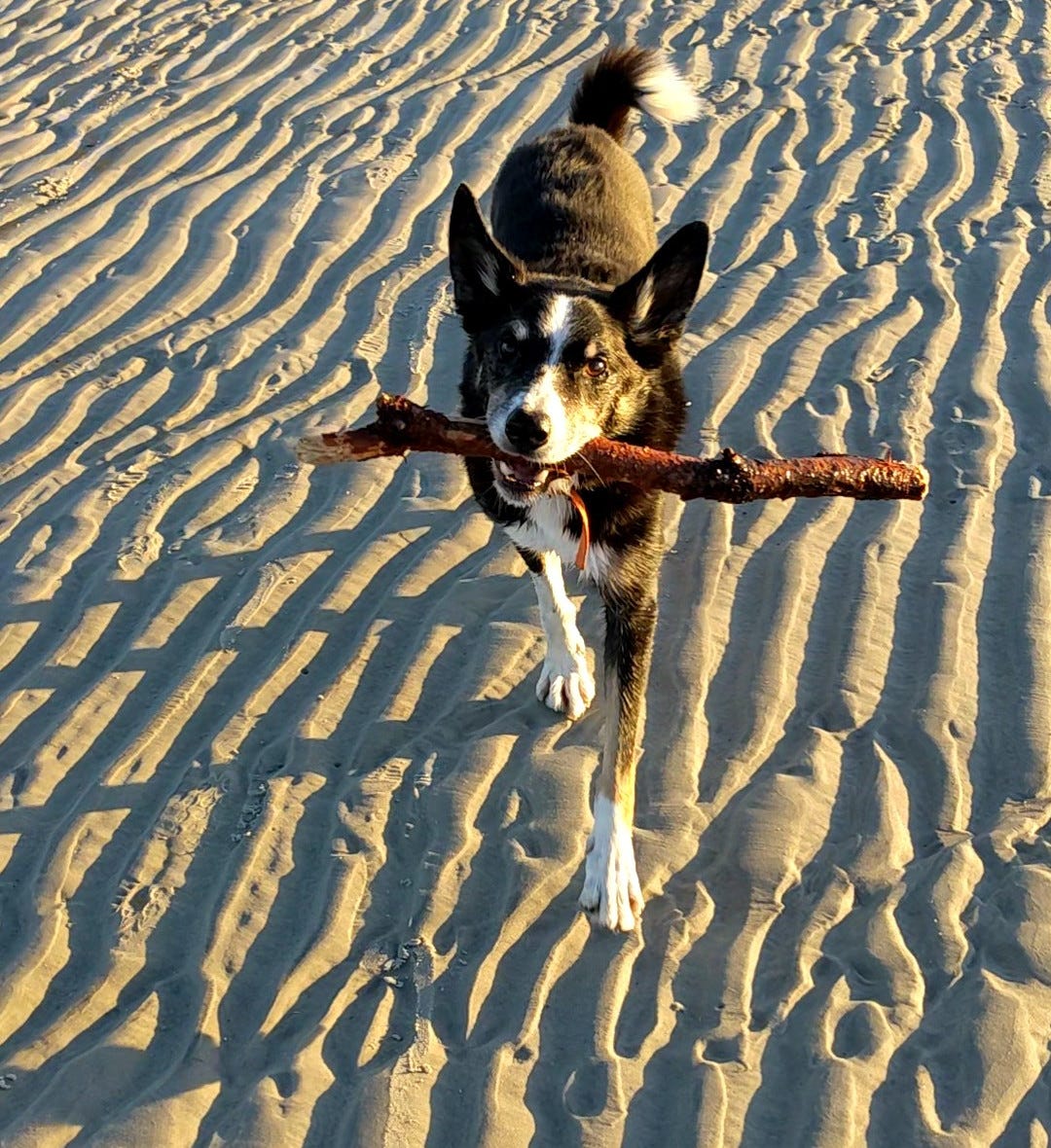
Tock delights in the anticipation of a big stick.
Because it does. I find nothing so satisfying as the feeling of a job well done, my body physically and mentally exhausted at the end of an arduous day of work. I can’t speak for my husband (whom I think would actually prefer a little less labor and more fun at times), but I know that if my dog could speak, he’d agree with me, one hundred percent.
At the end of the day, a tired dog is a happy dog.
Just like a book at its best will please only a fraction of the readers out there, I think the question of balance is one with a different answer for each of us. The right balance for me is one that would seem extremely unbalanced to a lot of other people. For many writers, in fact, the best balance may tip toward the hard work side of the scale. How else can you ever apply yourself enough to visualize that written world, fully understand those characters, and figure out that plot until everything is spelled out from the first page to the last? How can you ever polish each word, sentence, and scene, seeking out critiques, writing and rewriting until your story shines? The answer is, without a lot of pure hard work, you can’t.
I guess the moral of this little piece is to recognize whatever balance works for you—and then live it. Work hard, play hard, and revel in the Border Collieisms that help you along your chosen path.
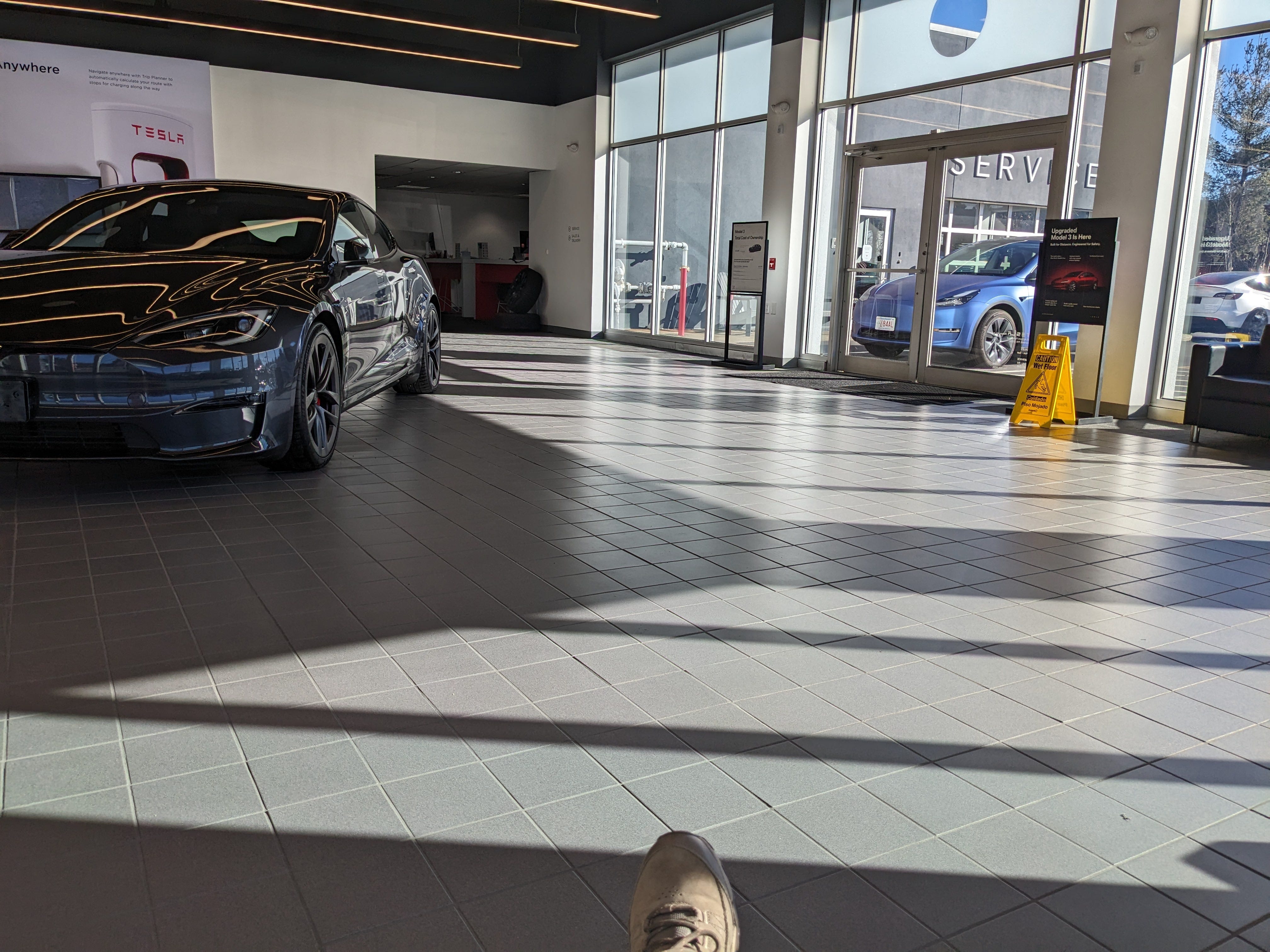
I had to take our car in for service this week. A mundane task, right? Well, I was dreading it. Not because of the hour-long drive in frozen weather, nor because the appointment was scheduled to take all day for some inexplicable reason. I was even willing to put up with the insipid pop music blasting without cease into the waiting room.
The endless wait
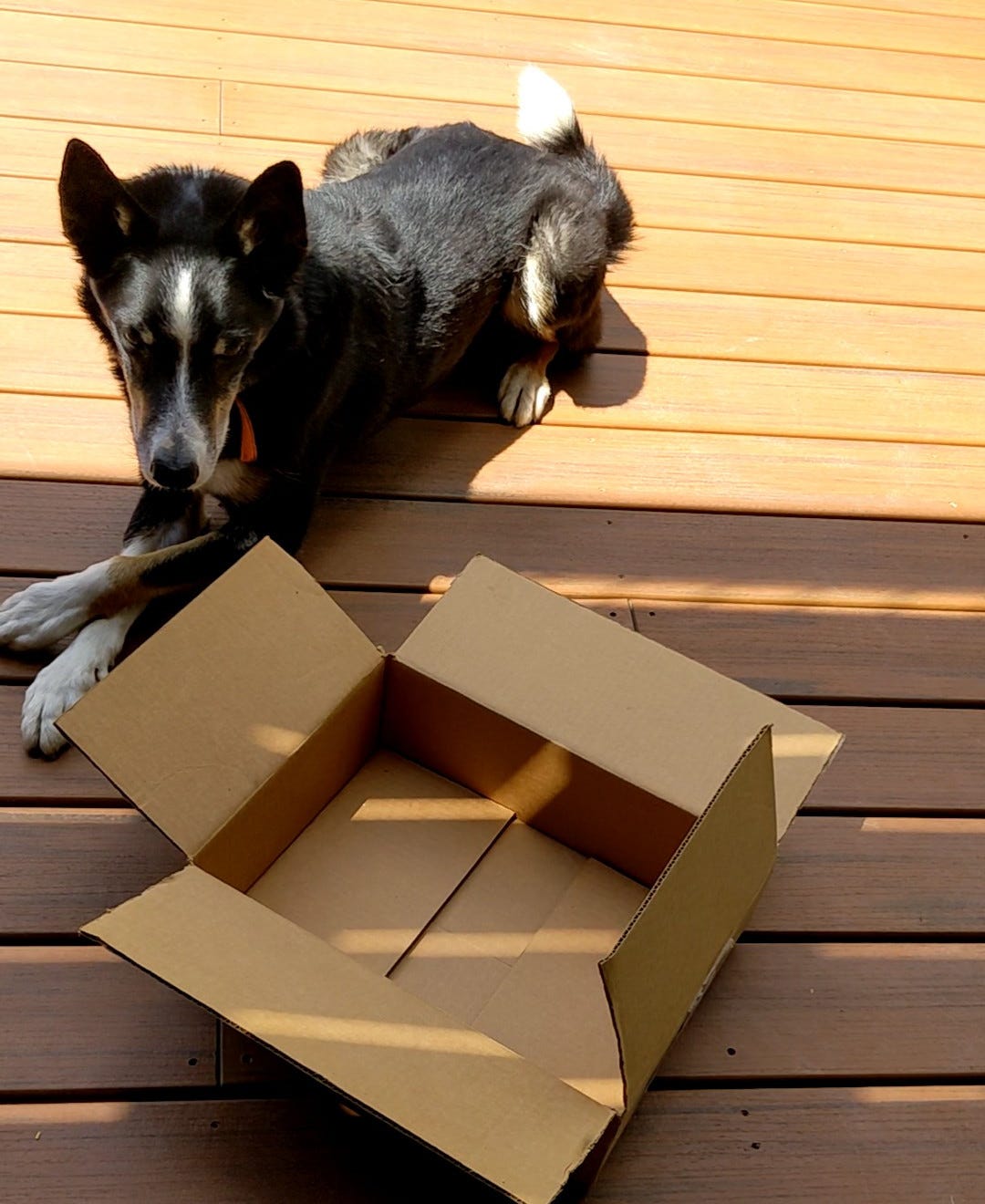
No, the main reason I was so reluctant to go was because I couldn’t bring my dog.
Pathetic? Maybe.
Weird? Yep.
True? Definitely.
He’s like a boomerang, always coming back to me.
In my defense, I’d better back up. I’m sure I’m not the only one for whom 2024 was a super tough year. For me, it was the toughest year on record (in my admittedly privileged life)—and that’s not even counting the usual pitch and query rejections that continue to chisel away at my sense of writerly worth. I won’t dwell on the chaos my family experienced because I’ve written about it plenty already. Let’s just say that while this past year was sometimes exciting and possibly character-building, it’s also been exhausting and downright scary.
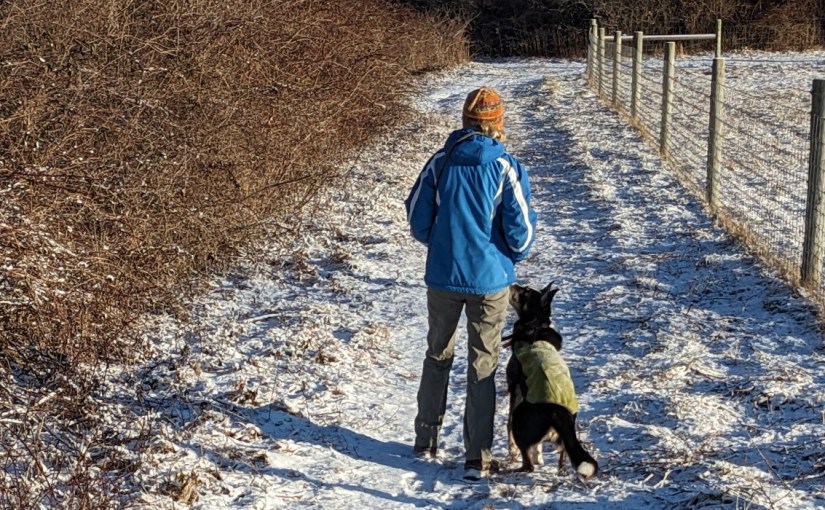
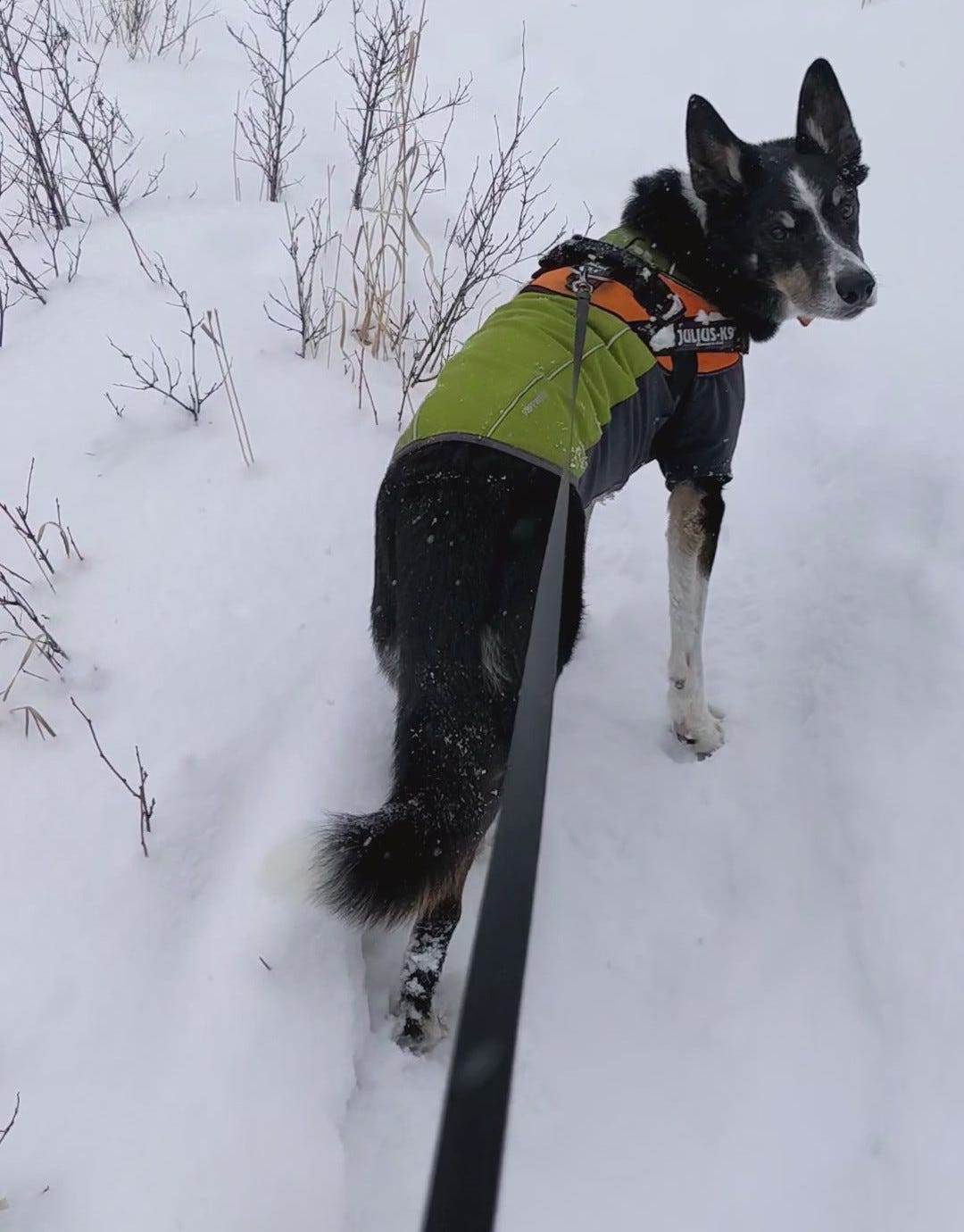
The one constant through all the turmoil, the one warm fuzzy creature by my side has been—you guessed it—my dog. He gets up when I do from his bed next to mine, he crunches his kibbles while I work on my cereal, he gets dressed (with help) in his fleece jacket right before I pull on my down one, and he strikes out on the trail while simultaneously leaping in my face to remind me how wonderful an excursion together will be. And so we walk, for two hours every morning and another half hour in the afternoon, despite horizontal rain, branch-snapping winds, and cold that freezes the sheep farm’s trickling faucets into lumpy white shrouds.
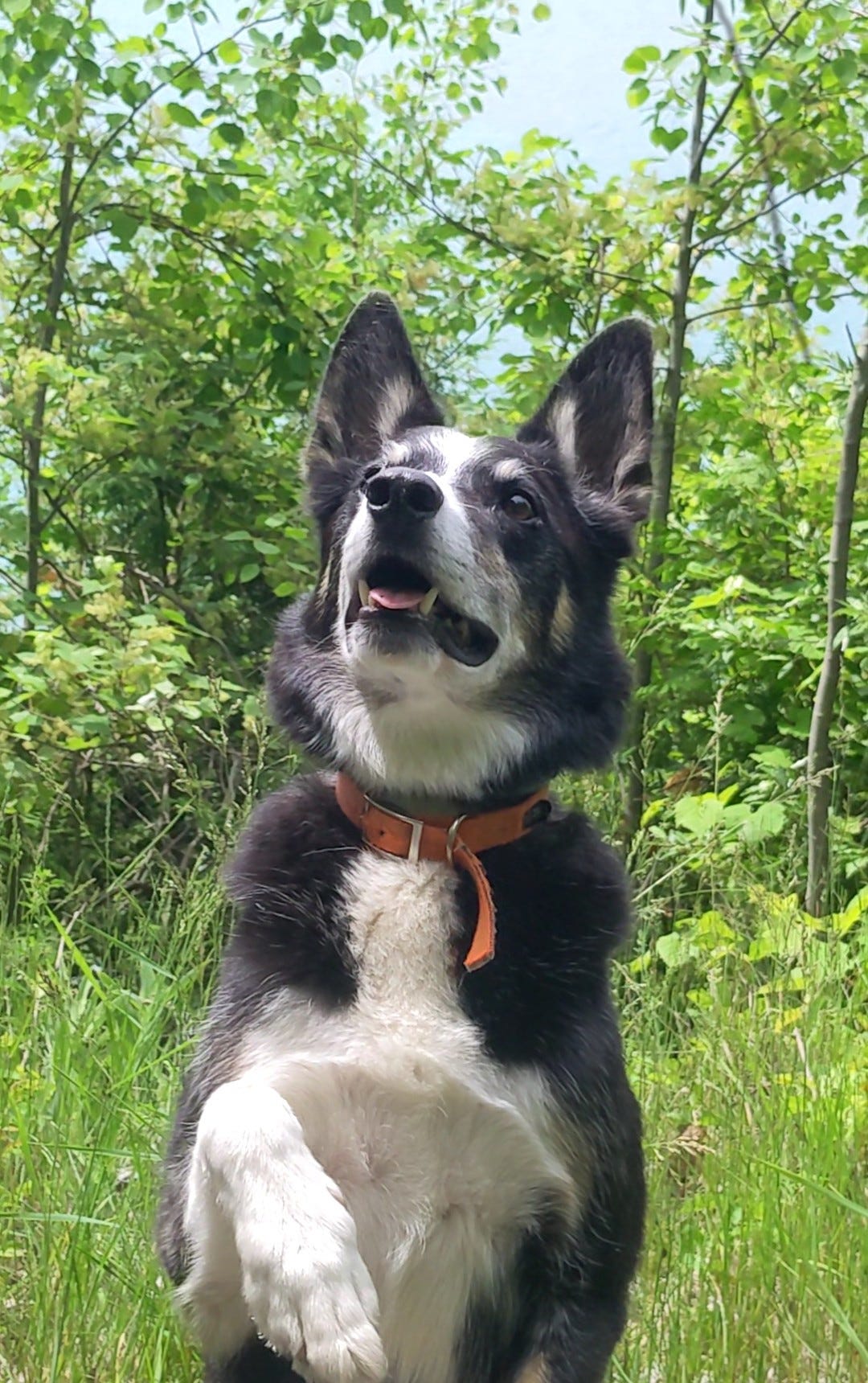
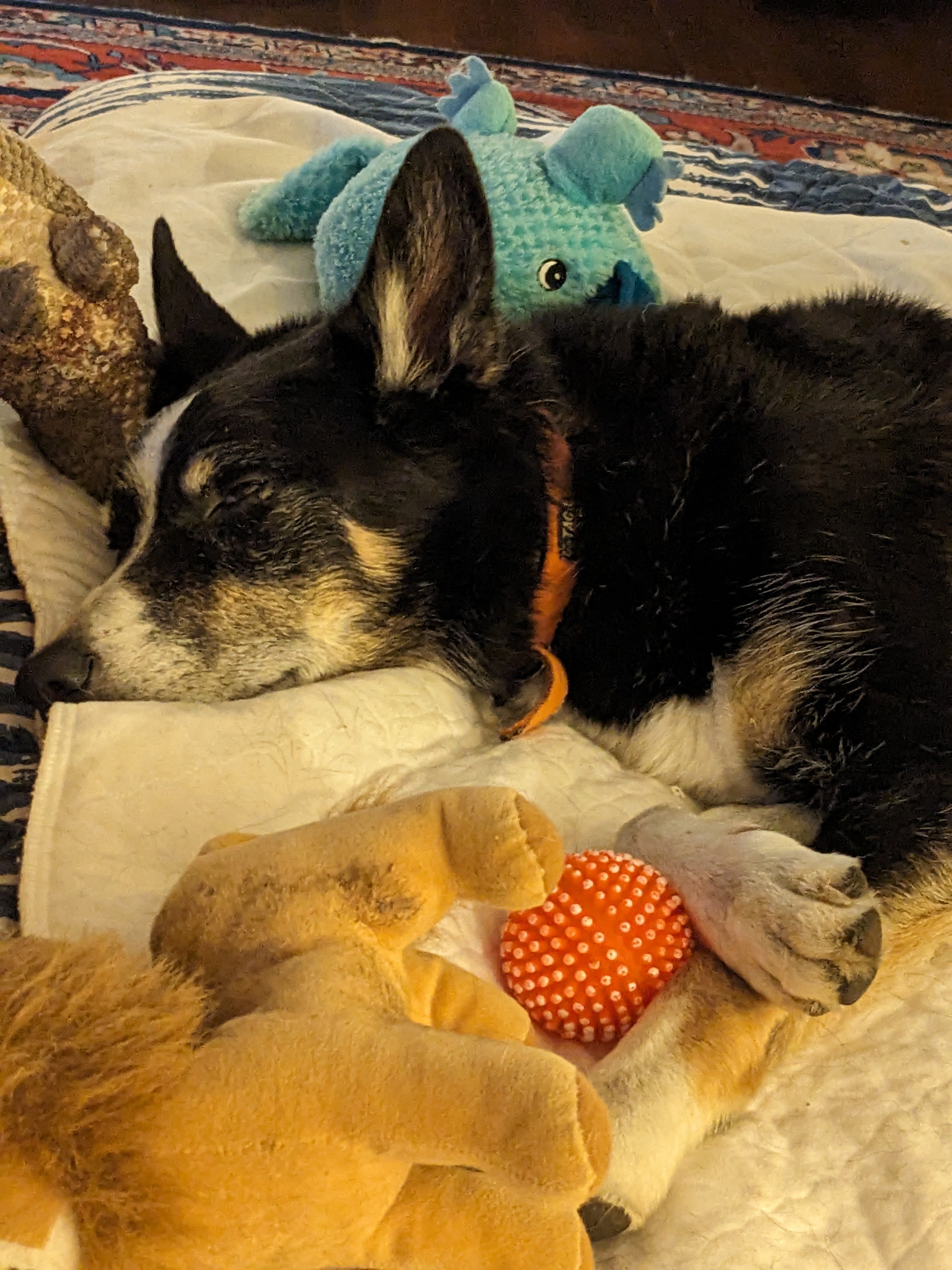
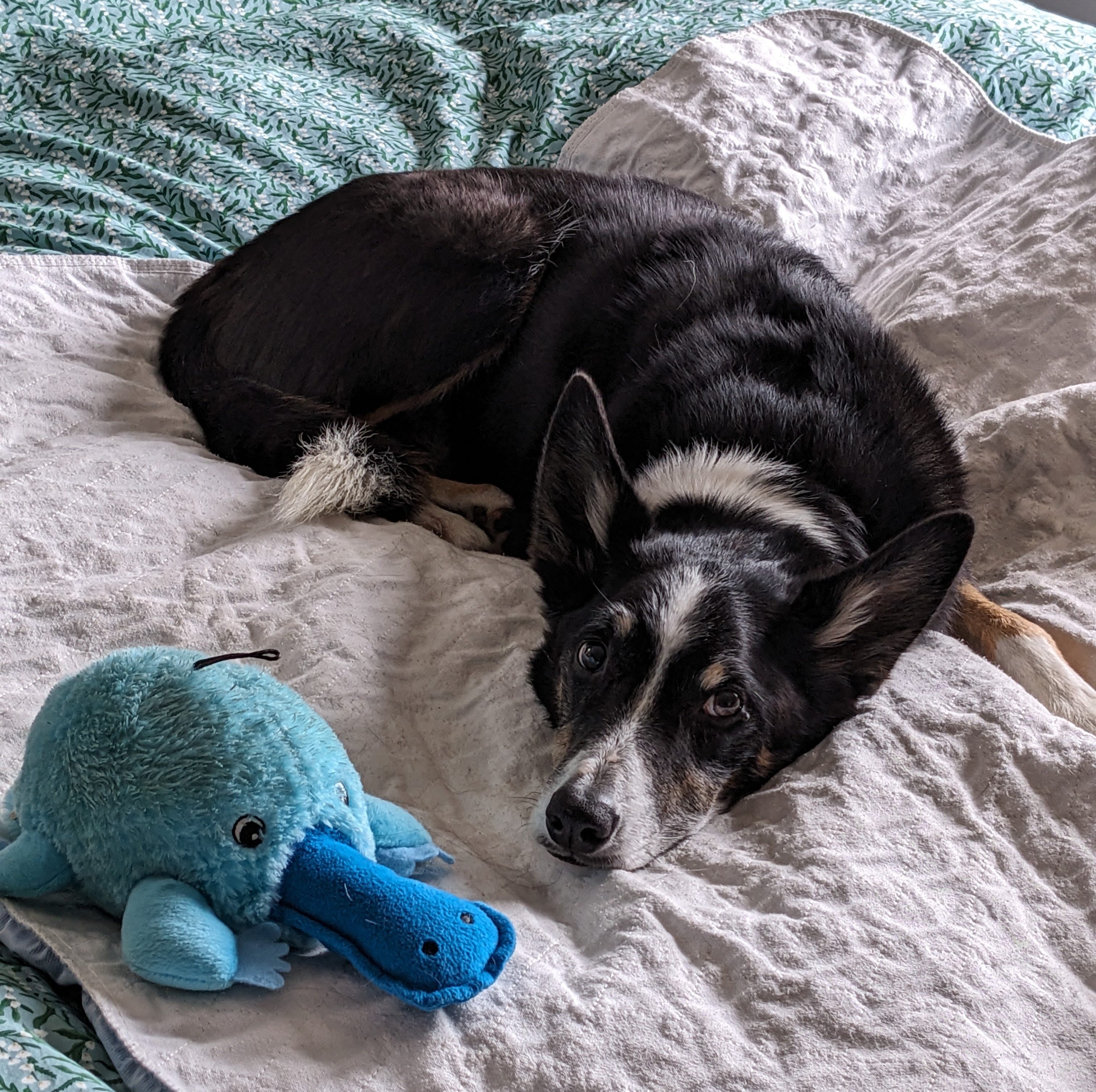
Could anyone avoid binding to this fellow? I think not. (True with or without the platypus.)
But my dog’s proximity doesn’t end with feeding and walks. He lies on the rug outside the bathroom while I shower, he sleeps in my office while I write, he sprawls at my feet while I cook, and he hops in the car to attend any errand with me, whether it’s a quick trip to the store or a multi-hour excursion to a distant town. Wherever we go, he usually gets an outing, even if only a brief stroll around a parking area or a game of frisbee in a small patch of grass by the hospital. (In the interest of dog safety, I feel it’s important to note that our car has a Dog Mode, in which the battery keeps the car at an optimal temperature no matter how inhospitable the weather is outside. Bringing a non-service dog along for errands would otherwise be impossible).
Tock is excellent at performing the dual functions of kitchen rug and auxiliary garbage disposal.
I’ve always kept my dogs close, but this year and this dog more than any other. He has become part of me, as inseparable as a limb from my body. On the rare occasions when he’s not with me, I feel his absence like a gaping wound that will never heal. Dramatic? You bet. True? Well, my arm has never actually been ripped off, so probably not, but you get the picture. My dog is part of my essence—that indefinable aggregation of things that makes up a person’s personality and convictions. My sense of self. My soul. I can’t picture myself without him.
This gets me to wondering: are there other things from which I am inseparable? That is, if they were taken away, I would feel as though I’m no longer me.
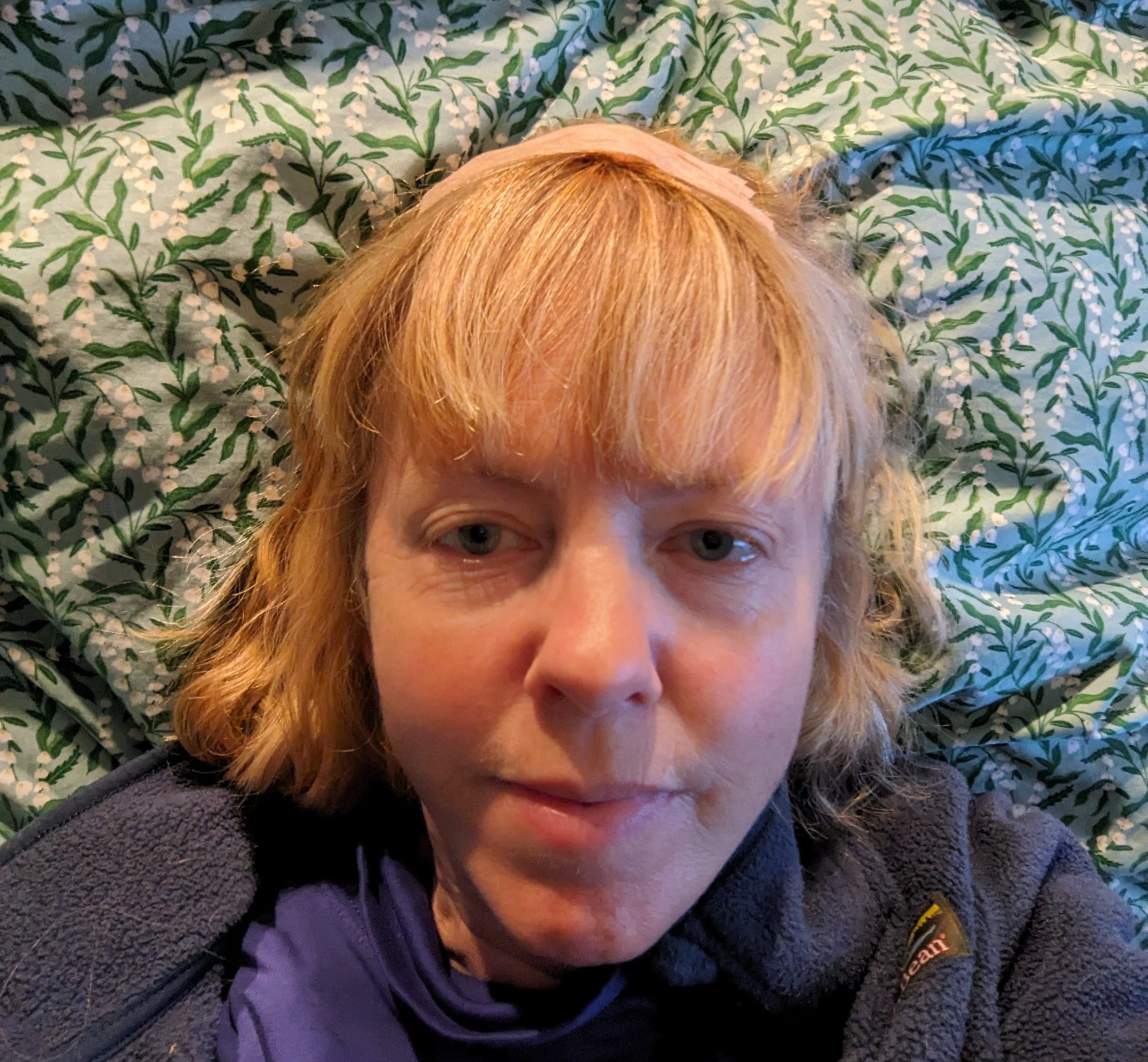
Short answer, yes. Some of these inseparabilities (is that even a word?) are vain and trivial. I can probably quickly get over them. My hair, for instance. I’m scheduled for surgery this week for skin cancer on my scalp. Though the doctor is hopeful they’ll be able to suture the area closed, it’s possible the removed section will end up large enough that they’ll have to do a skin graft and then I’ll end up with a bald patch on the top of my head. I’ve been trying to envision myself either wearing a hat or wig to cover it for the rest of my life or going the other route and shaving my head entirely. I know people routinely lose their hair for all sorts of reasons, so it’s totally selfish that I find this upsetting. I don’t know why my view of myself in the mirror is so strongly tied to my sense of who I am. I have to remind myself that at least my dog won’t care.
Breaking News: Surgery #1 (of 2) is done, with sutures!
Then there are the bigger things, like my human family. Son, husband, parents … all of them hold a part of me within them just as I do of them. Work is another big one. Though I’ve never had a steady, traditional, well-paying career, I seem to have spent most of my life working in one way or another. For whatever misguided reason, I’ve chosen to grind away at things that take a long time to learn and perfect, and I’ve invested years of passion in each. Music first: giving that up due to injury was traumatic and required a lot of internal rewiring of my sense of self. Next ecology, then dog agility training, then writing. I’ve now spent so much time studying the craft of writing middle-grade fiction, specifically, that it’s become a huge part of my identity. Even if no one but my husband and my critique partners ever read my finished works, writing these novels occupies an important part of every one of my days. I love being part of the writing community, and experiencing the pleasure of crafting a phrase, a scene, a story.
Photo credit:Glenn Carstens Peters
At this point in my life, if anyone asked me who I am, I’d say: children’s book writer and dog / nature lover (those last two things go hand in hand for me, because how can you have a dog if you don’t like to get outside?). Of course, this is but one moment in my existence. Maybe by next year, I’ll have added another inseparability to my list.
How about you? What are those things so intrexicably tied to your being that you can’t imagine existing without them?
Yesterday, I was walking up a trail when I encountered a person who asked me to hold my dog so she could pass. “Sure!” I said, and called Tock away from a bush he was sniffing about twenty feet off the trail. Once he got to my side, I snapped on his leash and held him there until the woman had hurried by.
Now, this was not a trail with a leash requirement, nor was my dog exhibiting any sort of alarming behavior toward others on the trail (complete disinterest, in fact). But from the woman’s rather unexpected request to the nervous way she went past my dog, she was clearly feeling out of her comfort zone. Though I was surprised at seeing a person with such a fear of dogs on a path where dogs often outnumber humans, I’m impressed that she was brave enough to visit it, and to take the action she needed to get past her fear.
Photo credit: Jakub Kriz
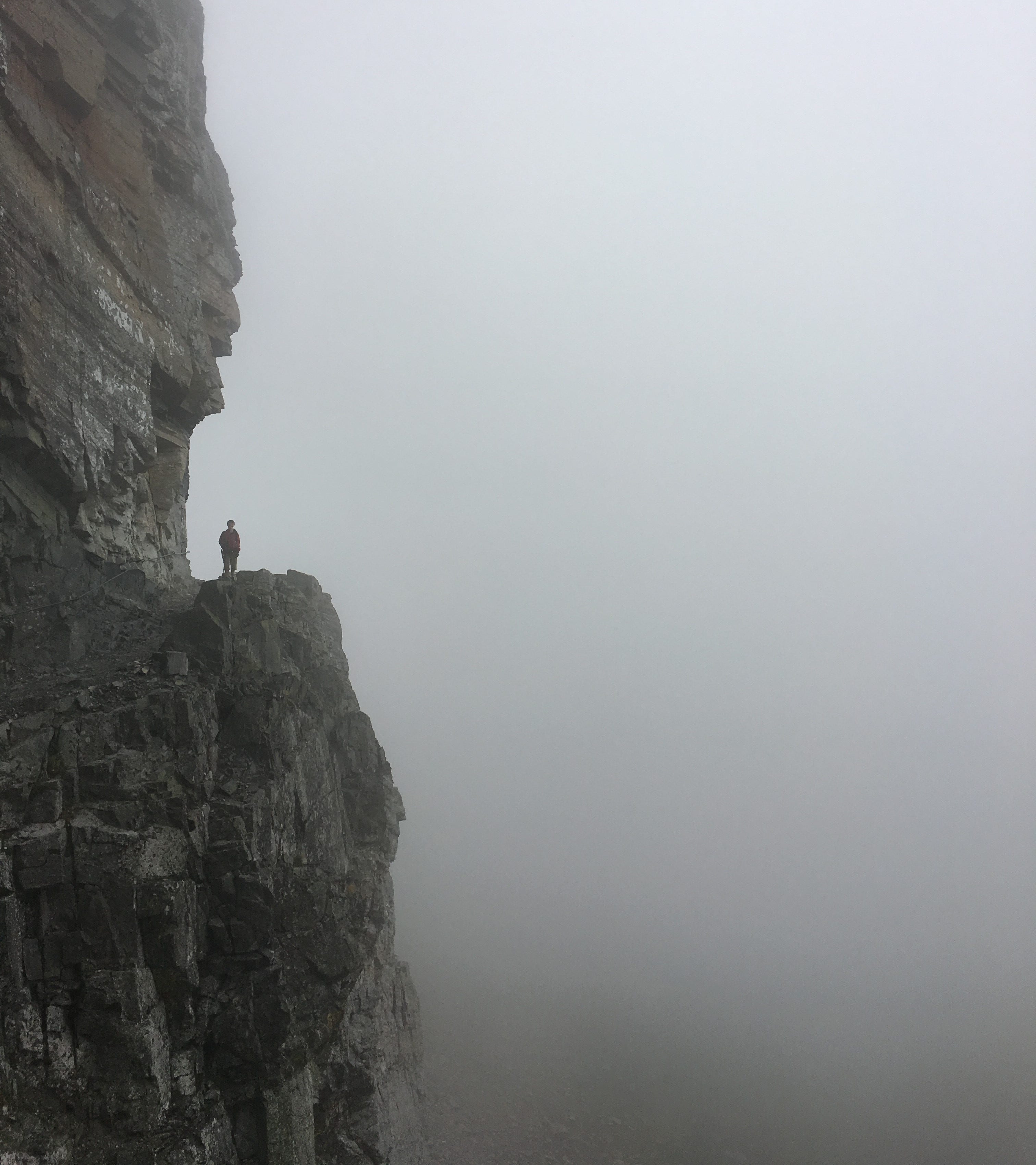
Like a dog-anxious person on a very doggy trail, we all have to do things we’re not comfortable with or not used to doing if we want to make any forward progress. It happens to me on narrow trails that cut into steep, treeless slopes, where vertigo literally causes my feet to freeze in place. And as a writer, it happens to me every single day.
Photo credit: Michael Loftus
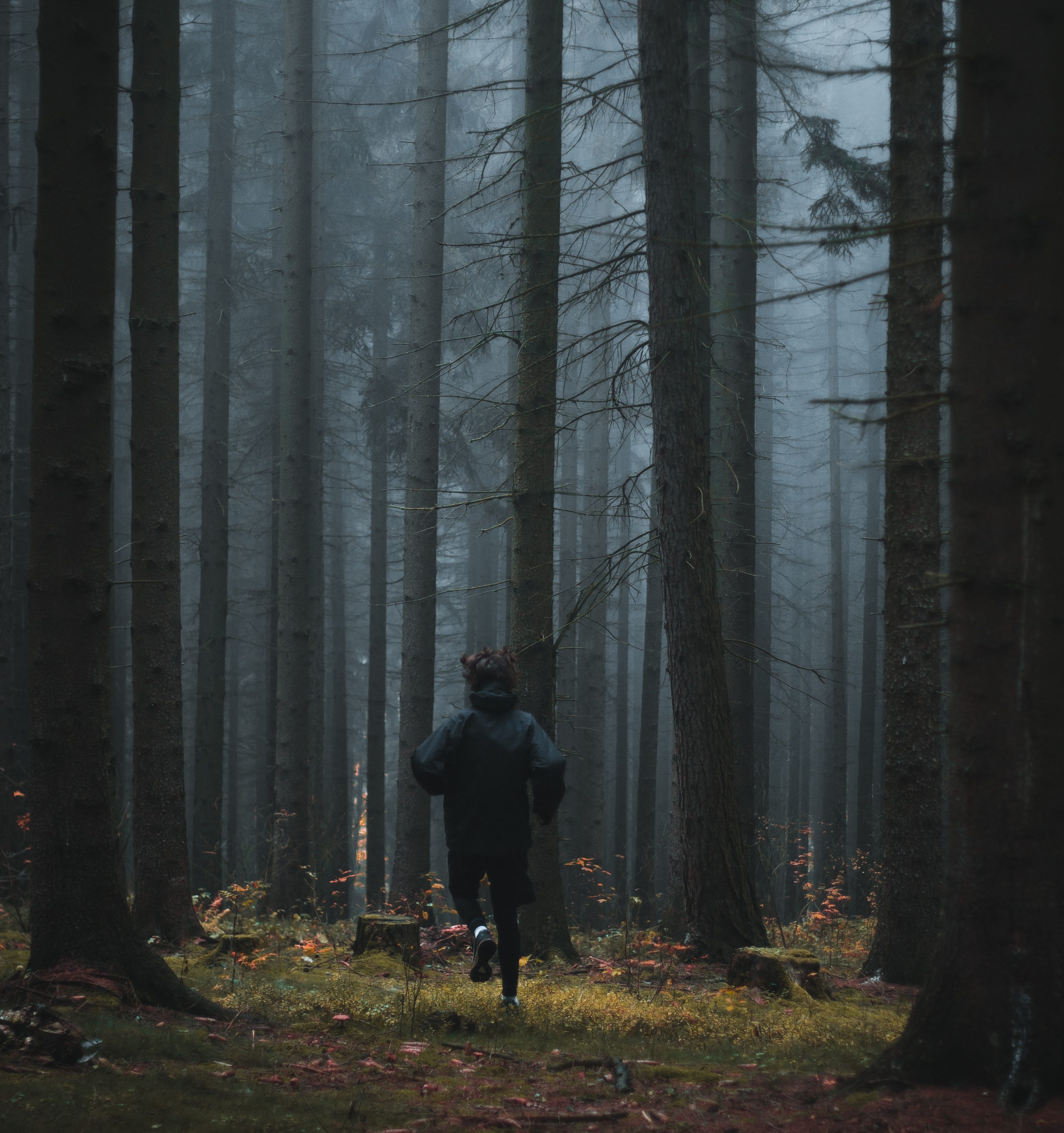
No time is more difficult than when I sit down to write the first couple chapters of a new novel. No matter how many weeks I’ve already spent outlining the story, developing the characters, and researching the setting, I still feel a pretty big mental block at actually starting to write. I’m overwhelmed with the thought that whatever I do is going to have huge implications for the rest of the story. I’m overcome with doubt that I’ll have the talent to create entirely new characters in a brand new world.
Photo credit: Evgeni Tcherkass
So if I’m to take inspiration from the worried trail-walker, I need to come up with a plan that’ll get me past my writing roadblock. For some writers, this might consist of simply waiting, putting the writing off for another day or week or month until their story starts to flow into their fingertips.
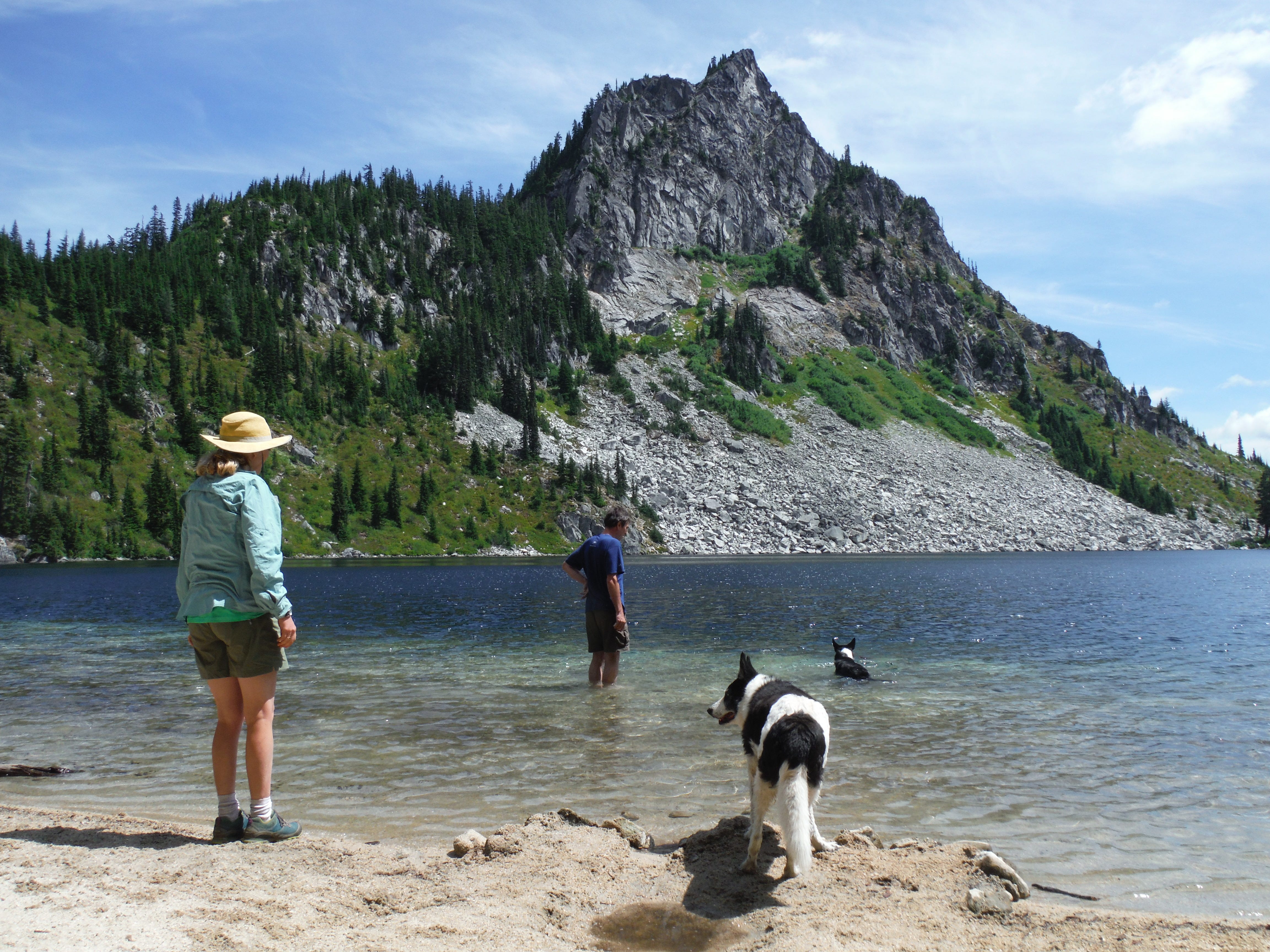
Not me. If I did that, I’d probably never write another word. I’d turn into a mummified husk of a writer staring at a dusty black screen, fingers permanently frozen to the keyboard. Ugh. I’d rather end up petrified while sitting on a sun-warmed rock by an alpine lake, thanks very much.
Now this would be a terrific place to remain stuck forever!
My plan for stepping out of my comfort zone happens in two steps:
(1) Akin to the dog-fearful person planning in advance to ask for help from those hikers who are crazy enough to own such slavering, vicious creatures, I seek help from my main characters so I can get as close to their eventual voices as possible. I do this by writing some first-person “prequel scenes,” which take place long before the story will occur, and in which my MC’s basic misunderstanding about the world develops (thanks to Lisa Cron’s Story Genius for this brilliant idea). There’s a lot less pressure in writing these scenes than in composing the actual story because they’re not the actual story. Not yet, anyway (full disclosure: I often end up incorporating bits and pieces of them into flashbacks).
(2) After playing around with character voice and motivation in this way, I’m ready to walk past the metaphorical scary dog. I open the document to the blank page and force myself to write. Word after word after word. I’m not saying this is easy for me. It’s terrifying and often feels painfully slow compared to writing later in the story, when I’m comfortable with all the of the character voices and how they relate to one another. But it gets my feet moving along the trail to a place where I feel much safer and happier.
Photo credit: Nick Bolton
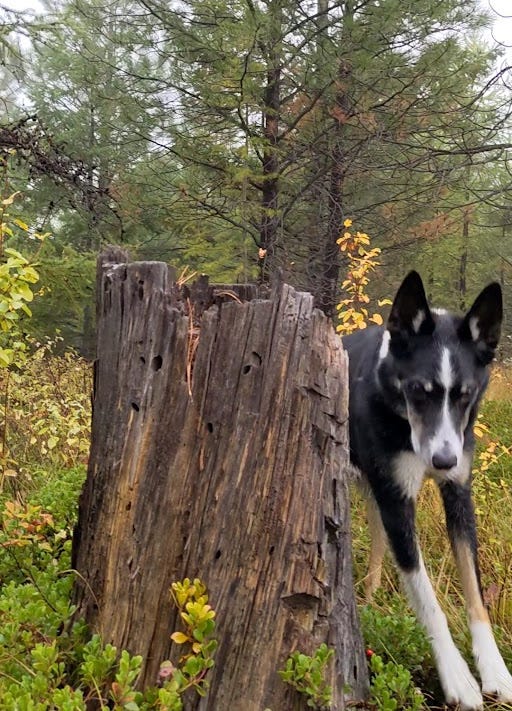
This combination of preparation and a little bit of sheer will power goes for any fear I might have. But what if you just can’t muscle your way into writing? Or what if the stranger-dog situation is reversed? What if it’s the dog that’s scared? I actually have a particularly fearful dog who gets nervous when he encounters “unfamiliar” things. I put that word in quotes because something that’s unfamiliar to him is generally not at all unexpected to me, from a visit to the vet to having to enter a barn through a large sliding door. Occasionally, a previously visited stump in the trail that’s turned extra black from rain or extra visible from lack of leaves will cause him to leap back in surprise with a little growl. Oh my goodness, it might attack us!
Racing past a scary stump.
I jest, but these are very real terrors to my dog. And since he’s pretty much joined at the hip to me, going wherever I go, I must own his fears and find ways to mitigate them. If you’ve read one of my previous posts, Backstory’s Bad Rap is Underserved, you’ll already know that I deal with Tock’s fear of the vet in the two-step manner I’ve described above. But for most of his fears, I have the option to replace that second step with an alternative that is always, always better for getting a dog over their terror: (3) the use of reverse psychology, or more generally, thinking outside the box.
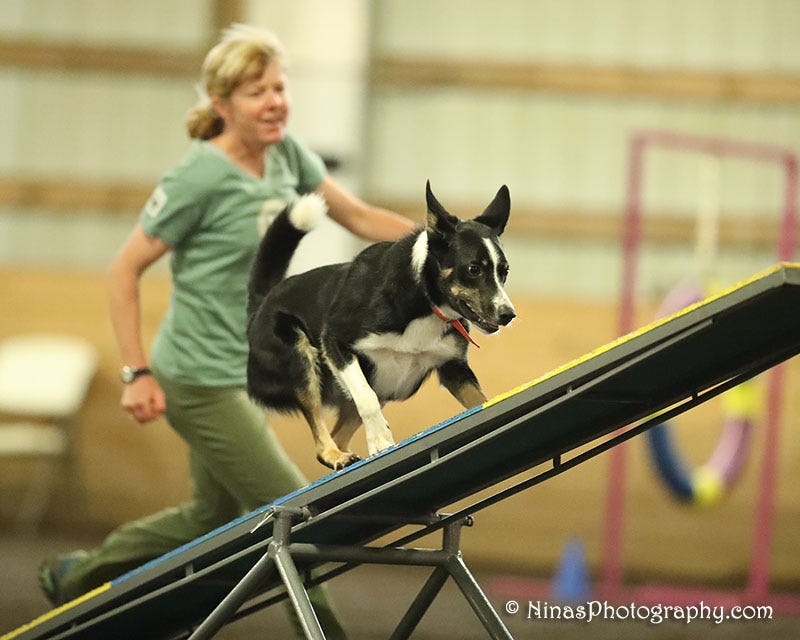
For the scary barn door, for example, I found another entrance into the barn through a much smaller door. Tock was perfectly fine with going in that way. And once he did, he had no problem exiting—and then re-entering—through the big door. For a suspicious stump, I wait for him to take a single step toward it, and then reward him far away from it, so he realizes that doing one tiny difficult thing reaps great rewards in a safe place. Incidentally, this reverse psychology is the same approach I use for agility students’ dogs who are terrified of the teeter.
Some dogs are born scared of the teeter’s sudden tip, or the banging noise it makes when it hits the ground, or the height they have to ascend before the board tips. Others become scared due to a frightening experience, such as using a teeter that tips much faster than the one they were used to. Either way, asking for a tiny approach to the teeter, followed by a fun reward elsewhere works wonders (thanks to Leslie McDevitt’s Control Unleashed for this method).
Just as the second step of my Two-Step Approach needs gentling and modification to help dogs overcome their fears, it may need tweaking for you, too. If the setting of the new world causes you to stop and puzzle about it excessively, skip it for the moment and move straight to interiority or dialogue. This allows you to get directly into your character’s head in a manner that you’re already comfortable with (remember those prequel scenes?). Another way to sneak words out of your mind and onto paper is to write more prequel scenes that get closer and closer to the time the story takes place—until they are the story.
What techniques do you use to step out of your comfort zone, past the danger, and into a brave new world?




 Flights of Fancy